 | Updated:
Since the start of 2026, sports media headlines have revolved around the strained Chelsea–Maresca relationship, Manchester United’s damaged connection with Ruben Amorim, and, most recently, Celtic’s woes, as the club moved on from Wilfried Nancy just 32 days after he succeeded Brendan Rodgers. Together, these rapid-fire changes on some of Europe’s biggest benches have turned the spotlight firmly onto managers and how little time they are given to turn things around.
All these proceedings prompted Sportingpedia to take a wider look at the coaching carousel across the continent, analysing managerial changes since the start of the 2025/26 season in 18 of Europe’s top 20 leagues, excluding Sweden and Norway, whose domestic seasons run on a different calendar and identifying where sackings have been most common, which competitions now lead the way for dismissals, and which clubs have already gone through multiple head coaches in a single campaign.
Some of the most curious findings are that since the start of the 2025/26 campaign there have already been 110 managerial changes across these leagues. Turkiye’s Super Lig stands out as the most volatile league with 17 changes, while among the traditional top five competitions the Premier League now leads the way with six dismissals, ahead of the Bundesliga, La Liga, Serie A and Ligue 1. What is most alarming, however, is that eleven clubs across eight different leagues have already made multiple managerial changes this season, meaning those teams are already on their third manager of the campaign while many of their rivals have yet to change even once.
Methodology
The study covers 18 of Europe’s top 20 leagues in the 2025/26 season, excluding Sweden and Norway because their competitions follow a different calendar. For each league, every managerial change since the start of the current campaign was counted. A “managerial change” is any instance of a head coach leaving his position, regardless of whether the departure was formally described as a sacking, resignation or mutual agreement.
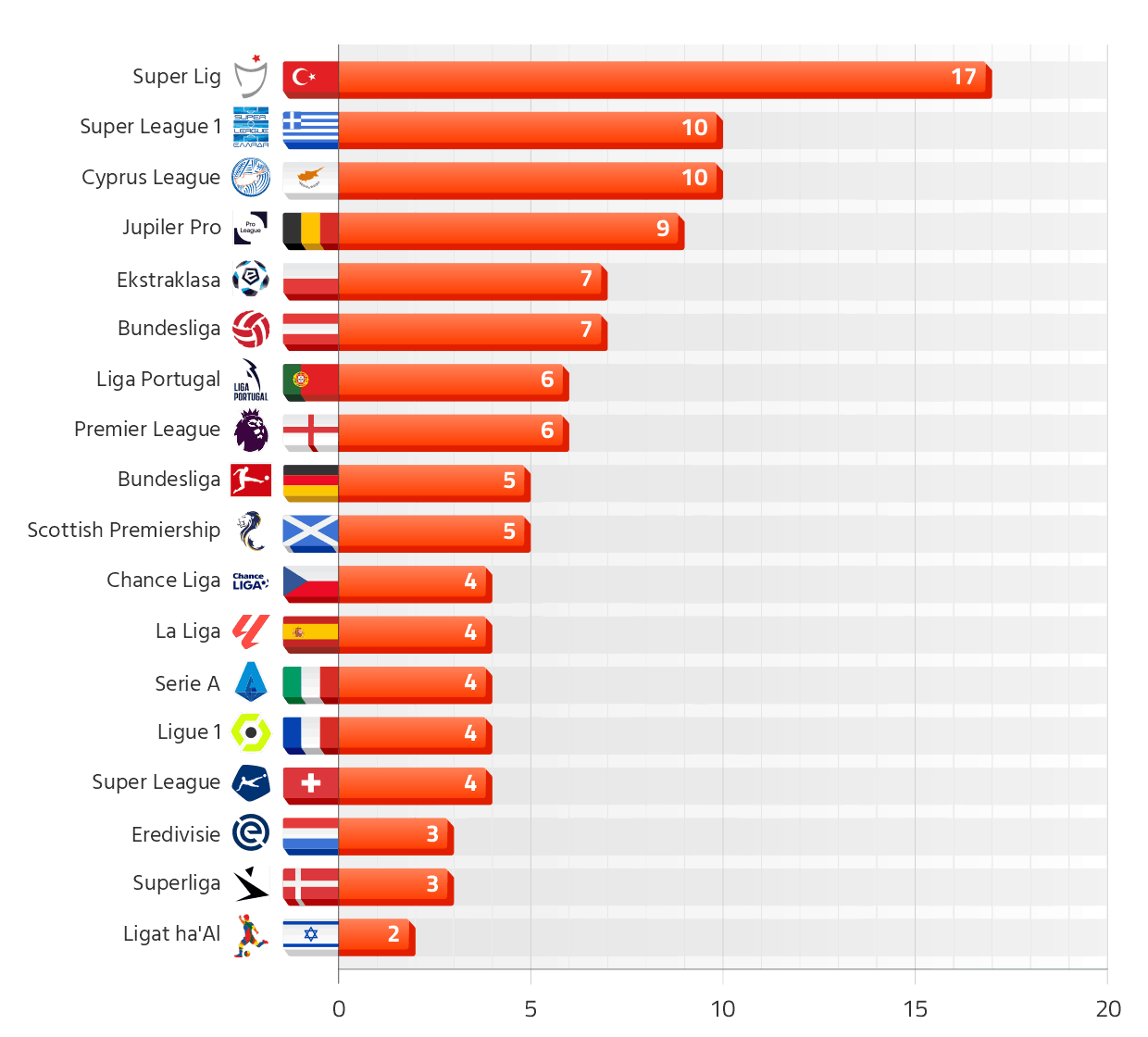
Number of managerial changes in Europe’s top leagues since the start of the 2025/26 season
Data Source: Transfermarkt
At league level, Turkiye’s Super Lig clearly stands at the top of the instability table. With 17 managerial changes already recorded in 2025/26, clubs there have been quicker to replace head coaches than in any other competition included in the study.
Greece’s Super League 1 and the Cyprus League share second place with 10 changes each, underlining how rapidly clubs in those championships move when results or performances fall below expectations. Belgium’s Jupiler Pro League sits just behind them with 9 changes, confirming that coaching turnover has also been high in one of Europe’s most competitive smaller leagues.
Poland’s Ekstraklasa and Austria’s Bundesliga have each registered 7 changes so far, placing them firmly in the high-turnover bracket. Liga Portugal and the Premier League follow with 6 changes apiece. In England, that figure has been pushed up by the recent dismissals at Chelsea and Manchester United, ensuring that the Premier League now has more sackings than any of the other traditional top five leagues.
Germany’s Bundesliga and the Scottish Premiership have each seen 5 managerial changes, while La Liga, Serie A, Ligue 1, the Czech League and Switzerland’s Super League form a middle group with 4 departures each. These competitions sit between the most turbulent and the most stable environments: changes are regular, but not at the levels seen in Turkey, Greece or Cyprus.
At the calmer end of the scale, the Eredivisie and Denmark’s Superliga have each recorded 3 managerial departures since the start of the season. Israel’s Liga ha’Al has seen only 2 changes, making it the most stable league in the sample.
Clubs already on their third manager
Alongside the league-wide numbers, a small group of clubs shows just how extreme instability has become. In total, 11 teams across the 18 leagues have already worked with more than two head coach this season. In every case, two managers have left their roles in 2025/26, meaning a third coach has taken over by this stage of the campaign.
Nottingham Forest is the only Premier League club in this group. Nuno Espirito Santo’s spell at Forest ended after 629 days, and his successor, Ange Postecoglou, left the job after 39 days, leaving the team already on a third head coach for 2025/26.
Celtic are the most high-profile case in Scotland’s Premiership. Brendan Rodgers’ long tenure ended after 849 days, and his replacement, Wilfried Nancy, then remained in charge for only 32 days before also departing.
In Liga Portugal, Avs Futebol have already dismissed two managers. Jose Mota was in charge for 139 days earlier in the season before leaving his position. He was followed by Joao Pedro Sousa, whose time on the bench lasted 88 days before his departure.
Poland’s Ekstraklasa is represented by Widzew Lodz. Zeljko Sopic’s tenure as head coach ended after 161 days, and the next manager, Patryk Czubak, left the role after a 50-day spell.
Greece’s Super League 1 contributes two clubs. Panathinaikos first parted ways with Rui Vitoria after 319 days in charge, then later saw Christos Kontis depart after 36 days. AE Larisa followed a similar pattern, with Georgios Petrakis leaving after 96 days and Stelios Malezas after 61 days.
In the Cyprus League, Ethnikos Achnas have also seen two coaches come and go. Hugo Martins remained in charge for 89 days before his exit, and Igor Angelovski’s spell ended after 73 days.
Austria’s Bundesliga is represented by Wolfsberger AC. Mitja Morec was head coach for 148 days before leaving, and his successor, Andreas Gahleitner, lasted 31 days before his departure.
Turkey’s Super Lig adds three more names to the list of repeat changers. Antalyaspor dismissed Emre Belozoglu after 264 days and later moved on from Erol Bulut after a 65-day spell. Genclerbirligi parted company with Huseyin Eroglu after 307 days and then with Volkan Demirel after 37 days. Eyupspor first saw Selcuk Sahin leave after 96 days in charge, followed by Orhan Ak, whose tenure lasted 83 days before his departure.
Set against the broader picture of 111 managerial changes across 18 leagues, the fact that 11 clubs have already gone through multiple dismissals in a single season highlights how quickly pressure can escalate on the touchline and how fragile job security has become for coaches at all levels of European football.