 | Updated:
 The UEFA Champions League gathers the strongest clubs in European football, but behind every squad lies a global map of talent. While the focus usually falls on teams and star players, another question reveals a deeper layer of the competition: which countries supply the most footballers to the Champions League, and which nationalities actually see the most time on the pitch?
Sportingpedia analysed the top 20 countries by number of players appearing in the 2025/26 Champions League, before comparing how heavily each nationality is used by looking at average minutes played per footballer.
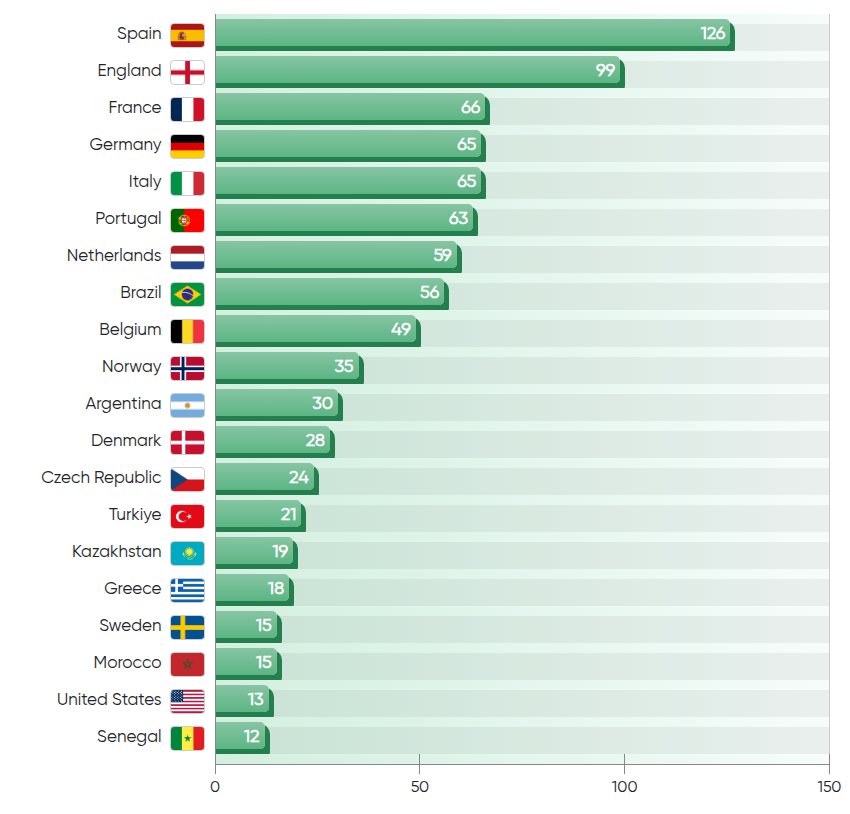
One of the report’s most curious revelations comes from the gap at the very top of the representation table. Spain is the only country to supply more than 100 footballers to the competition, with 126 players, while England is the only other nation close to that mark with 99, and no other country even reaches 70.
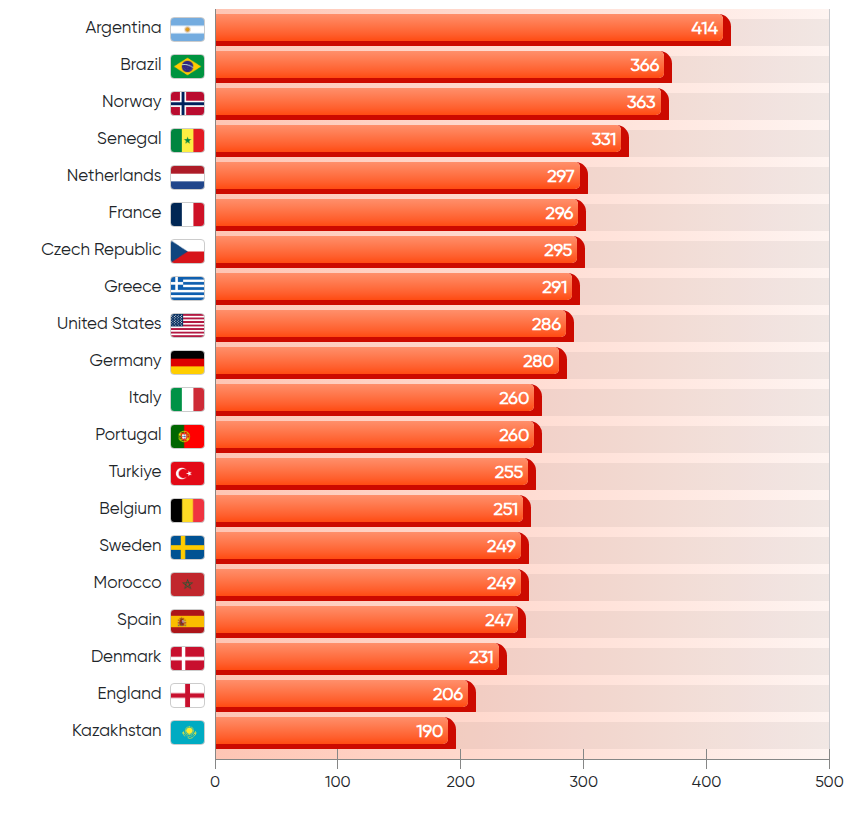
Another striking contrast appears when comparing representation with influence on the pitch. Only one non-European country appears in the top 10 by player numbers – Brazil with 56 players, yet when playing time is examined, three non-European nations dominate the top four positions. Argentina’s players average 414 minutes each, the highest figure in the dataset, while Brazil (366) and Senegal (331) also rank among the most heavily used nationalities in the tournament.
All data in this report was recorded as of 9 March 2026, before the first legs of the Champions League round of 16 were played. The figures include only players who featured in the Champions League main phase and the following play-off rounds, and do not include appearances from the preliminary or qualifying rounds.
Countries Ranked by Number of Footballers
Featured in the Champions League 2025/26
Data Source: fbref.com
All data in thе report was recorded as of 9 March 2026, before the first legs of the Champions League round of 16 were played. The figures include only players who featured in the Champions League main phase and the following play-off rounds, and do not include appearances from the preliminary or qualifying rounds.
Spain dominates the representation table not only by leading the ranking, but also by standing alone above the 100-player mark. A total of 126 Spanish footballers have appeared in Champions League squads this season.
England is the only country within touching distance of that level, supplying 99 players, while the next closest nation is France with 66. Germany and Italy follow immediately behind with 65 players each, forming a tightly packed group among Europe’s traditional football powers.
Portugal also maintains a strong presence with 63 footballers, confirming its role as one of the continent’s key talent producers, while the Netherlands place seventh with 59 players.
The first non-European country appears in eighth place. Brazil contributes 56 footballers, making them the most represented nation outside Europe and the only non-European country in the top ten.
Belgium ranks ninth with 49 players, while Norway completes the top ten with 35 footballers, a notable total for a country of its size.
Further down the ranking, Argentina contributes 30 players, followed by Denmark with 28 and the Czech Republic with 24. Turkiye supplies 21 footballers, while Kazakhstan (19) and Greece (18) also feature among the 20 most represented nations.
The remaining places are occupied by Sweden and Morocco with 15 players each, the United States with 13, and Senegal with 12 footballers.
Overall, the ranking highlights the strong dominance of European countries in squad composition, with Brazil standing out as the only non-European nation among the ten most represented player pools.
Average Game Time (minutes) for Players from
the Most Represented Countries in the Champions League 2025/26
Data Source: fbref.com
Looking beyond simple squad numbers reveals a very different hierarchy when analysing average minutes played per footballer.
Argentina’s players record the highest average involvement, logging 414 minutes per player across the competition. Brazil follows with 366 minutes, while Norway ranks third with 363 minutes, underlining the strong influence of Norwegian players despite their relatively small representation.
Senegal also stands out with 331 minutes per footballer, placing fourth in the ranking despite contributing only 12 players to the competition.
The Netherlands and France occupy the next two positions with 297 and 296 minutes per player respectively, showing that their players combine strong representation with consistent playing time.
A group of mid-sized football nations also perform strongly in terms of average usage. The Czech Republic averages 295 minutes per player, Greece 291, and the United States 286, all ranking within the top half of the table.
Germany’s players average 280 minutes, while Italy and Portugal both record 260 minutes per footballer.
Belgium follows with 251 minutes, while Sweden and Morocco both average 249 minutes per player. Spain – despite supplying by far the largest number of footballers – sits further down the ranking with 247 minutes per player.
At the lower end, Denmark averages 231 minutes per footballer, England 206, and Kazakhstan records the lowest average playing time in the dataset at 190 minutes per player.
The comparison highlights a clear contrast between representation and influence. While European nations dominate the rankings by player numbers, the playing-time table shows a stronger impact from outside the continent, with Argentina, Brazil and Senegal occupying three of the top four positions for average minutes played per footballer.