 | Updated:
Modern football keeps changing on the touchline. Clubs want fresh ideas, quicker impact and constant adaptation, yet they do not all look for those qualities in the same type of head coach. Some leagues still lean towards long-established figures, while others are far more willing to hand the dugout to younger managers.
That is what led Sportingpedia to examine the current head coaches across Europe’s Top 7 Leagues in 2025/26, focusing on age first and foremost. The study compares average age, the share of head coaches under 40, and the youngest and oldest current manager in each league, while using average tenure and the share who have lasted at least two years as supporting context.
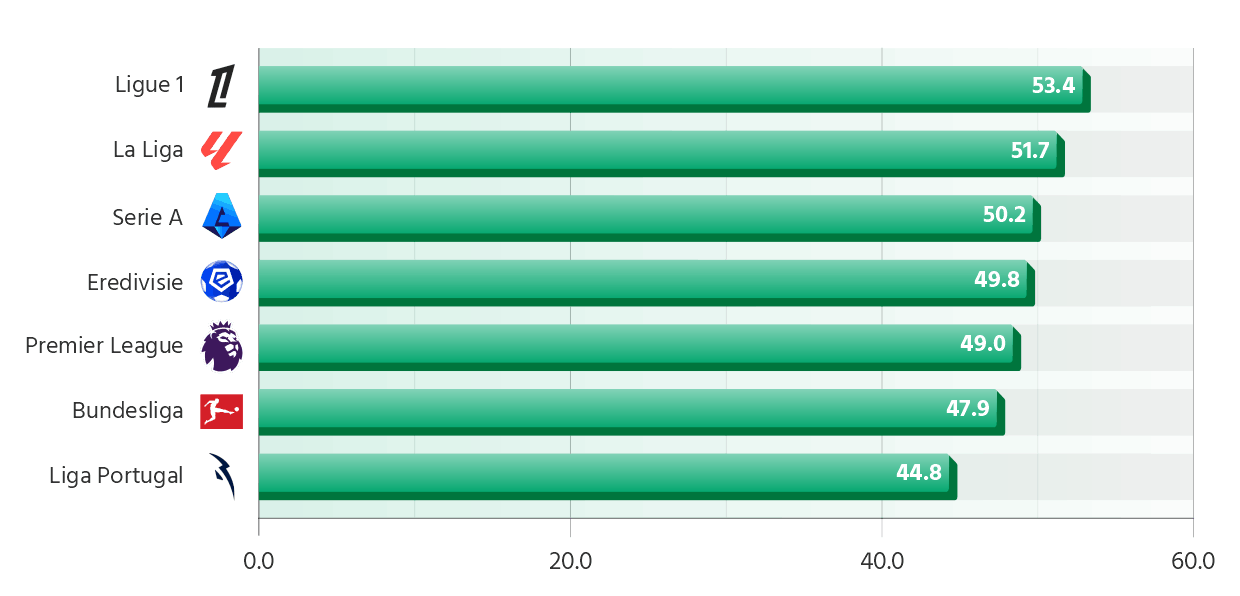
The numbers point in two different directions. Liga Portugal has by far the youngest coaching profile, with an average age of 44.8 and one third of current head coaches still under 40. Ligue 1 sits at the opposite end on 53.4. The full range is even wider, stretching from Parma’s Carlos Cuesta, who at 30 is the youngest current head coach across all seven leagues, to Nantes’ Vahid Halilhodzic, who at 73 is the oldest.
Average Age of Head Coaches in Europe’s Top 7 Leagues
Data Source: CIES
The first clear divide appears in average age, where the coaching profiles across Europe’s Top 7 Leagues spread far more widely than they might seem at first glance. Ligue 1 has the oldest dugouts overall, with head coaches averaging 53.4 years of age, followed by La Liga on 51.7 and Serie A on 50.2. The Eredivisie and Premier League sit close together on 49.8 and 49.0, while the Bundesliga is slightly younger at 47.9. Liga Portugal stands apart from the rest as the youngest coaching league in the study, with an average age of just 44.8. That leaves an 8.6-year gap between Portugal and France, underlining how differently leagues are shaping their technical areas. The individual age range is even wider. Parma’s Carlos Cuesta, at 30, is the youngest current head coach across all seven leagues, while Nantes’ Vahid Halilhodzic, at 73, is the oldest. In between those two ends, the Premier League ranges from Brighton’s Fabian Hurzeler at 33 to Everton’s David Moyes at 62, La Liga from Rayo Vallecano’s Inigo Perez and Celta Vigo’s Claudio Giraldez at 38 to Manuel Pellegrini at 72, and the Bundesliga from Union Berlin’s Marie-Louise Eta at 34 – the only woman currently working as a head coach across Europe’s Top 7 Leagues – to Dieter Hecking at 61. The broad picture is clear: France’s topflight remains the league most shaped by experience, while Portuguese clubs are giving chance in the dugout to a much younger profile.
Share of Head Coaches younger than 40 years in Europe’s Top 7 Leagues
Data Source: CIES
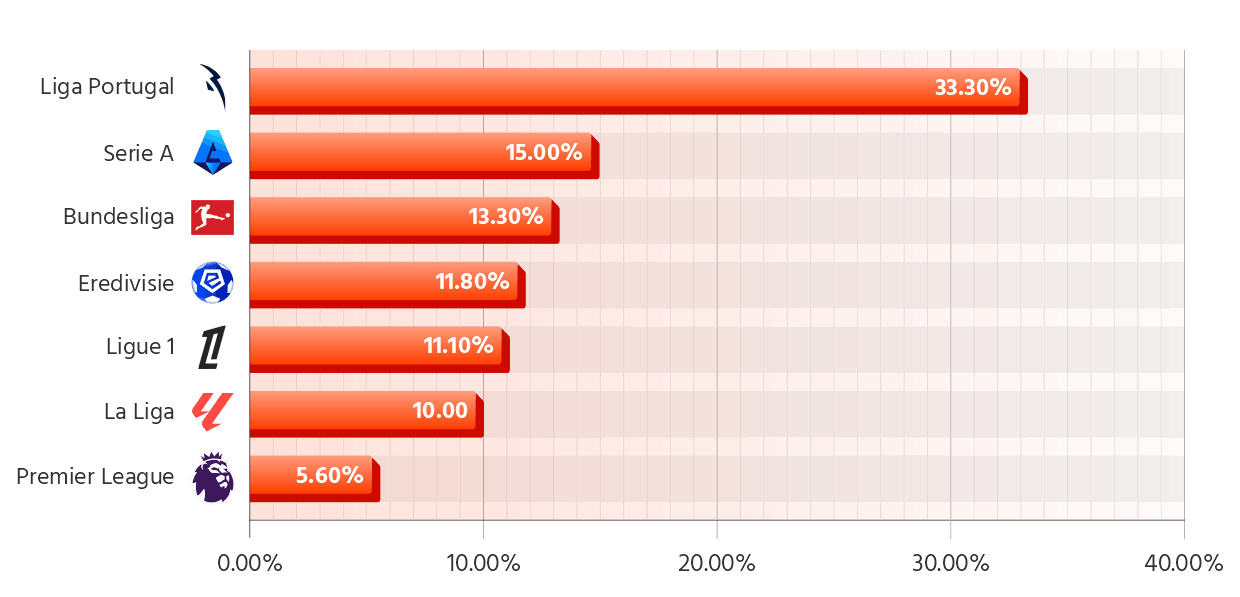
That contrast becomes even sharper when looking at the share of head coaches under 40. Liga Portugal again leads comfortably, with 33.3% of its current managers falling into that bracket, by far the highest proportion in the study. Serie A follows on 15.0, then the Bundesliga on 13.3, the Eredivisie on 11.8, and Ligue 1 on 11.1. La Liga drops to 10.0, while the Premier League sits last on just 5.6. That means Portugal is not only the youngest league on average, but also the one most willing to give younger coaches a meaningful slice of jobs. Italy is also notable here, because although its average age sits above 50, it still gives under-40 coaches the second-highest share of positions. England points in the opposite direction. The Premier League is not especially old overall, yet it remains the least open to younger head coaches of any league in the report. So while average age shows where leagues lean younger or older in general, the under-40 measure reveals where clubs are most actively willing to trust youth with the main role.
Average Tenure of Head Coaches in Europe’s Top 7 Leagues (months)
Data Source: CIES
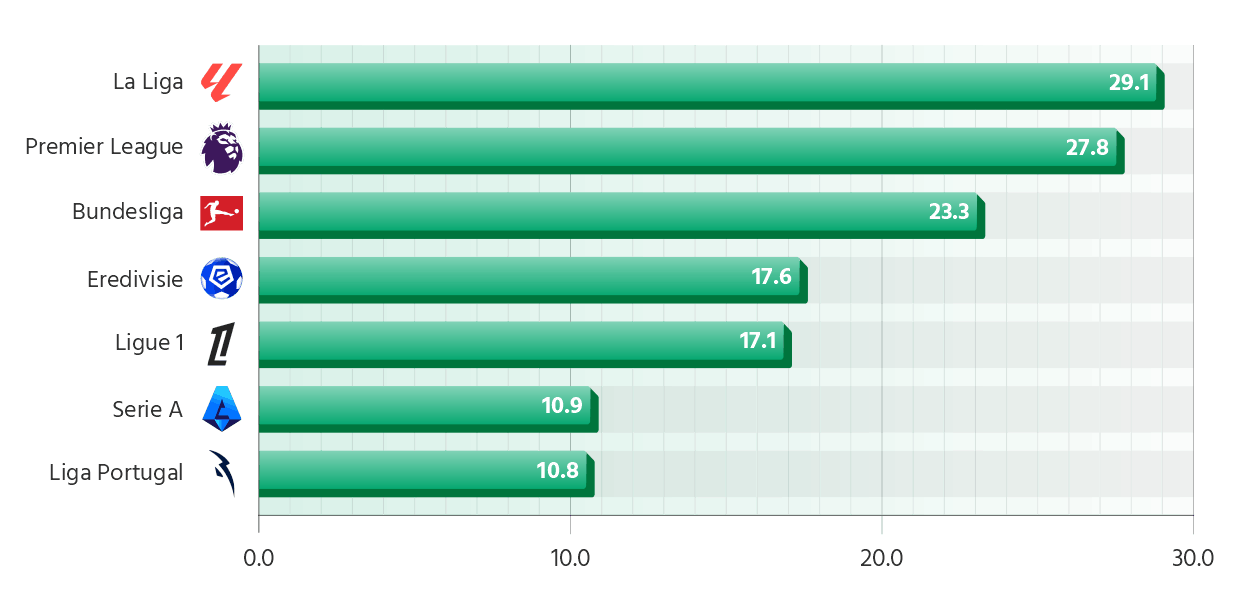
Average tenure adds a different layer to the story, showing where clubs allow time for a coach to settle and where they move on quickly. La Liga tops this ranking at 29.1 months, with the Premier League next on 27.8, making Spain and England the only two leagues where the average current head coach has lasted well beyond two years. The Bundesliga follows on 23.3 months, then the Eredivisie on 17.6 and Ligue 1 on 17.1. At the other end, Serie A and Liga Portugal are almost identical at 10.9 and 10.8 months, meaning the average current coach in those two leagues has not even lasted a full year. That creates one of the strongest contrasts in the report. Portugal is the youngest coaching environment, yet one of the shortest-lived. Serie A is not especially young, but is just as quick to change direction. By comparison, Spain combines an older coaching profile with the longest managerial stays, while England also remains relatively patient despite its reputation for pressure and scrutiny.
Share of Head Coaches in Europe’s Top 7 Leagues
Who Have Completed 2 Years at Their Clubs
Data Source: CIES
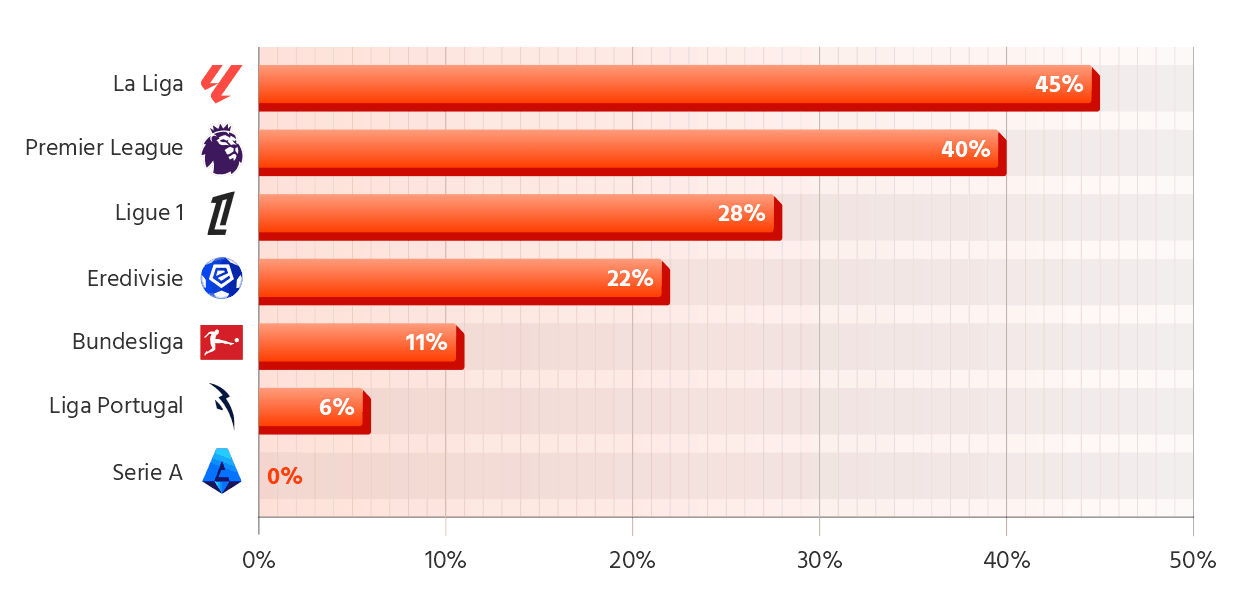
That same pattern is reinforced even more clearly by the share of head coaches who have stayed in post for at least two years. La Liga again leads the way, with 45% of current head coaches already beyond the 730-day mark, while the Premier League is next on 40.0. After those two, the numbers fall sharply. Ligue 1 stands on 27.8, the Eredivisie on 22.2, the Bundesliga on 11.1, and Liga Portugal on 5.6. Serie A is the most extreme case of all, with 0% of current head coaches reaching the two-year threshold. That means not one coach currently working in the Italian top flight has managed to build even a medium-term run at his club. In practical terms, Spain and England remain the only two leagues in the study where continuity still exists on a meaningful scale, while Italy and Portugal offer the least room for long managerial projects. Germany sits in an interesting middle position, giving a relatively healthy share of jobs to younger coaches but still offering little long-term security once those appointments are made.
Taken together, the four categories show that Europe’s Top 7 Leagues are moving in very different directions on the touchline. France’s Ligue 1 has the oldest coaching environment, but not one built on especially long stays. Portugal has the youngest head coaches, but is also one of the quickest to replace managers. La Liga combines one of the older managerial profiles with the longest continuity, while Serie A gives younger coaches a reasonable foothold but almost no time. The Premier League remains cautious about appointing very young coaches, yet still stands alongside Spain’s La Liga as one of the only places where managers are allowed to build something lasting.