 | Updated:
The 2026 World Cup brings together some of football’s most valuable squads, but raw market value usually tells the story of the biggest nations. Divide each team’s value by the population of the country behind it, however, and the whole map changes. Instead of the usual financial powers sitting comfortably at the top, the table is suddenly led by much smaller football nations squeezing extraordinary value out of far smaller populations.
That is what led Sportingpedia to rank all 48 finalists by market value per capita, measuring how much squad value each World Cup nation brings per resident. The most curious revelation is that Curacao, officially recognised as the smallest nation by population to ever qualify for a men’s World Cup, tops the entire table on €135.68 per person despite carrying one of the tournament’s smallest overall squad values at €25.78 million. At the other end, Iran sits bottom on just €0.34, while Brazil drops as low as 35th despite bringing one of the most expensive squads to the tournament.
Another curious revelation is that only five nations clear the €100-per-capita mark – Curacao, Uruguay, Cape Verde, Norway, and Croatia. Portugal just misses out on that bracket at €97.12, but still stands out as the only billion-euro squad to come anywhere near it, with France, England, and Spain all ranking outside the top 10.
World Cup 2026: Squad Value per capita by Country
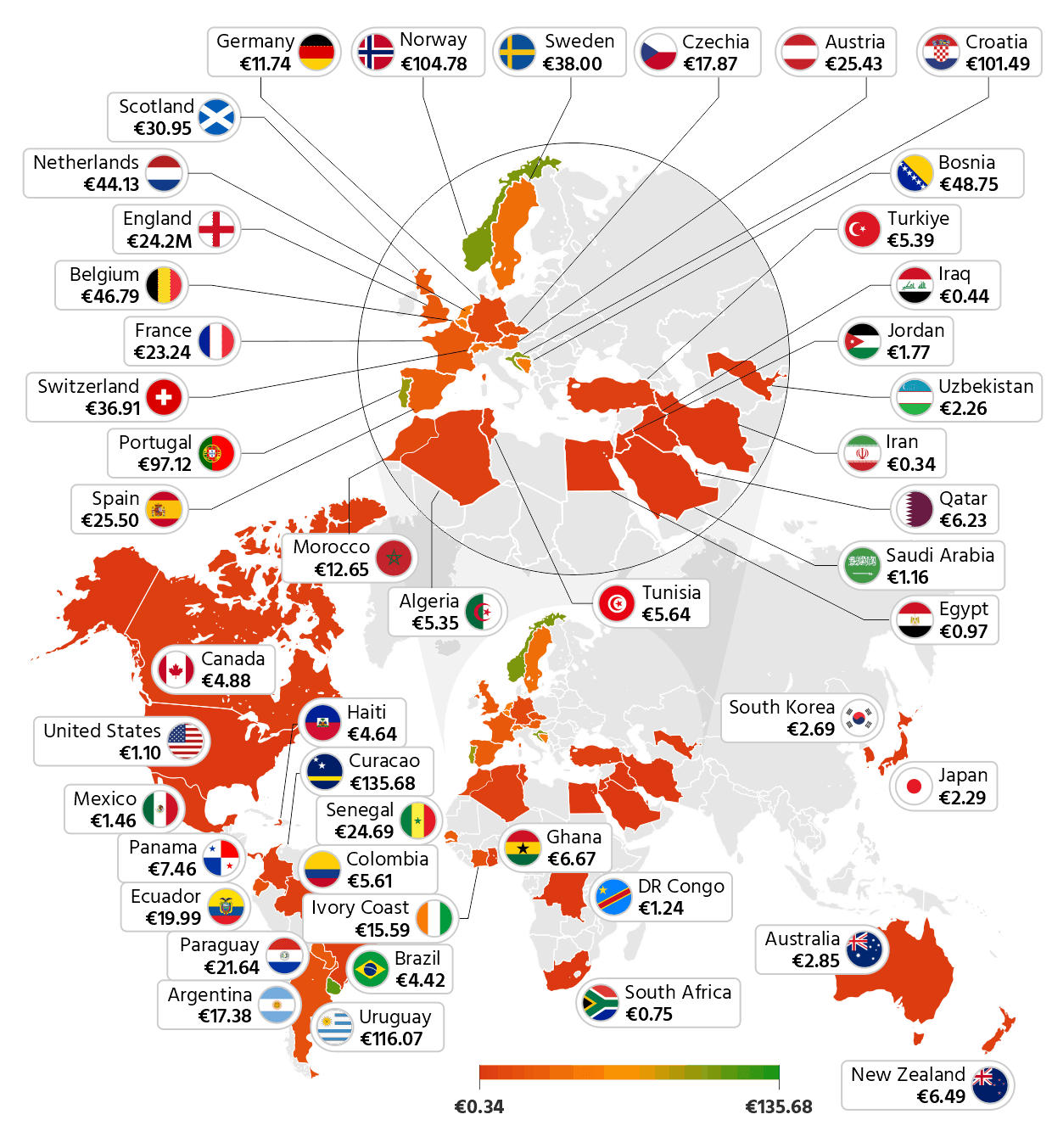
Data Sources: Transfermarkt, Worldpopulationreview
Curacao’s place at the summit says everything about how different this measure is from a standard squad-value table. Their overall squad is worth only €25.78 million, yet no one comes close once that figure is spread across a population of just 0.19 million. Uruguay follows on €116.07, Cape Verde sits third on €108.49, Norway ranks fourth on €104.78, and Croatia is fifth on €101.49. Portugal then comes next on €97.12, making them the only billion-euro squad anywhere near the very top.
That upper end is shaped far more by demographic efficiency than by raw financial muscle. Bosnia & Herzegovina ranks seventh on €48.75, Belgium eighth on €46.79, the Netherlands ninth on €44.13, Sweden 10th on €38.00, and Switzerland 11th on €36.91. Several of the World Cup’s biggest football powers sit much lower. Spain stands 13th on €25.50, England 16th on €24.20, France 17th on €23.24, Argentina 21st on €17.38, and Germany only 24th on €11.74. In other words, the richest squads still belong to the established powers, but population size drags many of them well down the per-capita table.
Brazil provides the sharpest example of that collapse. Their squad is worth €943.20 million, the sixth-highest total at the tournament, yet that works out at only €4.42 per resident, leaving them 35th overall. Argentina fares much better, but even the reigning world champions remain nowhere near Uruguay, whose €116.07 leaves them 6.7 times ahead despite both coming from South America. That is one of the clearest contrasts in the whole study. Two of the region’s traditional giants still cannot match one of their own smaller neighbours once the numbers are adjusted for population.
The tournament’s hosts tell another striking story. Canada ranks highest of the three in 33rd on €4.88 per resident, but Mexico drops to 41st on €1.46 and the United States sinks to 44th on €1.10 despite carrying an overall squad worth €385.60 million. So even with the spotlight of a home World Cup, none of the host nations looks especially strong once squad value is measured against the size of the country it represents.
At the lower end, the table is dominated by countries with large populations and modest squad values. Saudi Arabia stands 43rd on €1.16, Egypt 45th on €0.97, South Africa 46th on €0.75, Iraq 47th on €0.44, and Iran 48th on €0.34. That leaves Curacao almost 400 times clear of the bottom spot, which is the starkest single contrast anywhere in the ranking.
The wider picture is clear. Once squad value is measured per resident, the 2026 World Cup stops looking like a tournament ruled simply by the biggest football economies. Instead, it becomes a table of which nations generate the most elite football value relative to their size. By that standard, Curacao leads the way, Uruguay remains exceptionally strong, and several smaller European countries surge above the traditional heavyweights. The biggest teams still dominate the raw money, but not this table.
Methodology
Each team’s market value is divided by the population of its country, with both figures measured in millions. That produces a per-capita value figure showing how much squad market value each World Cup nation brings per resident, allowing all 48 teams to be measured on the same basis regardless of population size.