 | Updated:
A World Cup does not end with the final whistle for every national-team coach. Results reshape expectations, federations reassess their plans and contracts written around the tournament reach their natural conclusion. In the weeks following the 2026 edition, the changes on the touchline have been almost as striking as those witnessed on the pitch.
SportingPedia compared the 48 head coaches who began the 2026 World Cup with the managers still in charge after the tournament. Following Vladimir Petković’s departure from Algeria, 18 of those coaches have now left their positions. That means 37.5% of the coaches who started the tournament are already gone – exactly three in every eight.
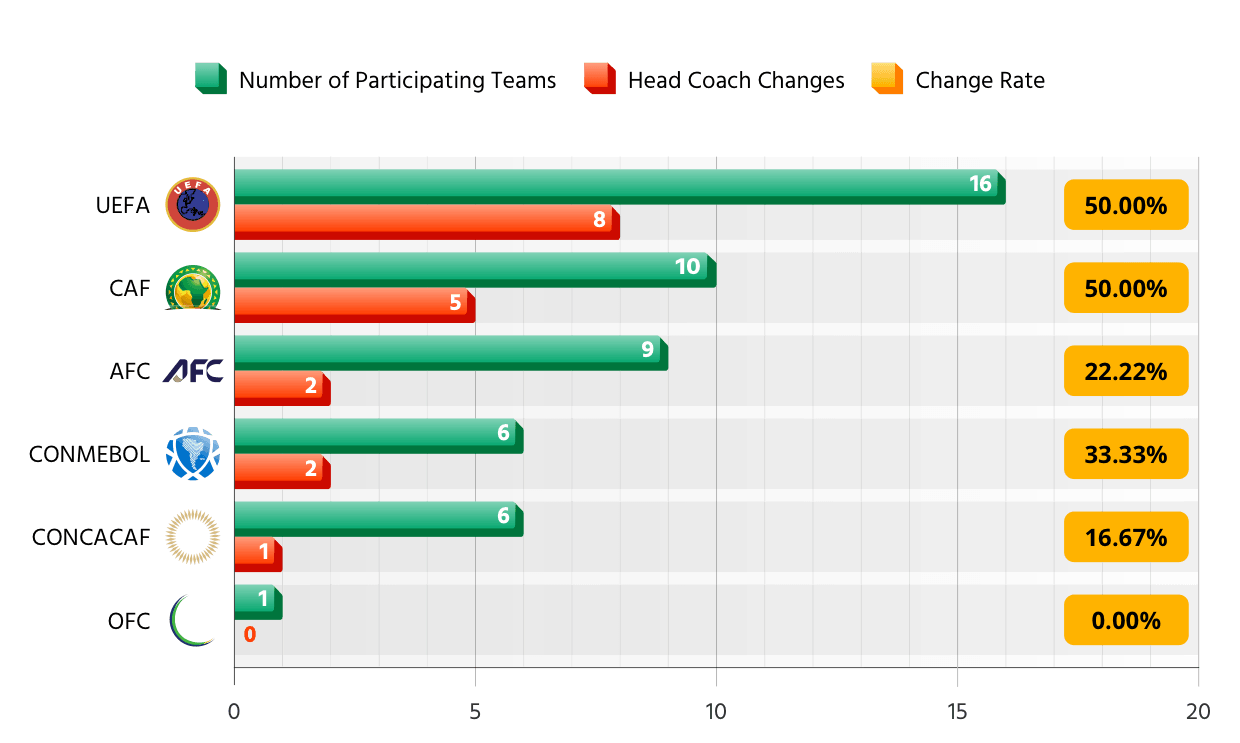
UEFA and CAF account for 13 of the 18 changes. Eight of UEFA’s 16 World Cup teams and five of CAF’s 10 have changed coaches, giving both confederations a turnover rate of 50%. The remaining five departures are split between the AFC and CONMEBOL with two each, and Concacaf with one, while the OFC has recorded none.
2026 World Cup Head Coach Turnover by Confederation
Data Source: Transfermarkt
The Turnover Began During The Group Stage
Tunisia made the first change after a 5-1 defeat by Sweden in their opening match, ending Lamouchi’s tenure before the group stage had been completed.
More departures followed as teams were eliminated. Hong Myung-bo resigned from the South Korea job, Miroslav Koubek left Czechia by mutual agreement and Steve Clarke ended his seven-year spell with Scotland. Jamal Sellami also parted ways with Jordan after leading the country to its first World Cup, while Marcelo Bielsa reached the end of his contract with Uruguay.
The first knockout round brought another series of changes. Carlos Queiroz stepped down from the Ghana role, while Julian Nagelsmann, Ronald Koeman, Sebastián Beccacece and Zlatko Dalić also left after Germany, the Netherlands, Ecuador and Croatia were eliminated. Roberto Martínez and Javier Aguirre followed after the exits of Portugal and Mexico.
Not Every Departure Followed а Poor Result
The turnover cannot be explained by disappointing performances alone. Several coaches resigned after early elimination, but others completed contracts that had always been expected to end with the tournament.
Didier Deschamps had announced in advance that the World Cup would conclude his long tenure with France. His departure ended a 14-year spell that included victory at the 2018 tournament, with Zinedine Zidane subsequently appointed as his successor.
Belgium reached the quarter-finals under Rudi Garcia, but his contract was not renewed when it expired at the end of July. Hugo Broos also left after guiding South Africa into the knockout stage, choosing retirement rather than beginning another cycle with the national team.
These cases make the 18 changes broader than a simple list of sackings. The total includes dismissals, resignations, mutual agreements, retirements and contracts that expired without being renewed.
UEFA and CAF Account For Most оf The Coaching Changes
European and African teams have experienced the highest turnover. Eight of UEFA’s 16 World Cup participants have changed head coaches: Belgium, Croatia, Czechia, France, Germany, the Netherlands, Portugal and Scotland.
Five of CAF’s 10 representatives have also made a change: Algeria, Ghana, Senegal, South Africa and Tunisia. UEFA and CAF therefore both have a turnover rate of 50%, and together account for 13 of the 18 departures.
The remaining five changes are spread across three other confederations. South Korea and Jordan represent the AFC, Uruguay and Ecuador come from CONMEBOL, and Mexico is the only Concacaf team to have changed head coach. New Zealand, the tournament’s only OFC representative, has not made a change.