 | Updated:
 International football is reaching a symbolic changing of the guard. Lionel Messi is preparing for his farewell match with Argentina, bringing one of the defining international careers of the modern era towards its close. Cristiano Ronaldo remains active with Portugal and leads all players for international goals, although he was an unused substitute in their latest 2-1 victory over Norway. At the same time, the next generation is moving increasingly into focus: Kylian Mbappé has just played his first France match under Zinédine Zidane, while Erling Haaland scored Norway’s only goal against Portugal after recently overtaking Ronaldo Nazário and Zlatan Ibrahimović in the all-time international scoring charts.
For almost two decades, Ronaldo and Messi provided football with its defining goalscoring comparison. As their international careers move towards different endings, Mbappé and Haaland are emerging as the obvious pair to carry that discussion into the next generation. Their current international records already make for a fascinating contrast. Mbappé has scored 67 times in 107 matches for France, while Haaland is only two goals behind on 65 despite having played just 57 times for Norway.
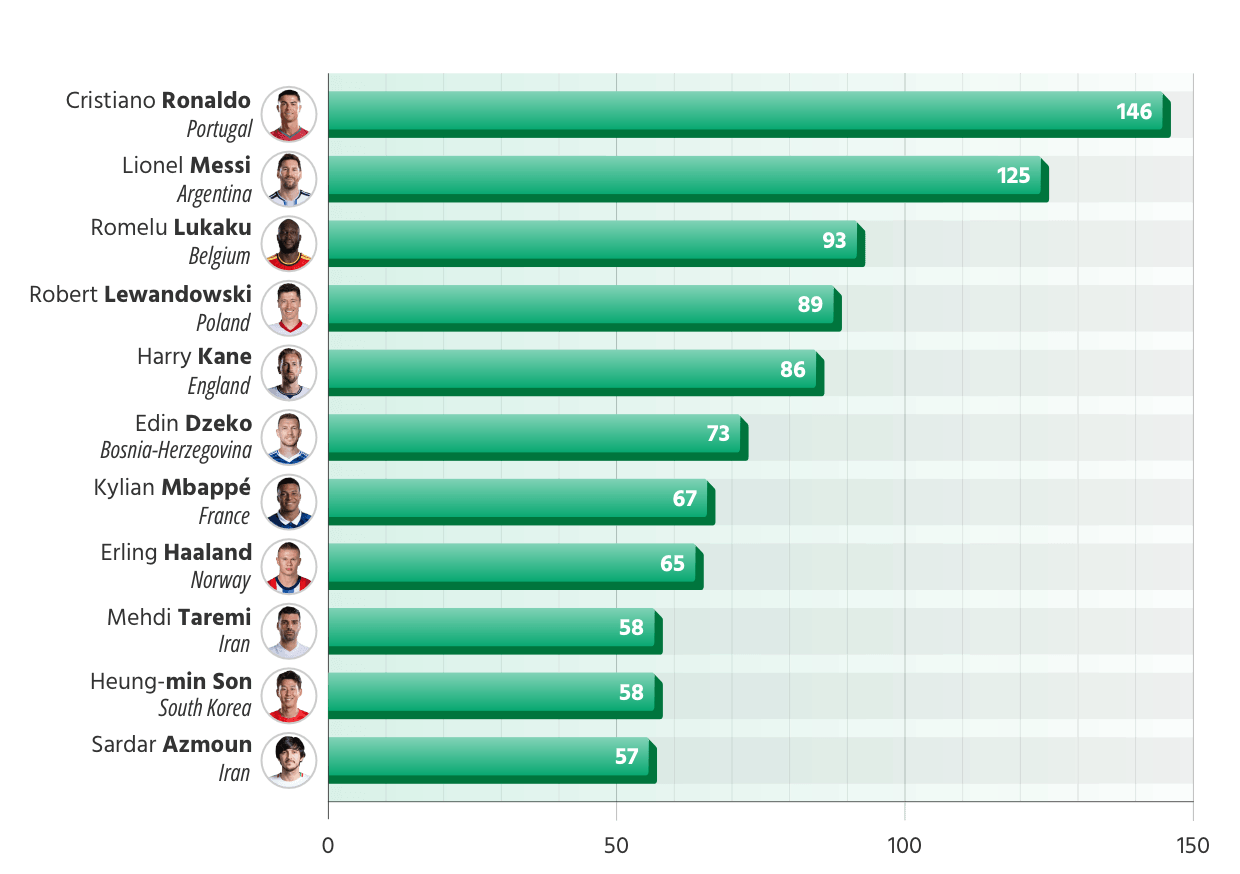
SportingPedia analysed the 11 active footballers with the most international goals, first ranking them by their career totals and then reordering the same players by goals per match. The two rankings produce very different pictures. Ronaldo leads comfortably on volume with 146 goals, followed by Messi with 125, while Haaland sits only eighth with 65. Once scoring efficiency becomes the measure, however, the Norwegian jumps to first at 1.14 goals per match, comfortably ahead of Harry Kane and Romelu Lukaku at 0.70. At his current pace, Haaland could pass Ronaldo’s current 146-goal total after roughly 129 international matches, around 105 fewer appearances than the Portugal’s superstar has made so far.
Active Footballers with the Most International Goals
Data Source: Transfermarkt
Ronaldo and Messi remain well separated from everyone else when international goals are counted in absolute terms. Ronaldo’s 146 leave him 21 ahead of Messi, while there is another sizeable drop to Lukaku on 93. The Belgian is followed closely by Lewandowski with 89 and Kane with 86, meaning only five active players in the group have reached 80 international goals.
Longevity is a major part of that hierarchy. Ronaldo has accumulated his record across 234 appearances and Messi his 125 goals across 207. Lewandowski has played 169 times, Dzeko 151 and Son 150. Their totals reflect not only scoring ability but the capacity to remain central figures for their national teams over many years.
That makes Haaland’s position unusual. He is eighth by total goals, behind players such as Dzeko, Mbappé and Kane, but has reached 65 after just 57 international matches. Every player above him has made at least 107 appearances, and several have played more than 150 times.
Mbappé and Haaland offer the clearest comparison between the new generation. France’s leading forward currently holds the advantage in total goals, 67 to 65, but has required 107 matches compared with Haaland’s 57. The Norwegian is therefore just two goals away from Mbappé despite a difference of 50 international appearances.
Iran is the only nation represented twice among the 11, with Mehdi Taremi on 58 goals and Sardar Azmoun on 57. Son has also scored 58 for South Korea, placing all three within a single goal of each other before the ranking is adjusted for appearances.
The 11 Leading Active International Goalscorers Ranked by Goals per Match
Data Source: Transfermarkt
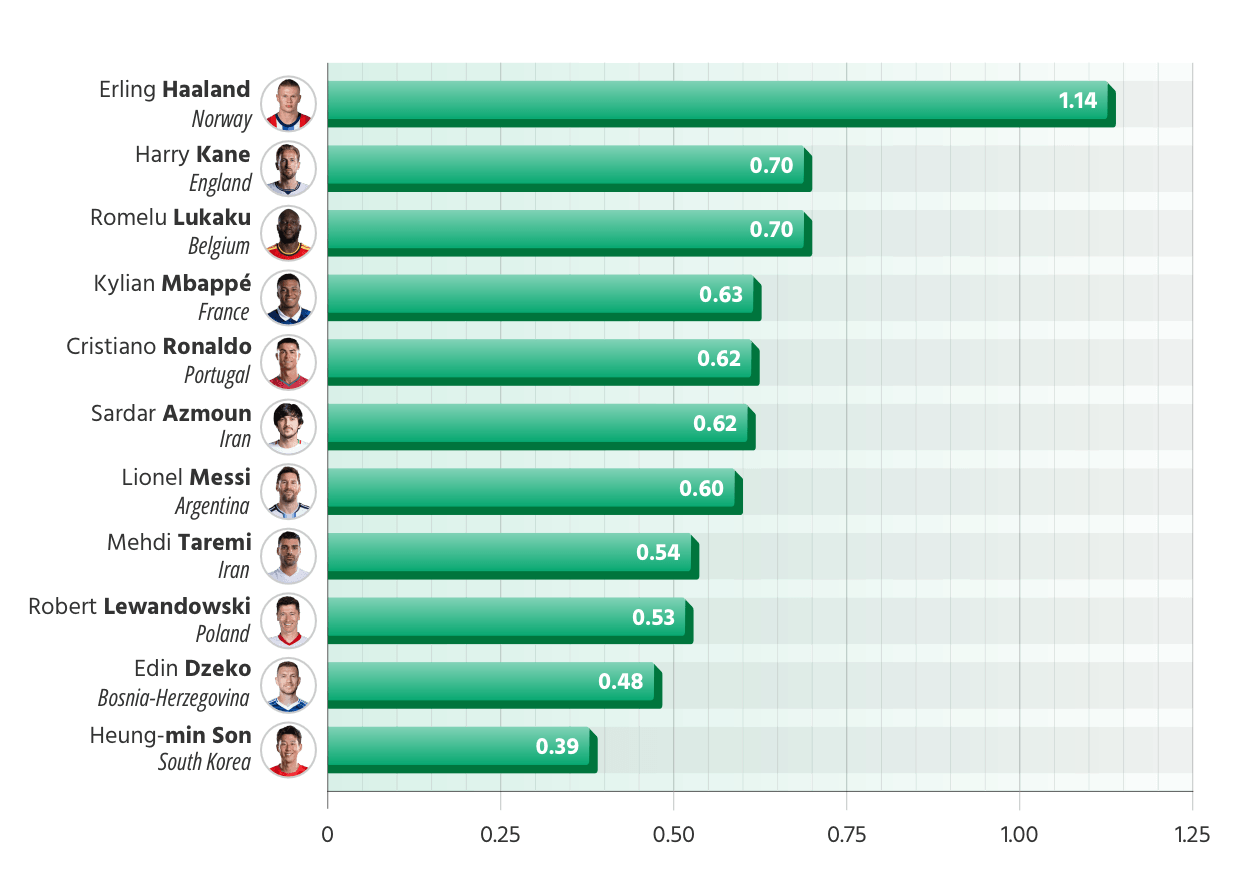
Once appearances are taken into account, Haaland separates himself from everyone else. His average of 1.14 goals per match makes him the only player among the leading 11 active scorers to average more than one goal every time he represents his country. At his current scoring pace, Haaland would need about 72 more games to match Ronaldo’s current total of 146 goals. He would reach that point after roughly 129 international appearances – around 105 fewer than the Portuguese legend has played so far.
Kane and Lukaku share second place at 0.70, leaving a considerable 0.44-goal gap between Haaland and his nearest challengers.
Kane is one of the biggest beneficiaries of the change in measure. He ranks fifth by total goals with 86 but climbs to joint second by rate. Lukaku, meanwhile, performs strongly in both rankings: third with 93 goals overall and joint second at 0.70 per match.
Mbappé also moves upwards, from seventh in total goals to fourth in scoring rate at 0.63. That puts him narrowly ahead of Ronaldo and Azmoun at 0.62 and Messi at 0.60. The differences between those four rates are relatively small, but the numbers of appearances behind them are very different.
Ronaldo and Messi illustrate most clearly how the two rankings reward different things. Their enormous totals put them first and second among active players, but their rates of 0.62 and 0.60 leave them fifth and seventh respectively when efficiency becomes the measure. Their position at the top of the traditional goals table is therefore built on a combination of elite scoring and exceptional longevity.
Lewandowski experiences an even larger shift. His 89 goals place him fourth by total, but his 0.53 rate drops him to ninth. Dzeko moves from sixth to tenth, while Son remains 11th by scoring rate at 0.38 despite being level with Taremi on 58 career goals.
Haaland and Mbappé: The Next Great Goalscoring Rivalry?
For much of the past two decades, international scoring debates naturally returned to Ronaldo and Messi. The Portuguese forward accumulated the larger total, while the Argentine remained close enough for every new milestone to renew the comparison. Their careers developed alongside one another for long enough that the rivalry became one of football’s defining reference points.
Mbappé and Haaland are now creating a very different version of that comparison. Their international goal totals are almost identical – 67 for Mbappé and 65 for Haaland – but the routes they have taken to those numbers could hardly be more different.
Mbappé has played 107 times for France and averages 0.63 goals per match. Haaland has needed only 57 appearances to reach 65 and averages 1.14. In other words, the Norwegian has scored just two fewer goals despite playing 50 fewer international matches, while his scoring rate is around 81% higher.
The comparison also highlights why looking only at career totals can hide an important part of the story. Mbappé currently sits one place ahead of Haaland in the traditional ranking, seventh against eighth, but the efficiency table places Haaland first and Mbappé fourth. The gap between them changes from just two goals to more than half a goal per match depending on which measure is used.
With Messi preparing for his Argentina farewell and Ronaldo now 41, the international goalscoring conversation is beginning to move towards a new generation. Mbappé already has the larger body of international appearances and a slight advantage in goals, while Haaland is scoring at a rate unmatched by any of the other leading active internationals. If Ronaldo and Messi provided football with its great goalscoring comparison for much of the last two decades, Mbappé and Haaland are increasingly giving the next generation one of its own.