 | Updated:
Few aspects of football expose a team’s temperament as clearly as its disciplinary record. Yellow cards can reflect persistent fouling, tactical interruptions or dissent, while red cards show when that line has been crossed altogether.
SportingPedia examined yellow and red cards across the Premier League, La Liga, Serie A, Bundesliga, Ligue 1, Eredivisie and Liga Portugal in the 2026/27 season so far. Because clubs and competitions have played different numbers of matches, the comparison is based on cards per match rather than raw totals. The teams with the worst disciplinary records were assessed through both yellow and red-card rates, while the most disciplined side of the comparison is based on yellow cards because a large number of clubs have yet to receive a red card.
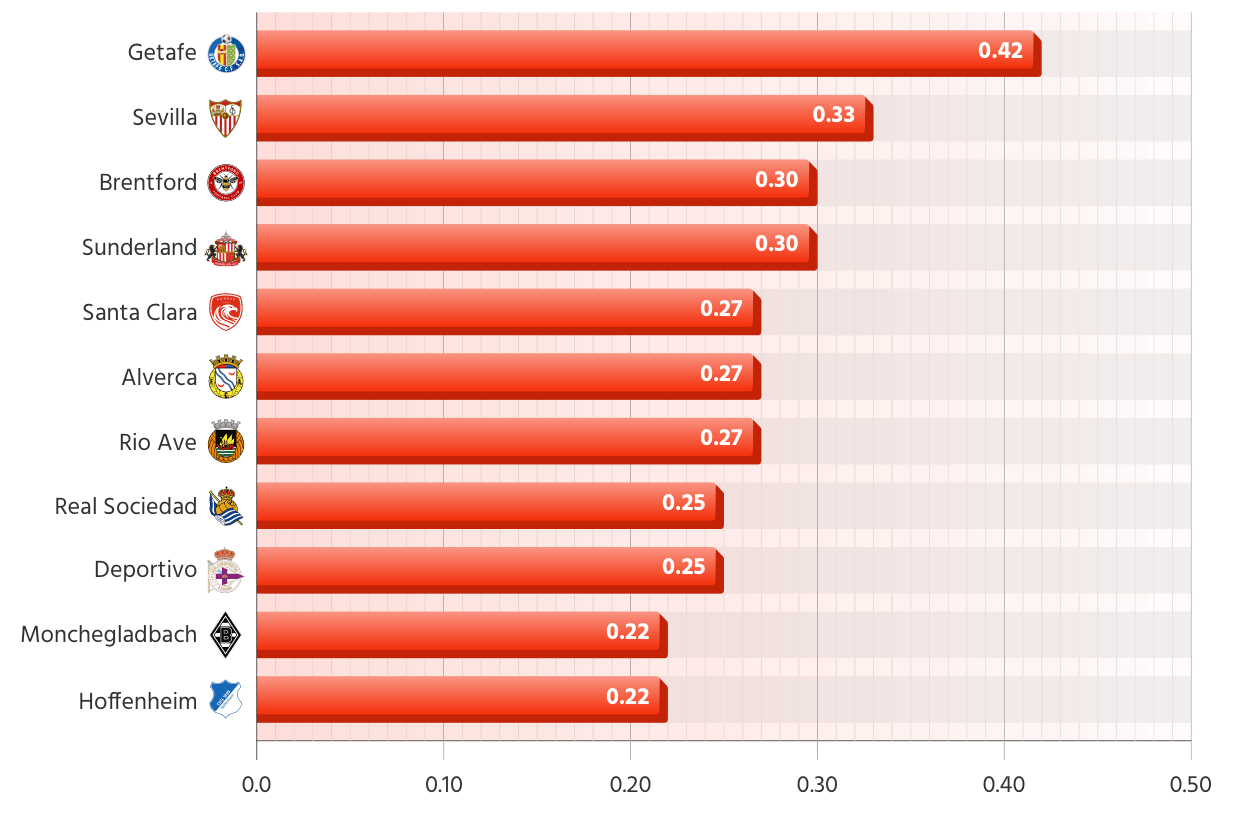
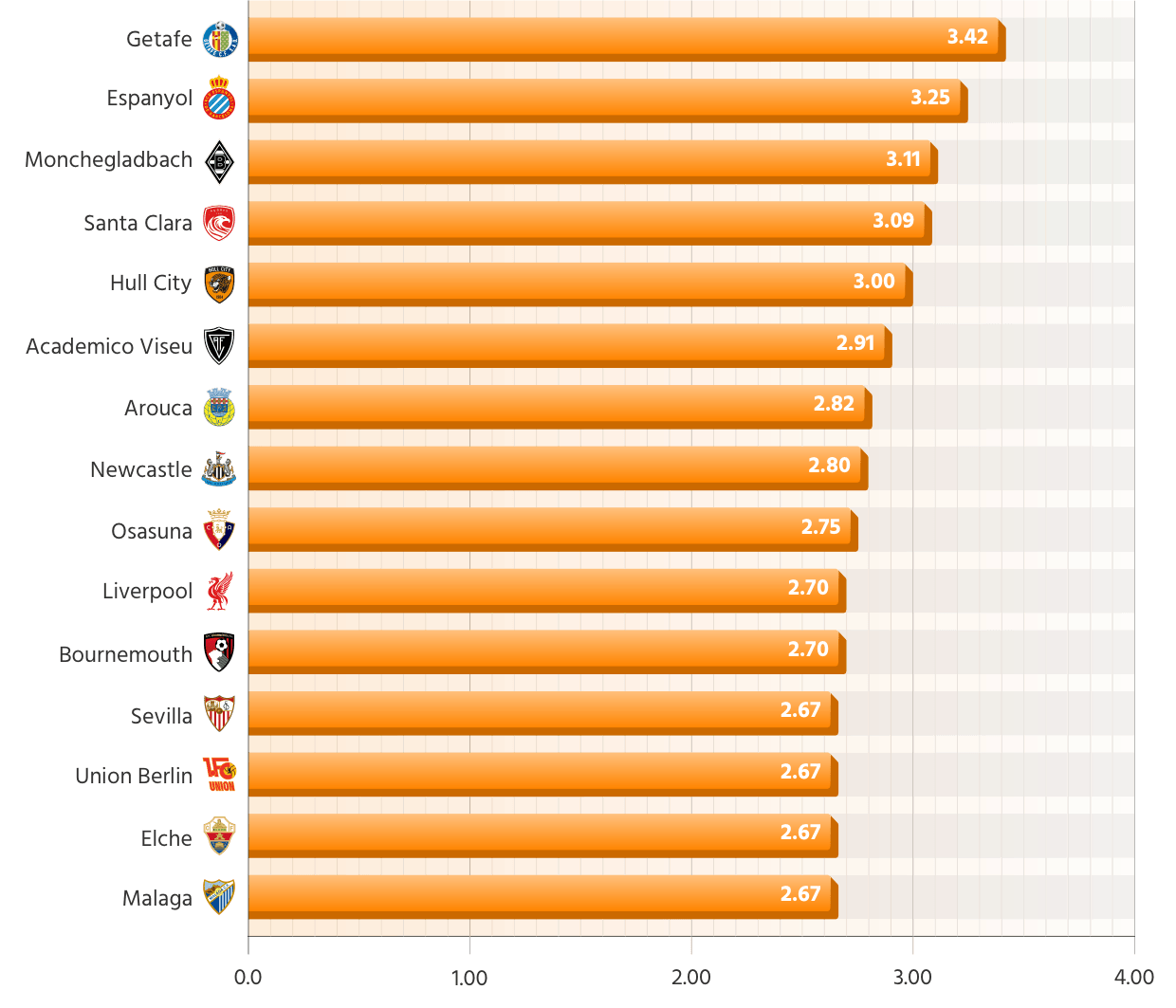
Getafe stand out more than any other team at the negative end, averaging 3.42 yellow cards and 0.42 red cards per match, the highest figures across all seven leagues in both categories. At the opposite end, Go Ahead Eagles average just 0.83 yellows per game, narrowly ahead of RB Leipzig at 0.89. Bayern Munich, PSG, Atalanta and Torino all sit at exactly one yellow card per match, showing how wide the gap is between the cleanest teams and those accumulating cautions several times as frequently.
red cards per match during the 2026/27 season
Data Source: Fbref
Getafe have Europe’s worst disciplinary record
No club combines yellow and red cards at the rate Getafe do. Their 41 cautions in 12 La Liga matches translate to 3.42 per game, while five dismissals produce a red-card rate of 0.42 per match.
Espanyol are closest on yellow cards at 3.25 per match, although they do not feature among the leading sides for reds. Borussia Mönchengladbach follow at 3.11 yellows per game and also average 0.22 red cards, making them one of the few clubs appearing prominently in both categories.
Santa Clara show a similar pattern, averaging 3.09 yellows and 0.27 reds per match. Sevilla are another major disciplinary outlier: their yellow-card rate of 2.67 is well above the European average, while four dismissals in 12 matches give them the second-highest red-card rate of all the teams compared.
yellow cards per match during the 2026/27 season
Data Source: Fbref
Go Ahead Eagles and RB Leipzig set the standard for fewest bookings
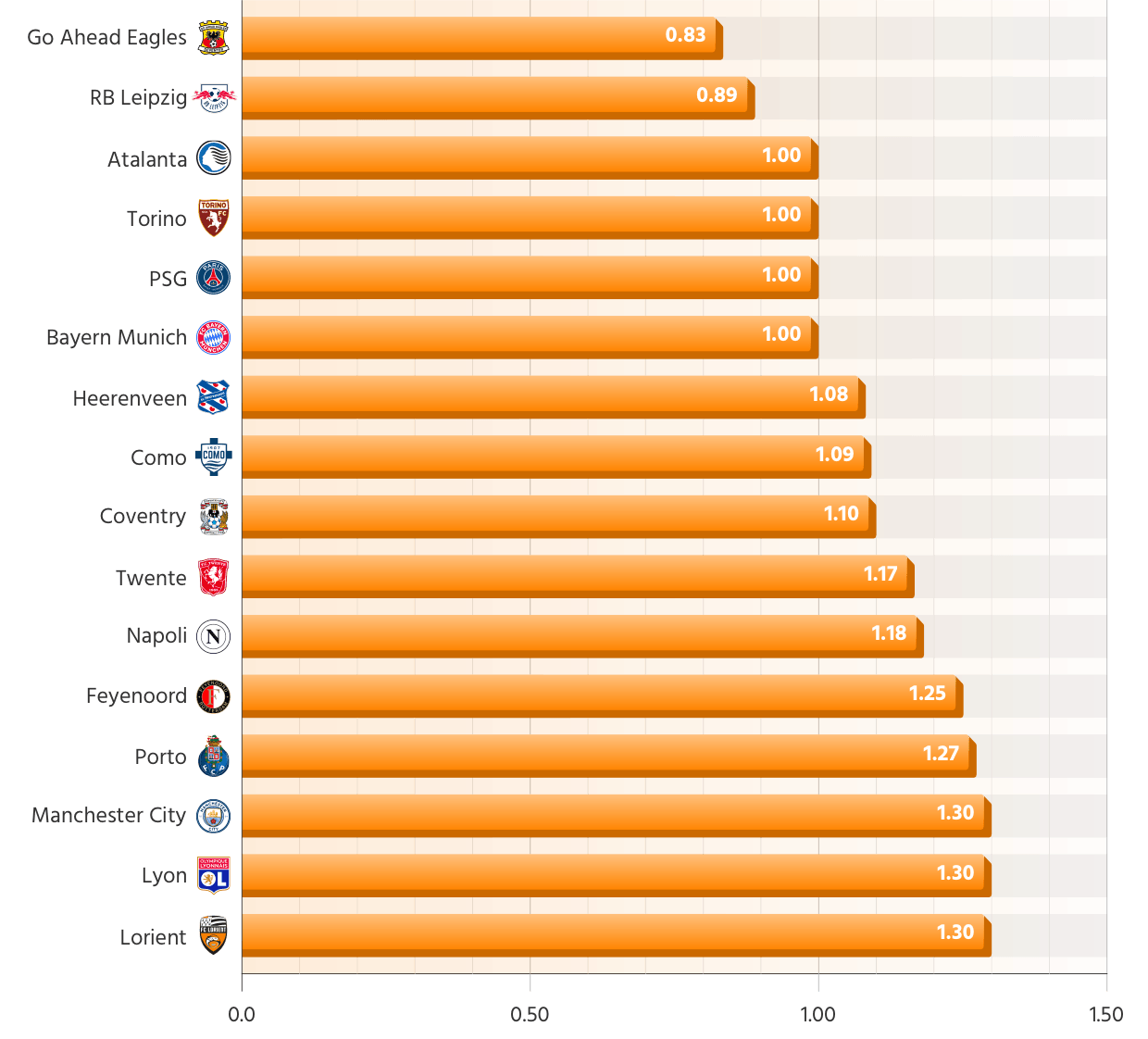
The other end of the comparison looks very different. Go Ahead Eagles average only 0.83 yellow cards per match, the lowest rate across the seven leagues, while RB Leipzig follow closely at 0.89. A group of high-profile clubs sit immediately behind them. Bayern Munich, PSG, Atalanta and Torino all average exactly one yellow card per match, showing that strong competitive performances do not necessarily have to come with frequent cautions.
Heerenveen are next at 1.08, followed by Como at 1.09 and Coventry at 1.10. Napoli also sit among the least frequently booked teams at 1.18 per match, while Porto, Manchester City, Lyon and Lorient all remain at or below 1.30.
The contrast with Getafe is stark. The Spanish side average more than four times as many yellow cards per match as Go Ahead Eagles and nearly four times as many as RB Leipzig.
yellow cards per match during the 2026/27 season
Data Source: Fbref
La Liga dominates the wrong end of the yellow-card ranking
Spain has by far the strongest presence among the teams with the highest yellow-card rates. Getafe and Espanyol occupy the top two positions, while Osasuna, Sevilla, Elche, Malaga, Valencia, Santander and Rayo Vallecano also feature among the clubs accumulating cautions most frequently.
The other end of La Liga looks very different. Barcelona, Levante and Betis share the league’s lowest yellow-card rate at 1.50 per match, with Celta Vigo just behind at 1.58. That leaves Getafe averaging well over twice as many cautions per game as the league’s least-booked teams.
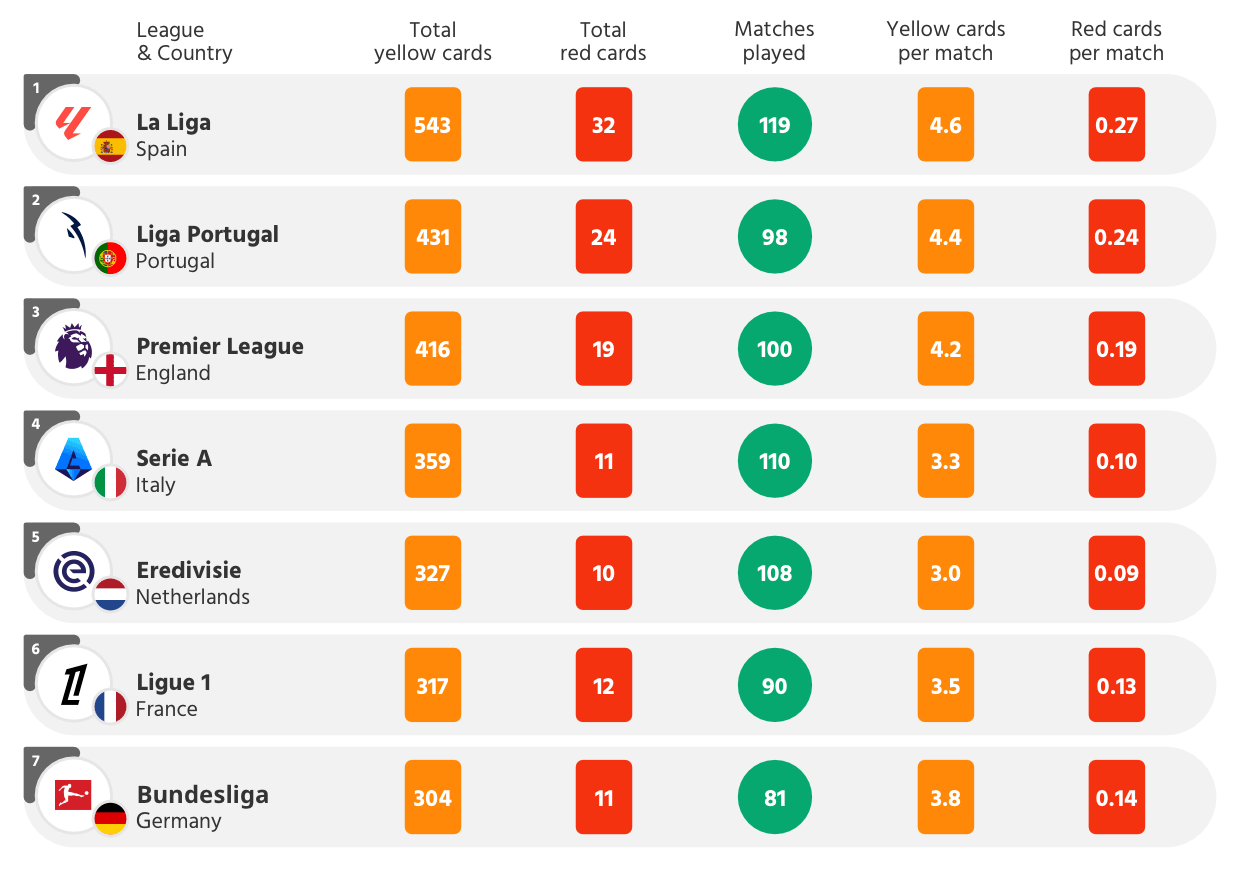
The red-card picture reinforces La Liga’s position at the harsher end of the comparison. Getafe lead with five dismissals in 12 matches, Sevilla follow with four, while Real Sociedad and Deportivo A Coruña have also received three each. Rayo Vallecano and Athletic Bilbao are both on two. That concentration is reflected at league level. La Liga averages 4.6 yellow cards and 0.27 reds per match, both the highest figures among the seven competitions.
for Europe’s top 7 leagues in the 2026/27 season
Data Source: Fbref
Liga Portugal also sits close to the top for cards
Portugal ranks immediately behind Spain on both measures, averaging 4.4 yellow cards and 0.24 reds per match.
Santa Clara are the clearest individual example, with 3.09 yellows and 0.27 reds per game. Académico Viseu and Arouca are also among Europe’s most frequently cautioned teams, while Alverca have received three red cards in 11 matches.
Rio Ave have also seen three players dismissed, while Estoril, Famalicão, Casa Pia and Benfica each appear among the clubs with relatively high red-card rates. At the other end, Porto average just 1.27 yellow cards per match, giving Portugal one of the sharper internal contrasts between frequently cautioned teams and one of Europe’s cleaner high-profile sides.
Premier League clubs show very different disciplinary profiles
Hull City have the highest yellow-card rate in the Premier League at exactly three per match, followed by Newcastle at 2.80. Liverpool and Bournemouth both average 2.70, putting them among the more frequently cautioned teams across the seven leagues.
The red-card picture is different. Brentford and Sunderland have each received three dismissals in 10 matches, giving both a rate of 0.30 per game and placing them behind only Getafe and Sevilla. Crystal Palace also appear among the leading sides for reds, with two dismissals in 10 matches.
At the cleaner end, Coventry average just 1.10 yellow cards per match, while Manchester City sit at 1.30. That gives the Premier League examples at both extremes, from clubs collecting close to three cautions per game to others averaging little more than one.
Borussia Mönchengladbach stand out in Germany, but RB Leipzig and Bayern sit at the other extreme
Borussia Mönchengladbach average 3.11 yellow cards per match, the highest Bundesliga figure and the third-highest across all seven leagues. Their two red cards in nine matches also place them among the teams with the highest dismissal rates.
Union Berlin also feature prominently for cautions at 2.67 per match, while Hoffenheim join Mönchengladbach among the Bundesliga clubs with two red cards.
The same league also produces two of Europe’s least frequently booked teams. RB Leipzig average only 0.89 yellow cards per match, while Bayern Munich sit at exactly one. Few leagues show such a sharp contrast between their disciplinary extremes.
Serie A combines low league-wide card rates with several of Europe’s cleanest teams
Fiorentina and Genoa have Serie A’s highest yellow-card rates at 2.18 per match, with Bologna and Venezia close behind at 2.09. Even those figures remain well below the leading rates seen in La Liga, the Premier League and Liga Portugal.
At the other end, Atalanta and Torino average exactly one yellow card per game, while Como sit at 1.09 and Napoli at 1.18. That places four Italian clubs among the teams with the lowest caution rates in Europe.
Serie A averages 3.3 yellow cards per match and just 0.10 reds, giving it the second-lowest red-card rate among the seven competitions. Atalanta provide an unusual contrast because they also appear among the clubs with the highest red-card averages after receiving two dismissals in 11 matches, illustrating why yellow and red cards do not always tell the same disciplinary story.
Nice lead Ligue 1 for bookings, while PSG sit at the opposite end
Nice have Ligue 1’s highest yellow-card rate at 2.40 per match, while Le Mans, Paris FC and Toulouse all follow at 2.20. The gap to the league’s cleaner teams is substantial, with PSG averaging exactly one caution per match and Lyon and Lorient both at 1.30.
Ligue 1 averages 3.5 yellow cards and 0.13 reds per match, placing it towards the lower end of the seven competitions in both categories.
Several French clubs have nevertheless experienced multiple dismissals. Auxerre, Lens and Le Havre have each received two red cards in 10 matches, meaning Ligue 1’s relatively low overall card rates have not prevented individual teams from seeing red comparatively often.
The Eredivisie combines Europe’s lowest league card rates with the most disciplined team
Ajax have the highest yellow-card rate in the Eredivisie at 2.33 per match, followed by Utrecht at 2.08. Cambuur and PSV both average 1.83, meaning even the league’s most frequently cautioned teams sit well below the leading rates recorded elsewhere in Europe.
At the other end, Go Ahead Eagles post the lowest individual yellow-card rate of any club across the seven leagues at 0.83 per match. Heerenveen sit at 1.08, Twente at 1.17 and Feyenoord at 1.25, giving the Netherlands several representatives among Europe’s least frequently cautioned teams.
That wider pattern is reflected at league level. The Eredivisie averages just 3.0 yellow cards per match, the lowest figure among the seven leagues, and its red-card rate of 0.09 is also the lowest.
The difference with Spain is substantial. La Liga produces 1.6 more yellow cards per match on average, while red cards occur three times as often as they do in the Eredivisie.
The disciplinary picture across Europe is therefore far from uniform. Getafe sit at one extreme, leading both team rankings and embodying La Liga’s position as the competition with the highest overall card rates. Go Ahead Eagles sit at the other end for cautions, while RB Leipzig, Bayern Munich, PSG, Atalanta and Torino also keep their yellow-card averages around one per match.
The contrast also shows why yellow and red cards need to be considered separately. Liverpool and Bournemouth collect cautions frequently without appearing among the red-card leaders, while Brentford and Sunderland show the opposite pattern. Atalanta provide perhaps the clearest example from the low-card side: one of Europe’s lowest yellow-card rates, but two dismissals in 11 matches.