 | Updated:
Player wage spending across Europe’s biggest leagues has never been higher, and the way those salaries are distributed within each competition shapes the balance of power as much as the total amounts. From England to the Netherlands, the gap between clubs at the top and bottom of each championship has turned wage tables into a map of who can realistically compete for trophies and who is fighting simply to keep up.
The latest Sportingpedia report uses data from Capology to examine first team base wages in the Premier League, La Liga, Serie A, the Bundesliga, Ligue 1, Liga Portugal and the Eredivisie for the 2025/26 season. We compare total wage bills by league, measure how much of each total is controlled by individual clubs, and track the ratios between the highest and lowest spenders in every competition to show where wage spending is most concentrated and where it is more evenly spread.
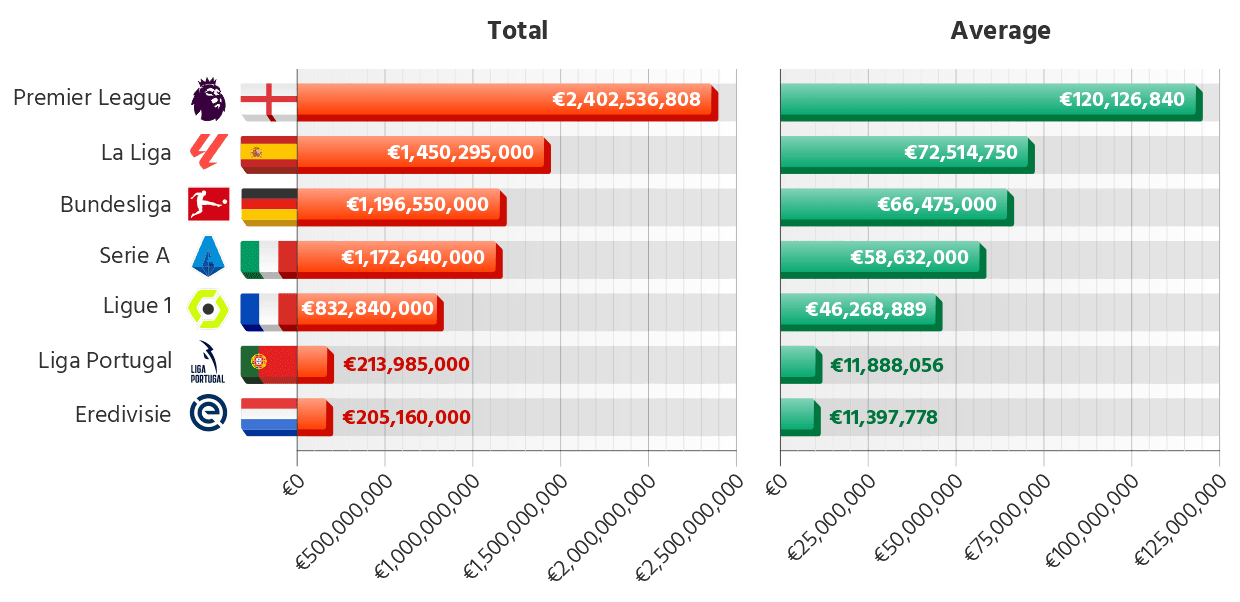
The headline finding is that the Premier League sits alone at the top with just over €2.40 billion euros in salaries. That is about 66% more than La Liga’s €1.45 billion and more than twice the totals in the Bundesliga and Serie A, while England also has the flattest internal profile, with a little over four to one between its richest and poorest clubs. At the opposite end, other leagues have far steeper internal divides, with wage gaps stretching beyond ten to one and, in the Eredivisie, past fifteen to one between their biggest and smallest payers.
Total and Average Club Wages
in Europe’s Top 7 Leagues for 2025/26 Season
Data Source: Capology.com
Premier League 2025/26: First Team Base Wages
Data Source: Capology.com
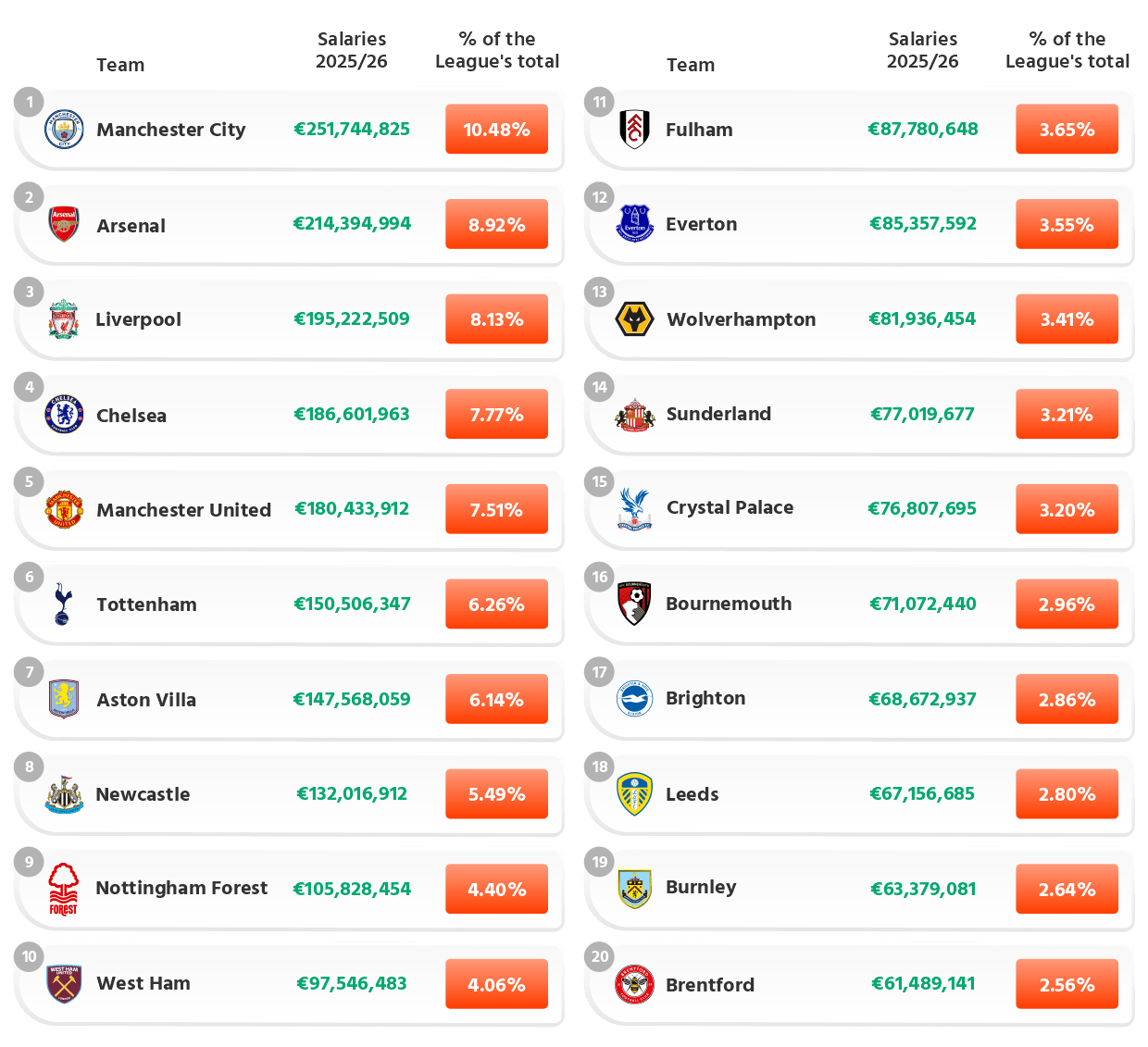
No league in world football spends more on player wages than the Premier League, but within England’s top flight the gulf between the top and bottom remains stark. Manchester City lead the way, committing €251.74 million in salaries for 2025/26 – 10.48% of the entire league’s €2,402,536,808 wage bill. Arsenal, Liverpool, Chelsea, Manchester United and Tottenham round out the traditional “big six”, each dedicating around or well over €150 million to player wages, and together accounting for just under half (about 49%) of the division’s total payroll. Aston Villa and Newcastle are the only other sides exceeding the €130 million mark, a threshold the majority of Premier League clubs cannot reach.
In stark contrast, Brentford spend €61.49 million – barely a quarter of City’s outlay and just 2.56% of the league-wide total. Burnley, Leeds and Brighton all sit between 2.64% and 2.86%, while Bournemouth’s €71.07 million gives them 2.96%. Sunderland and Crystal Palace each hover just above 3.2% of the wage bill, with Wolverhampton, Everton and Fulham clustered between 3.4% and 3.7%. Nottingham Forest’s €105.83 million, equal to 4.40% of the total, marks the last club above €100 million. The seven lowest-paying clubs combined still fall short of matching City’s wage bill. Despite this imbalance, the ratio between the top and bottom payers in England remains far lower than in Spain, Germany or the Netherlands, where the leading clubs typically control more than one fifth of all salaries.
La Liga 2025/26: First Team Base Wages
Data Source: Capology.com
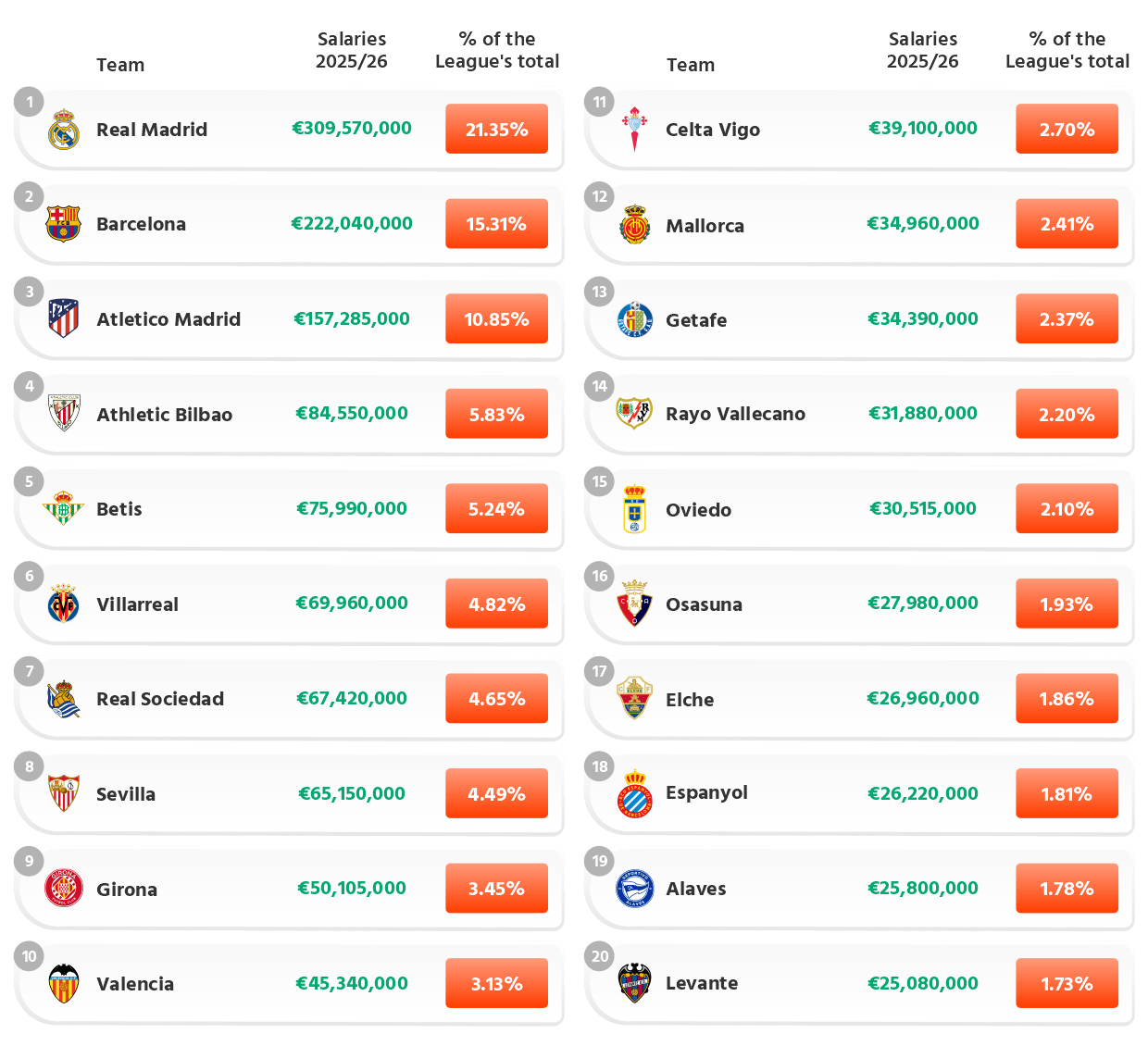
Real Madrid are the undisputed paymasters of Spanish and European football, committing €309.57 million to first team base salaries for 2025/26 – more than 21% of the entire league’s €1,450,295,000 wage bill and over €87 million clear of their historic rivals Barcelona, whose €222.04 million payroll still places them comfortably in second on 15.31% of the total. Atletico Madrid rank third at €157.29 million (10.85%), a figure that stands apart from the rest of the league but is roughly half of Real Madrid’s outlay. Together, Spain’s big three clubs account for 47.5% of all La Liga salaries.
Beyond the established giants, only Athletic Bilbao (€84.55 million) and Betis (€75.99 million) exceed the €70 million mark, holding 5.83% and 5.24% of league wages respectively. Clubs such as Villarreal, Real Sociedad and Sevilla operate in the €65–70 million range, each controlling between 4.49% and 4.82% of the total and forming a clear second tier. The drop-off from there is steep: Girona, Valencia and Celta Vigo all spend less than €51 million on wages and sit between 2.70% and 3.45% of league salaries, while Mallorca, Getafe and Rayo Vallecano each fall below 2.5%. At the very bottom, Oviedo, Osasuna, Elche, Espanyol, Alaves and Levante each allocate less than €31 million to first-team salaries, with shares ranging from 1.73% to 2.10% – barely a tenth of what Los Blancos pay. The combined wage bills of the eight lowest-spending clubs do not match Real Madrid’s single payroll, underlining how dominant the giants of Spanish football remain both in absolute terms and as a share of the total wages paid in La Liga.
Serie A 2025/26: First Team Base Wages
Data Source: Capology.com
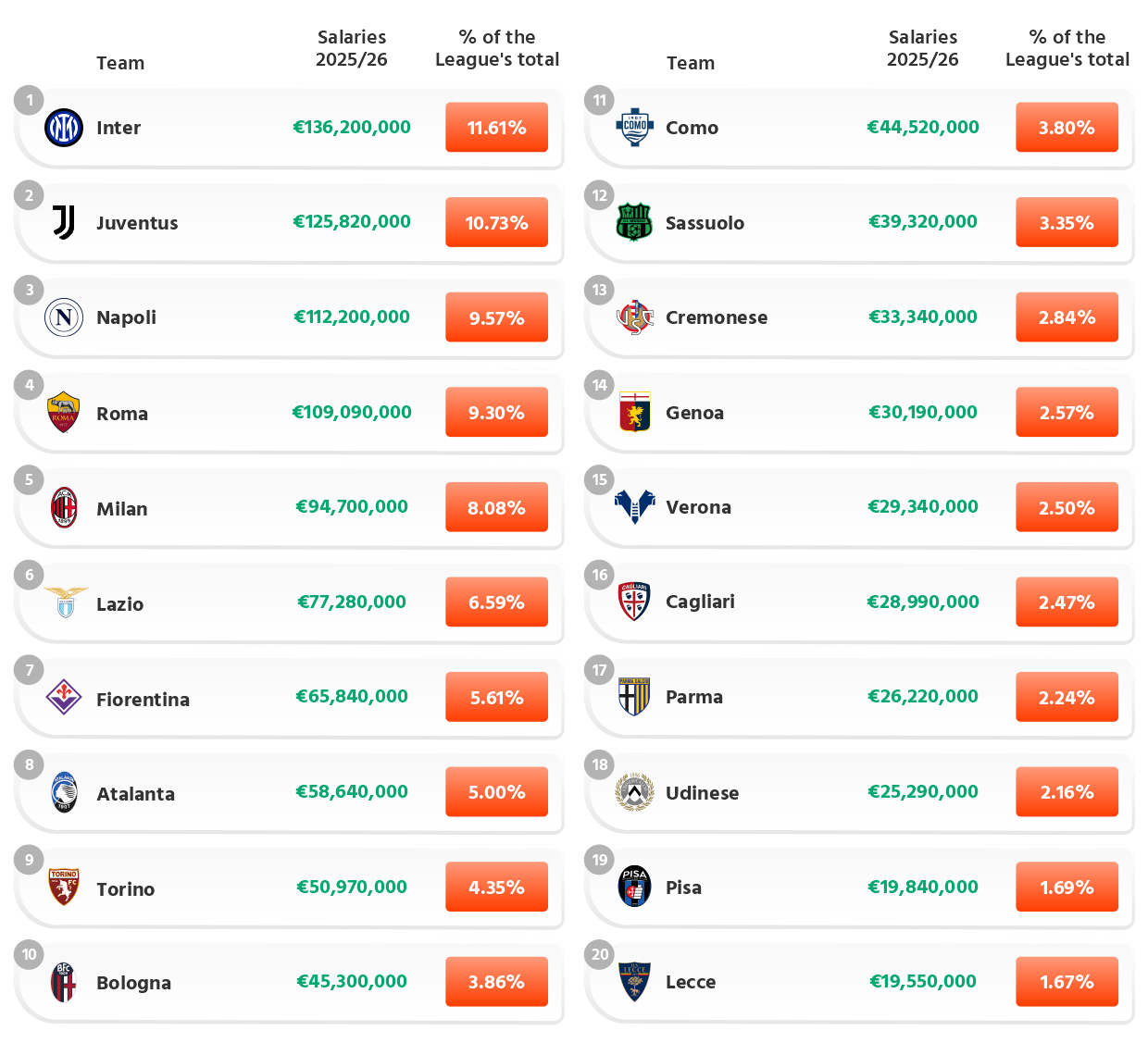
Inter top Serie A’s wage table for 2025/26, committing €136.2 million to salaries – more than any other club in Italy and accounting for 11.61% of the entire league’s €1,172,640,000 payroll. Their nearest rivals, Juventus and Napoli, follow with €125.82 million (10.73%) and €112.2 million (9.57%) respectively, with Roma not far behind on €109.09 million (9.30%). Collectively, the five biggest spenders (Inter, Juventus, Napoli, Roma, Milan) are responsible for €578.01 million – just under half (around 49.3%) of all salaries paid out in Serie A. Milan’s €94.7 million gives them 8.08% of the league total and completes a tightly packed top five.
At the other end of the scale, Lecce and Pisa are the league’s lowest spenders, allocating €19.55 million and €19.84 million respectively, with Udinese and Parma just above the €25 million mark. Their shares range from 1.67% to 2.24% of the total, highlighting how thinly resources are spread at the bottom. Genoa, Verona and Cagliari also sit in the lower band, with wage bills between €28.99 million and €30.19 million and shares of 2.47% to 2.57%. The gap between Inter and the lowest spender, Lecce, stands at €116.65 million – a financial gulf of nearly seven to one that mirrors the on-field disparity in resources. Inter’s wage bill alone is more than the combined salaries of the six lowest-spending clubs in Serie A, underlining the sharp divide between Italy’s elite and its strugglers and putting Serie A closer to Spain and Germany than to the relatively flatter profile seen in England.
Bundesliga 2025/26: First Team Base Wages
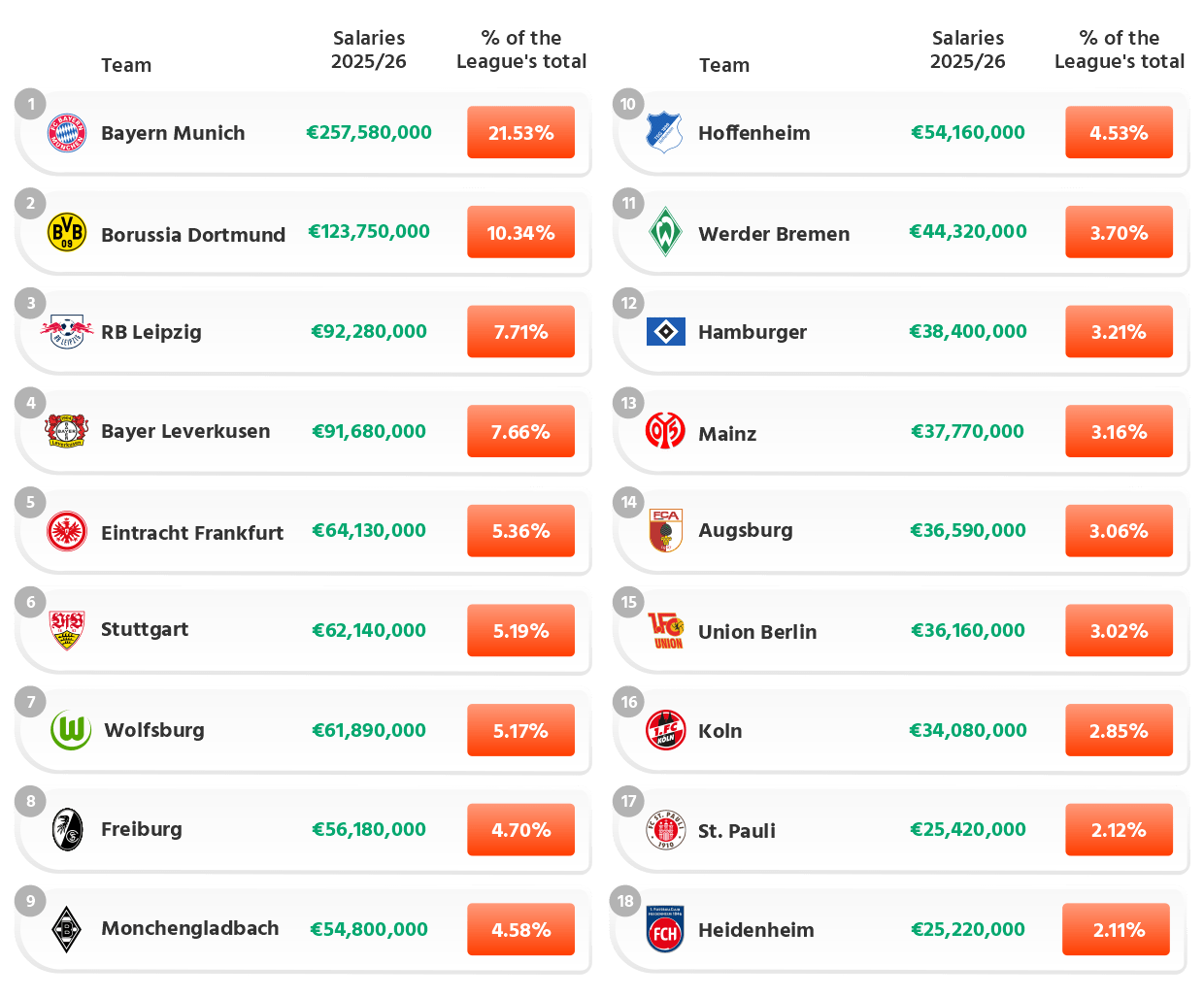
Data Source: Capology.com
Bayern Munich are the Bundesliga’s highest wage payers by a considerable margin, with a salary bill of €257.58 million – 21.53% of the league’s €1,196,550,000 total. Their outlay is more than double that of Borussia Dortmund, who are next on the list with €123.75 million (10.34%), and comfortably ahead of RB Leipzig (€92.28 million, 7.71%) and Bayer Leverkusen (€91.68 million, 7.66%). Eintracht Frankfurt’s €64.13 million gives them 5.36% of the total. The combined salaries of the top five spenders (Bayern, Dortmund, Leipzig, Leverkusen, Frankfurt) amount to €629.42 million, covering more than half (around 52.6%) of all wages paid in the division.
At the other end of the spectrum, St Pauli and Heidenheim have the lowest salary commitments in the Bundesliga, each spending just over €25 million. Heidenheim’s €25.22 million accounts for 2.11% of the league total, while St Pauli’s €25.42 million makes up 2.12%. Clubs such as Koln, Union Berlin, Augsburg, Mainz, Hamburger and Werder Bremen operate between €34.08 million and €44.32 million, with shares in the 2.85% to 3.70% range. The difference between Bayern Munich and the lowest spender, Heidenheim, is an extraordinary €232.36 million, and Bayern’s wage bill is more than ten times larger. It is also greater than the combined total of the eight lowest-spending clubs in the league. This extreme concentration of salary spending at the very top helps to explain Bayern’s long-term dominance in German football and places the Bundesliga alongside La Liga among Europe’s most top-heavy leagues in percentage terms.
Ligue 1 2025/26: First Team Base Wages
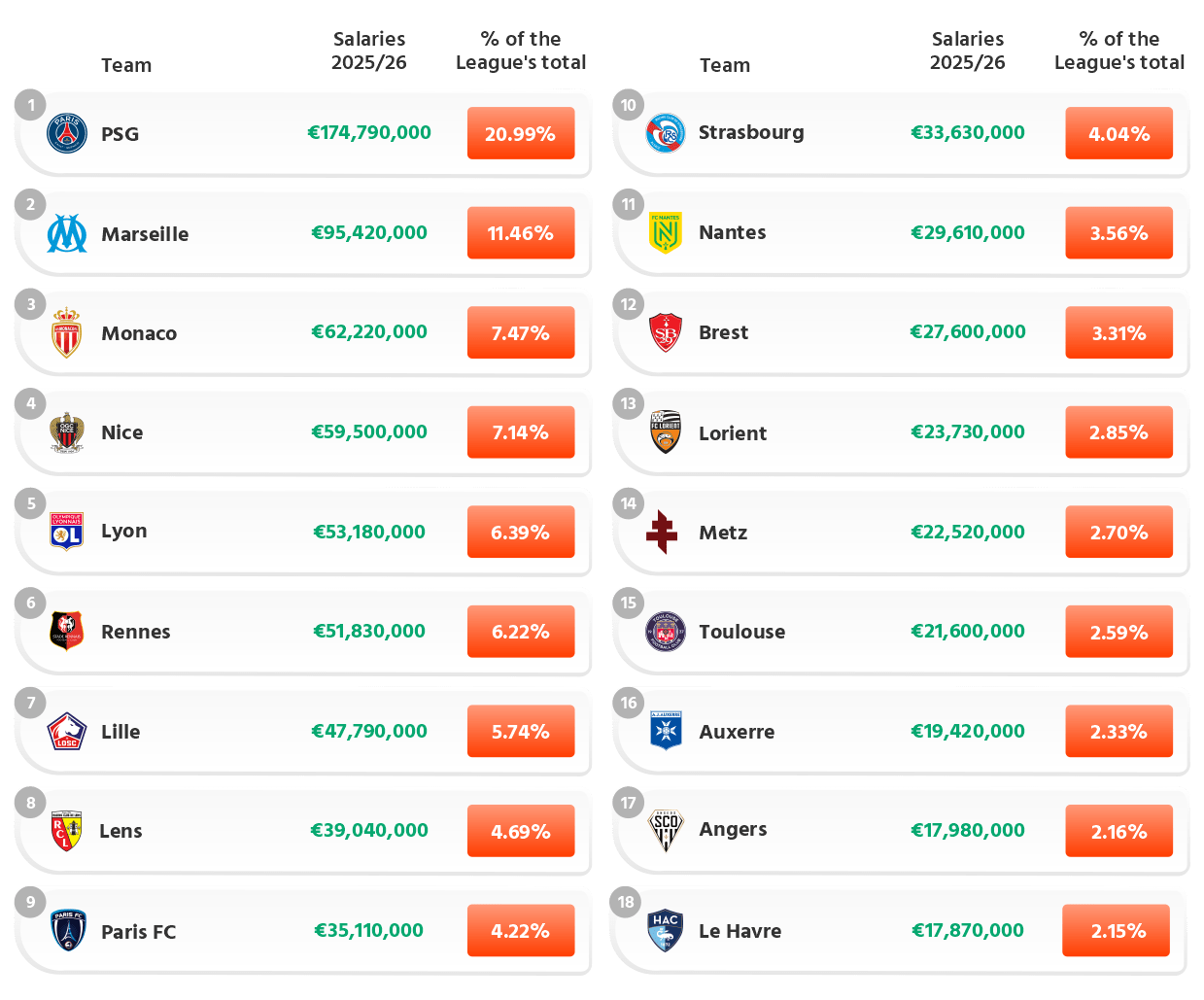
Data Source: Capology.com
Paris Saint-Germain are the dominant financial force in Ligue 1, with a wage bill of €174.79 million for the 2025/26 season – an amount that represents 20.99% of the entire league total of €832,840,000. The gulf between PSG and their nearest competitors is striking: Marseille, the second-highest spenders, pay €95.42 million (11.46% of the total), just over half of PSG’s outlay, while Monaco follow in third at €62.22 million (7.47%). The three biggest spenders together account for almost 40% of all salaries paid in Ligue 1, reflecting an extraordinary concentration of resources at the very top.
At the opposite end of the table, Le Havre and Angers are among the league’s lowest spenders, with annual wage bills of €17.87 million and €17.98 million, each worth a little over 2.1% of the league total. Auxerre, on €19.42 million, holds 2.33%. Lorient, Metz and Toulouse sit slightly higher, between €21.6 million and €23.73 million, but still remain below 2.9% of the total each. This means that PSG commit almost 10 times more to player wages than the smallest clubs, with the gap between the top and bottom standing at around €156.9 million. The wage bill of PSG alone is higher than the combined salaries of several of the league’s lowest-paying sides. Such disparities highlight how Ligue 1 remains one of Europe’s most polarised top flights, with financial power heavily concentrated in Paris and only a handful of clubs capable of approaching that level of investment.
Liga Portugal 2025/26: First Team Base Wages
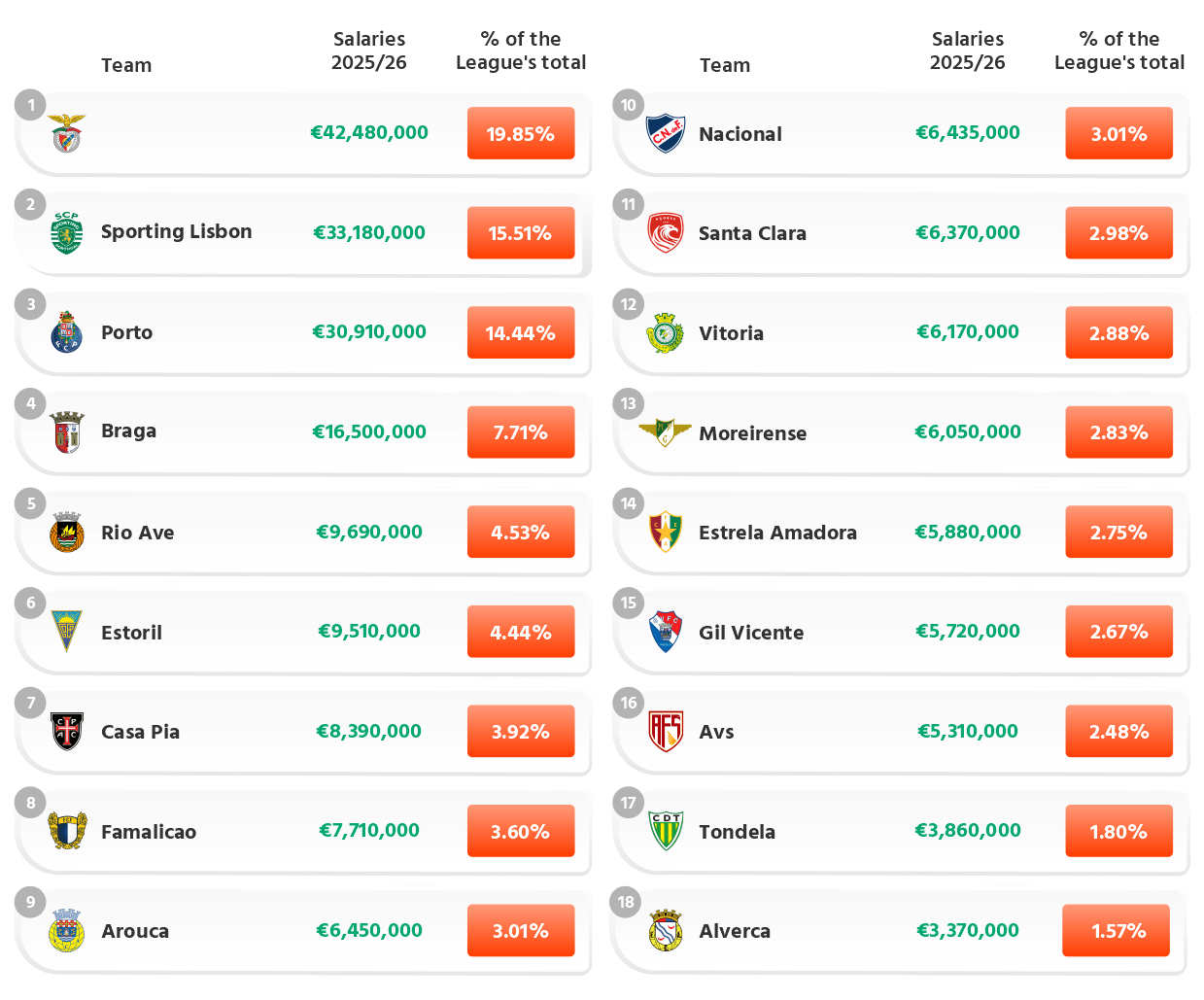
Data Source: Capology.com
Benfica top the wage rankings in Liga Portugal, committing €42.48 million to player salaries in 2025/26 – an amount that accounts for 19.85% of the entire league’s €213,985,000 outlay. Their nearest rivals, Sporting Lisbon and Porto, follow with wage bills of €33.18 million (15.51%) and €30.91 million (14.44%) respectively. Together, the three traditional giants are responsible for €106.57 million – almost half (49.8%) of all salary spending in the league. Braga, with €16.5 million in wages and a 7.71% share, are the only other side to surpass €10 million, underlining the steep drop-off after the top three.
Rio Ave and Estoril, at €9.69 million and €9.51 million, each carry just over 4.4% of league salaries, while Casa Pia and Famalicao, with €8.39 million and €7.71 million, sit between 3.60% and 3.92%. Arouca, Nacional, Santa Clara, Vitoria, Moreirense, Estrela Amadora, Gil Vicente and Avs all spend between €5.31 million and €6.45 million and hold shares from 2.48% to 3.01%. At the very bottom of the Portuguese top flight, Tondela and Alverca post wage bills of €3.86 million and €3.37 million, responsible for 1.80% and 1.57% of league salaries. Benfica’s spending is more than twelve times higher than Alverca’s and the gap between the highest and lowest payers reaches €39.11 million. In percentage terms, the difference between top and bottom payers in Portugal is wider than in Serie A or Ligue 1 and close to the ratios seen in La Liga and the Bundesliga. The data highlights just how pronounced the financial divide is in Portugal’s top flight, with the top three clubs maintaining a huge advantage over the rest of the competition despite operating at a much lower absolute level than their counterparts in England, Spain or Germany.
Eredivisie 2025/26: First Team Base Wages
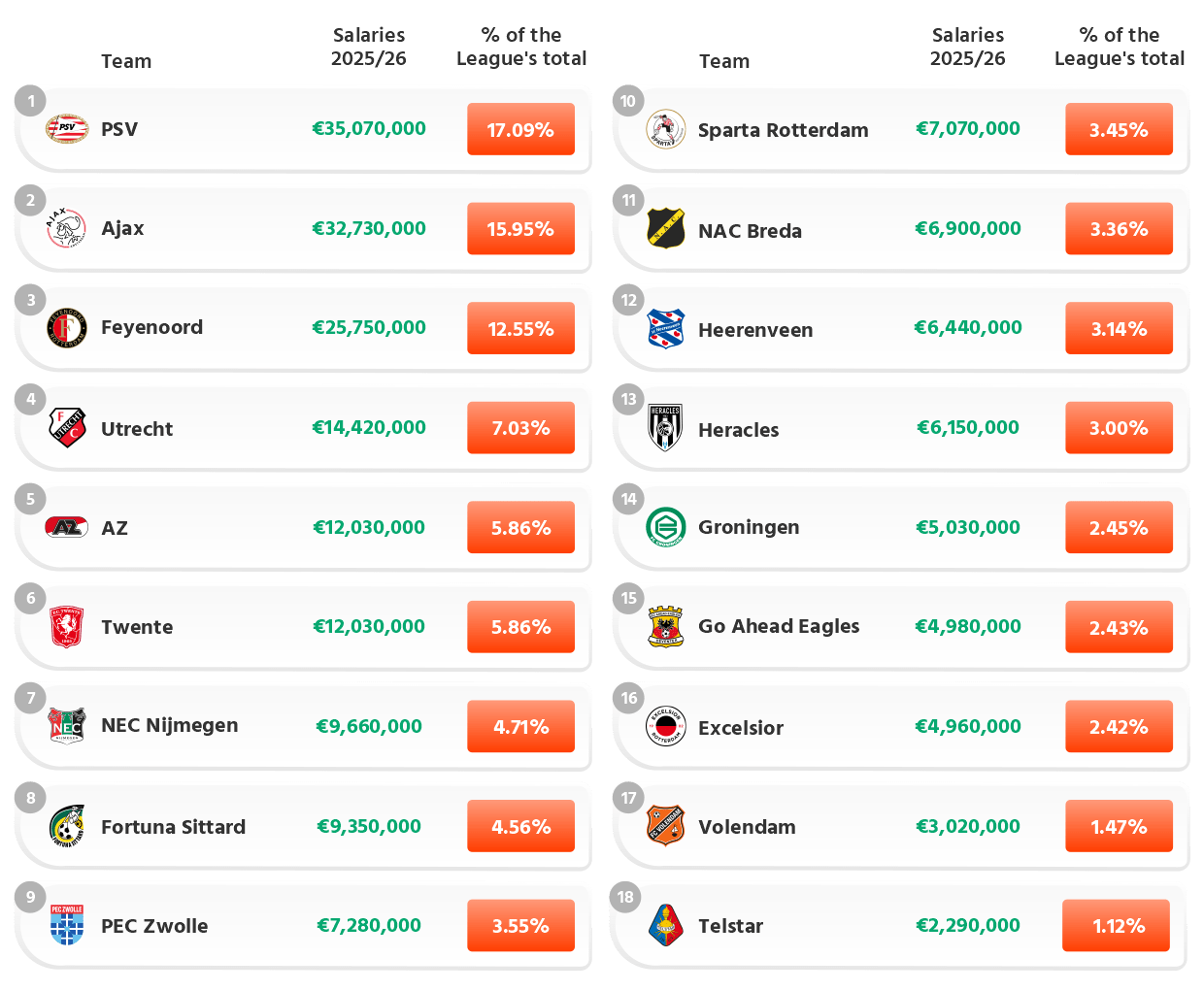
Data Source: Capology.com
PSV lead the Eredivisie in player salary spending, allocating €35.07 million in 2025/26 – a figure that amounts to 17.09% of the league’s total wage bill of €205,160,000. Ajax are close behind, with €32.73 million (15.95%), followed by Feyenoord on €25.75 million (12.55%). Collectively, these three clubs are responsible for €93.55 million in wages and 45.6% of all salaries paid in the Dutch top flight, underlining their financial dominance and the dependence of the league on a small group of traditional giants.
Beyond the big three, Utrecht (€14.42 million, 7.03%), AZ and Twente (each €12.03 million, 5.86%) are the only other clubs spending over €10 million on wages. NEC Nijmegen and Fortuna Sittard, on €9.66 million and €9.35 million, each account for around 4.6–4.7% of the total, while PEC Zwolle, Sparta Rotterdam and NAC Breda sit between €6.9 million and €7.28 million, with shares from 3.36% to 3.55%. Heerenveen, Heracles and Groningen operate in the €5.03–6.44 million range, corresponding to roughly 2.45% to 3.14% of league salaries, while Go Ahead Eagles and Excelsior each spend just under €5 million and carry around 2.42–2.43%.
At the bottom of the scale, Volendam pay €3.02 million (1.47% of the total) and Telstar just €2.29 million (1.12%). PSV’s outlay is more than fifteen times higher than Telstar’s, creating a gap of €32.78 million between the league’s highest and lowest spenders. The numbers reinforce the clear financial hierarchy in Dutch football, where the traditional giants and a handful of challengers are well ahead of the rest, and where the internal wage gap – measured in relative terms – is now the widest of any of Europe’s top seven leagues.