 | Updated:
Episodes like Real Madrid’s latest La Liga match with Celta, when two players were sent off after picking up quick fire second yellows, raised a simple question for us. In which leagues do fouls trigger yellow cards fastest, and where do referees allow more contact before reaching for their pocket.
Sportingpedia’s latest analysis looks at fouls and yellow cards in the Premier League, La Liga, Serie A, the Bundesliga and Ligue 1. Using aggregated league data, it compares how often fouls are committed, how many bookings are shown per match, and how many fouls on average it takes to produce a yellow card in each competition. The figures cannot show whether a card was for a late tackle or for dissent, but they do reveal where refereeing feels stricter or more permissive overall.
One of the report’s most curious revelations is that Serie A is the foul-heaviest league, with almost 30 fouls per match, yet its referees are the slowest to book, needing 6.8 fouls on average before a yellow, while the Bundesliga is the strictest with a card every 5.4 fouls. At team level the contrast is even sharper: Inter and Newcastle get almost ten fouls per booking (9.85 and 9.53), whereas Werder Bremen and Bayer Leverkusen see yellow after just 3.41 and 3.50 fouls. Sevilla emerge as Europe’s biggest card magnets with 3.33 yellows per game, while PSG and Newcastle sit at the opposite end of the scale, averaging close to just one booking per match despite committing more than ten fouls per game.
Methodology: We used league wide data for fouls committed, number of matches and yellow cards awarded in the five major European leagues. From this we calculated fouls per match, yellow cards per match and fouls per yellow card for each competition. The analysis focuses only on first cautions and does not separate tactical fouls from language or other offences.
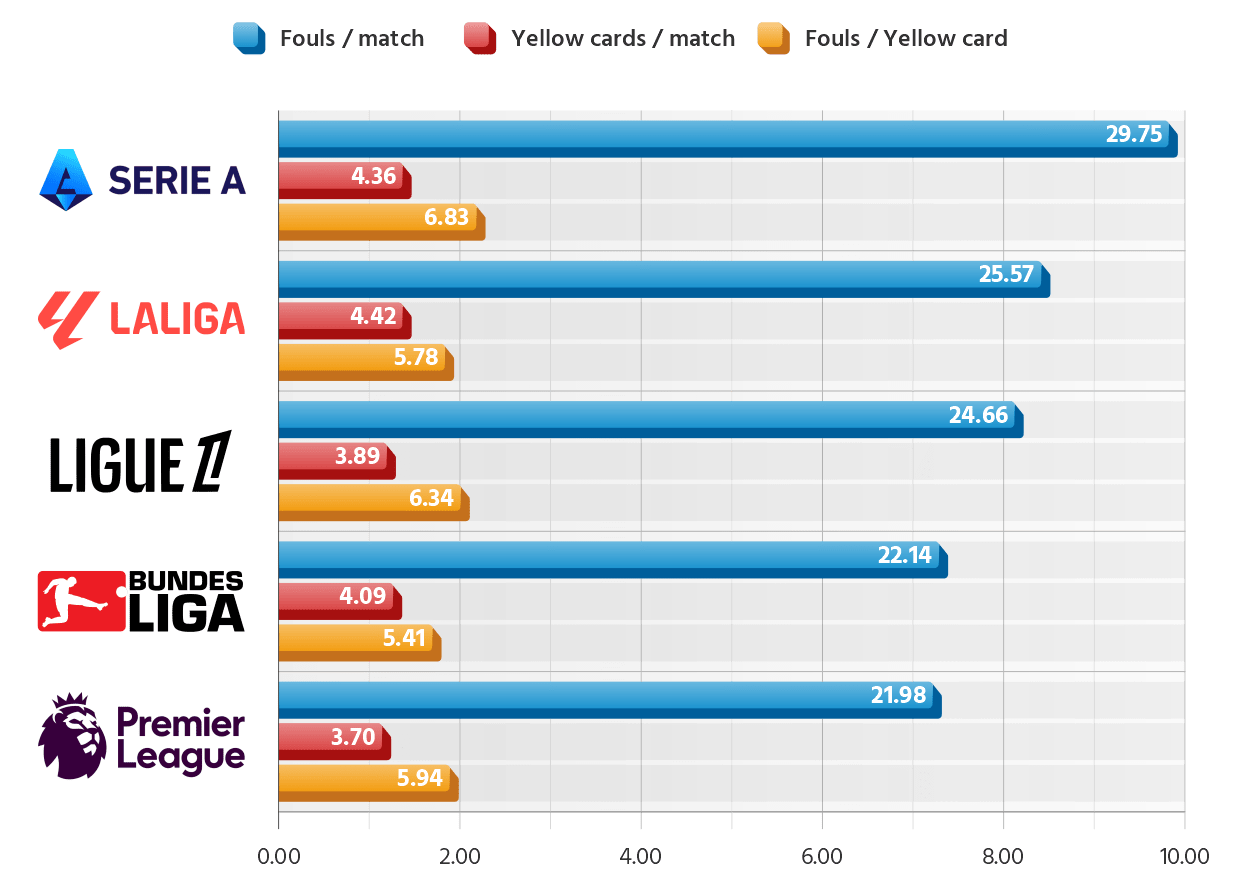
Number of fouls and yellow cards per match, along with how many fouls lead to a yellow card in Europe’s top 5 leagues
Data Source: statmuse.com
Serie A the most foul heavy, but not the fastest to book
Serie A sat top of the table for sheer physical contact. Across 126 matches there were 3749 fouls, an average of 29.75 per game, the highest of any league in the sample. Yet Italian referees did not turn that contact into cards at the fastest rate. They showed 549 yellow cards in total, 4.36 per match, and needed on average 6.83 fouls to produce each booking.
That combination suggests a competition where the threshold for a card is relatively high. Serie A matches involved plenty of fouls, but referees generally let more go before escalating to a caution. For players, that means living with more bumps and niggles, but once a yellow does arrive, it is likely to have been preceded by a series of infringements rather than a single isolated incident.
La Liga more fouls than most and the highest yellow rate
La Liga produced even more fouls in total, 3835 across 150 matches, but because it staged more games its average of 25.57 fouls per match sat below Serie A. The key difference came in how quickly those fouls turned into cards. Spanish referees showed 663 yellow cards, 4.42 per match, the highest rate in the comparison. On average they needed just 5.78 fouls to reach for their pocket.
This aligns neatly with headline grabbing matches in Spain where tensions escalate quickly and cards arrive in clusters. La Liga sits in the middle of the pack for pure foul volume but near the top for bookings per game and among the lowest for fouls per yellow card, marking it out as one of the strictest environments once contact starts to add up.
Ligue 1 moderate fouls, moderate cards
Ligue 1 placed in the middle of the spectrum on most measures. The French top flight saw 3329 fouls in 135 matches, 24.66 per game, and 525 yellow cards, 3.89 per match. On average there were 6.34 fouls for each yellow card, which put Ligue 1 between the more lenient Serie A and the stricter La Liga and Bundesliga.
In practice that means French matches featured fewer fouls than Italy and Spain but more than England and Germany, with referees showing cards at a steady but not especially aggressive rate. Players could expect a little more tolerance than in La Liga or the Bundesliga, but not the same level of leeway as in Serie A.
Bundesliga fewer fouls but the strictest refereeing
The Bundesliga stood out for combining relatively low foul counts with a high appetite for cards. German teams committed 2590 fouls in 117 matches, only 22.14 per game, yet referees still produced 479 yellow cards, 4.09 per match. That worked out at just 5.41 fouls per yellow card, the lowest ratio in the sample.
Even though there was less stoppage for fouls than in Italy or Spain, the price for crossing the line was steeper. In the Bundesliga, a smaller number of offences was enough to trigger a booking, which fits the league’s reputation for referees who manage games proactively and do not hesitate to clamp down once the temperature begins to rise.
Premier League less whistle, similar booking risk
The Premier League sat at the bottom of the ranking for fouls per game. Across 150 matches there were 3297 fouls, an average of 21.98 per match. English referees showed 555 yellow cards, 3.7 per match, the lowest booking rate in absolute terms. Measured per foul, however, the picture was closer to that of Ligue 1 than to Serie A.
On average Premier League referees needed 5.94 fouls to produce a yellow card. That ratio was stricter than Serie A and only slightly more lenient than La Liga and the Bundesliga. In other words, there were fewer fouls overall, but once a match became stop start, the chances of a caution arriving after a short sequence of infringements were not dramatically different from Spain or Germany. For players and coaches, it means that while the game might flow more, a cluster of late challenges or tactical fouls can still push a referee to act relatively quickly.
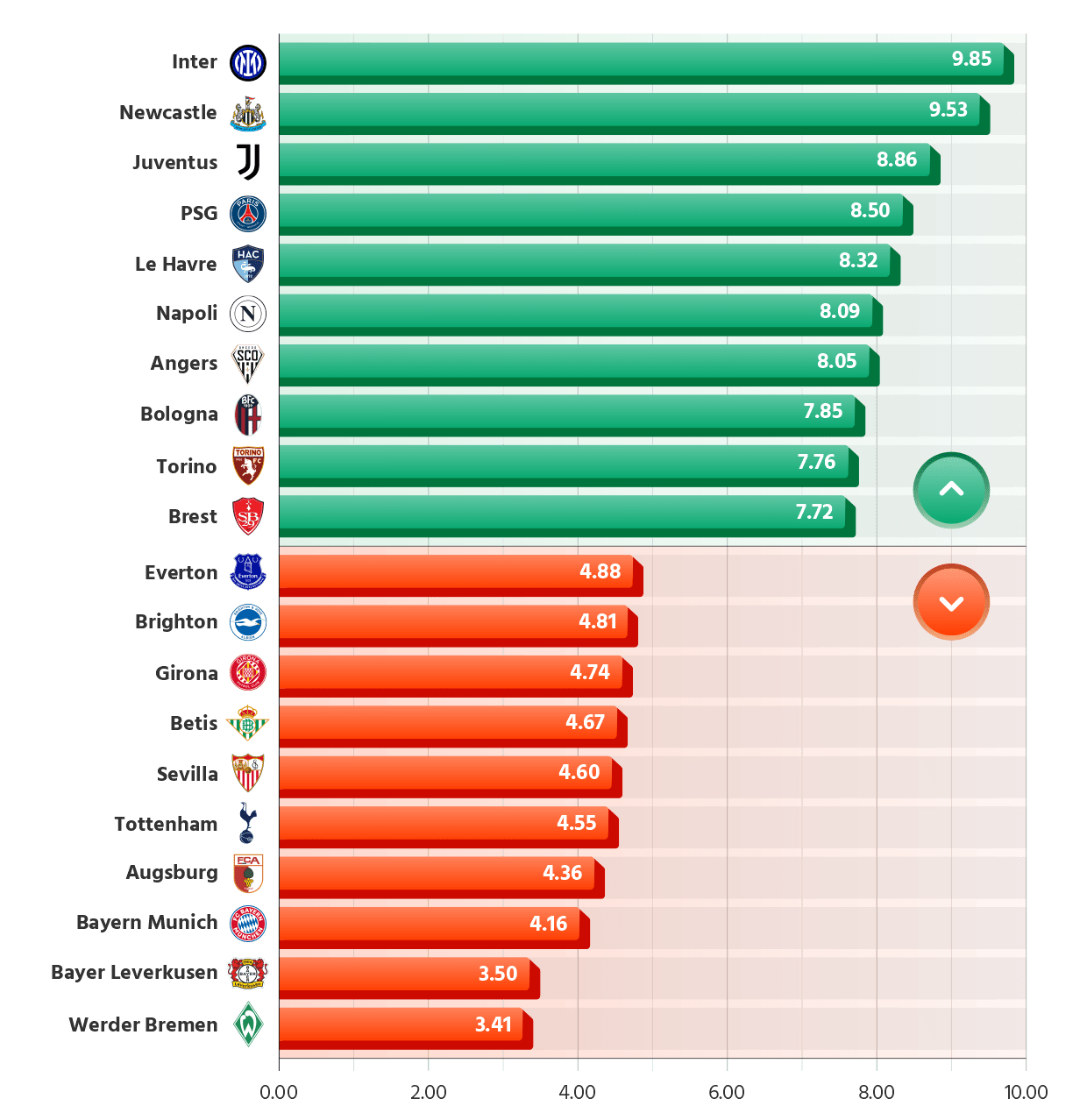
Teams in Europe’s top 5 leagues committing the highest and the lowest number of fouls before receiving yellow card
Data Source: statmuse.com
At team level, the data highlights a small group of sides who manage to rack up far more fouls than average before the referee finally reaches for a yellow card. Inter sit at the top of this list. They commit 197 fouls in 14 matches, but receive only 20 yellow cards – an average of 9.85 fouls per booking. Newcastle are close behind with 9.53 fouls per yellow (162 fouls, 17 cards), making them the Premier League team that pushes the limit most successfully before a caution arrives.
Serie A and Ligue 1 dominate this ranking. Alongside Inter, Juventus (8.86 fouls per yellow), Napoli (8.09), Bologna (7.85) and Torino (7.76) all appear, underlining how Italian teams as a group manage to test referees repeatedly before being booked. From France, PSG (8.50), Le Havre (8.32), Angers (8.05) and Brest (7.72) all feature, suggesting that in Ligue 1 both title contenders and relegation candidates can string together a relatively high number of fouls before the card threshold is reached.
Le Havre and Bologna stand out in particular because they combine high overall foul volume with generous foul-to-card ratios. Le Havre have already committed 208 fouls in 15 matches (13.9 per game) and Bologna 212 in 14 (15.1 per game), yet both still need more than 7.8 fouls on average to draw a yellow. For opponents, that translates into matches where contact is frequent and the first few fouls often go unpunished, while for these teams it shows how effectively they operate on the edge without constantly leaving players on a booking.
At the other end of the scale sit the teams who barely have any margin for error before the card comes out. Werder Bremen are the most extreme case: they give away just 126 fouls in 13 matches, but those challenges already bring 37 yellow cards. That works out at only 3.41 fouls per booking, the lowest buffer in Europes top 5 leagues. Bayer Leverkusen are not far behind on 3.50 fouls per yellow, with 112 fouls and 32 bookings from 13 games. Bayern Munich and Augsburg complete a very card sensitive German group, both under 4.4 fouls per yellow despite not being especially dirty in raw foul counts.
Premier League and La Liga sides also feature heavily among the quick to be booked. Everton, Brighton and Tottenham all sit below 5 fouls per yellow, meaning that two or three minor offences per half can be enough to put key players on a caution. In Spain, Girona and Betis hover around the same range, while Sevilla combine one of the highest foul volumes in Europe, 230 in 15 matches, with one of the fastest card rates at just 4.60 fouls per yellow. For these clubs, the data points to matches where referees clamp down early and often, and where tactical fouls or repeated small infringements are punished much sooner than for the likes of Inter, Newcastle or PSG.
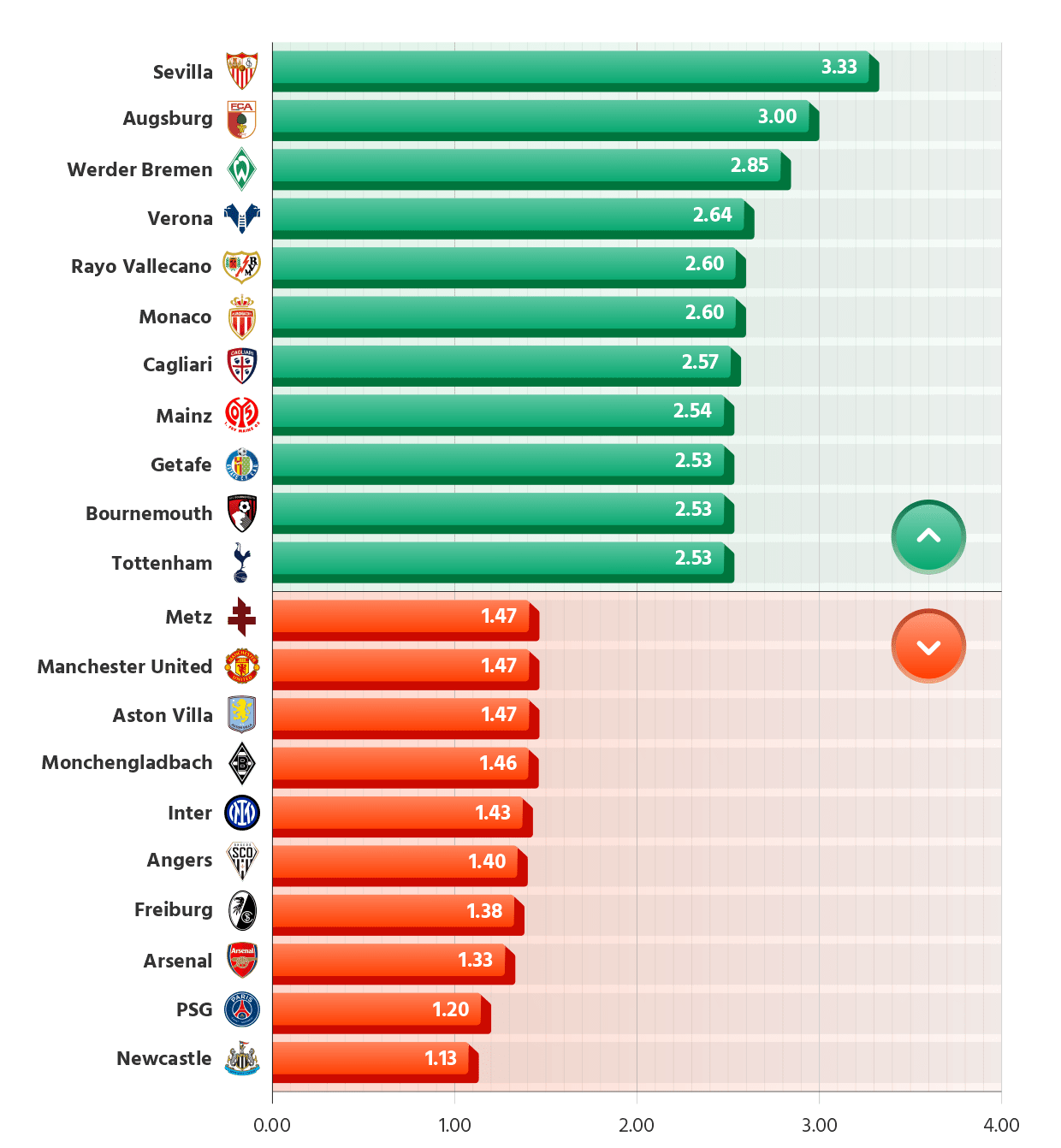
Teams in Europe’s top 5 leagues with the highest and the lowest number of yellow cards per match
Data Source: statmuse.com
Card magnets: teams living in the referee’s notebook
Another way to look at discipline is to focus purely on how often teams are booked, regardless of how many fouls they commit. On this measure, Sevilla sit top of Europe’s card table. They average 3.33 yellow cards per match (50 in 15 games), combining a high foul count of 15.3 per game with one of the fastest paths to a booking at just 4.60 fouls per yellow.
Augsburg and Werder Bremen follow as two of the most frequently cautioned sides on the continent, with 3.00 and 2.85 yellow cards per match. Both already appeared among the teams with the smallest foul-to-card buffers, underlining how little margin for error they enjoy once they start breaking up play. Mainz join them to give the Bundesliga three representatives in the top ten for bookings per game.
Sevilla are joined by Girona’s neighbours Rayo Vallecano and Getafe to form a distinctly La Liga-flavoured group. All three Spanish clubs combine aggressive pressing and frequent contact with referees who are quick to sanction repetition, ending up between 2.53 and 2.60 yellow cards per match. In Serie A, Verona and Cagliari stand out for coupling some of the highest foul rates in Europe, over 16 per game in Cagliari’s case, with more than 2.5 bookings per match.
Monaco and Bournemouth complete the list. Both average just over 13 fouls a game yet still receive 2.53 to 2.60 yellow cards per match, showing that even without extreme foul volumes it is possible to live in a constant state of disciplinary risk.
At the opposite end of the spectrum are the sides who manage to stay largely out of the referee’s notebook. Metz, Manchester United and Aston Villa all sit at 1.47 yellow cards per match, with Borussia Monchengladbach, Inter, Angers, Freiburg and Arsenal in the same band between 1.33 and 1.46. PSG (1.20) and Newcastle (1.13) are the most “card-light” of all, averaging little more than a single booking per game.
What stands out is that several of these teams combine low yellow-card averages with very generous foul-to-card ratios. Inter and Newcastle both need close to ten fouls on average before they are booked, while PSG, Angers and Arsenal all sit above seven fouls per yellow. In other words, they either foul in smarter areas, keep their reactions under control, or benefit from referees who are relatively reluctant to escalate to a caution.
By contrast, Freiburg and Gladbach show that it is also possible to avoid cards simply by not fouling very often in the first place: both commit fewer than 11 fouls per match and still stay around 1.4 bookings per game. Together, these ten clubs define the calmer end of Europe’s disciplinary table, where either style of play, game management or refereeing culture keeps the yellow count down.