 | Updated:
European club tournaments often appear to follow football’s financial hierarchy: the richest leagues tend to produce the strongest teams and the deepest European runs. But the 2025/26 season shows that the relationship between money and performance is far from perfect.
Sportingpedia analysed how teams from European leagues are performing in UEFA’s three club tournaments compared to their financial strength, using the season’s UEFA coefficient rankings and comparing them with total league market value.
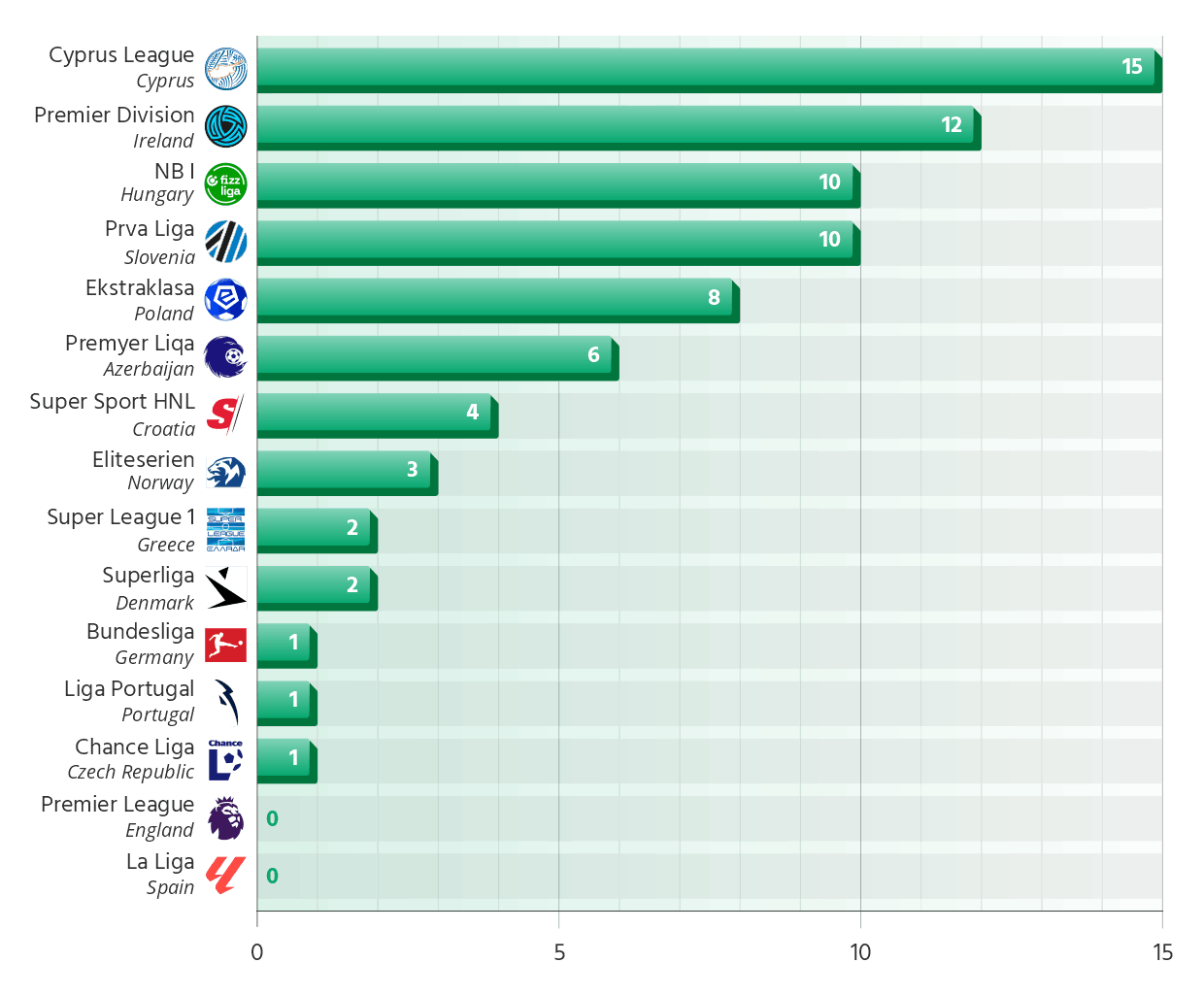
The biggest surprises come from Cyprus and Ireland. Their teams rank 10th and 27th in UEFA performance despite the leagues sitting only 25th and 39th by total market value, making them the most dramatic overachievers in the dataset.
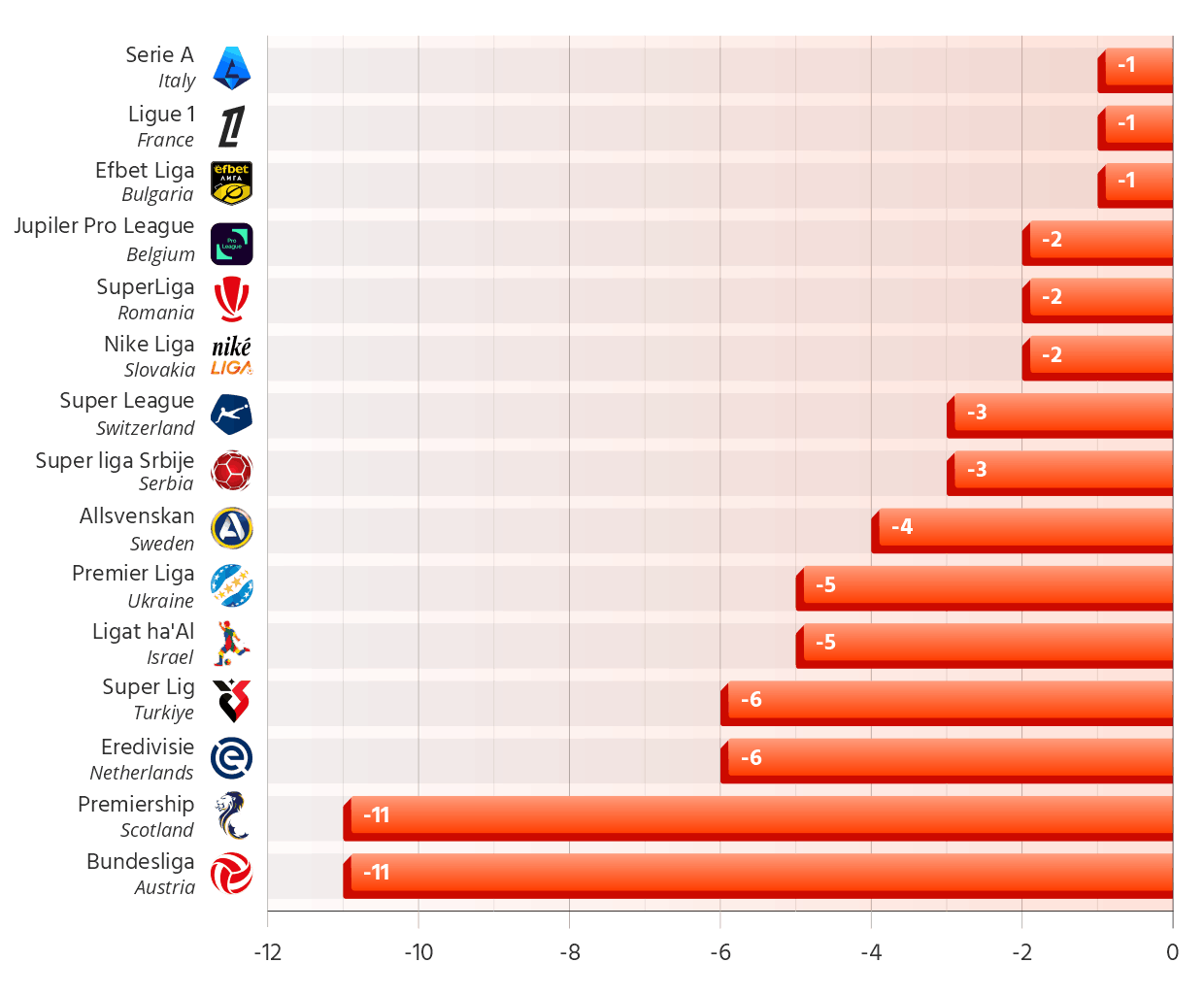
At the opposite end of the spectrum, teams from Scotland and Austria are the clearest underperformers, sitting far below their financial ranking in the UEFA coefficient standings. Meanwhile, Europe’s financial elite – England, Spain, Germany, Italy, France and Portugal – occupy the top six positions in the coefficient table, showing that the continent’s richest leagues largely perform exactly where their resources would predict.
Methodology: For this report, Sportingpedia analysed the 30 leagues with the highest UEFA coefficient points in the 2025/26 season, with the data reflecting results after the first legs of the round of 16 across the three European club tournaments. To assess whether teams from each league are overperforming or underperforming, their UEFA performance ranking was compared against the league’s total market value, using data sourced from Transfermarkt.
The Russian Premier Liga was excluded from the analysis, as Russian clubs are currently banned from participating in UEFA competitions.
in the 2025/26 European Club Tournaments
Data Source: Transfermarkt
Financial Power Still Defines the European Elite
At the very top of the European football pyramid, financial strength and sporting success remain closely aligned. The six leagues with the highest values also occupy the top six places in the UEFA coefficient ranking for the 2025/26 season.
Teams from England’s Premier League dominate both financially and competitively. With a total league market value of €12.58 billion and an average club value of €629 million, English clubs also lead the UEFA standings with 22.847 coefficient points, the highest seasonal total in Europe.
Teams from Spain’s La Liga follow in second place both financially and competitively. Spanish clubs have accumulated 18.406 coefficient points while maintaining the continent’s second-highest valuation at €5.48 billion.
Teams from Germany’s Bundesliga and Italy’s Serie A closely follow. Bundesliga clubs sit third in UEFA performance with 18.142 points, while Serie A teams rank fourth in performance with 17.928 points.
Teams from Portugal’s Liga Portugal complete the financial top six and even slightly exceed expectations. Portuguese clubs currently hold the fifth-highest UEFA coefficient total with 17.000 points, placing them ahead of France despite Ligue 1 (15.678 coefficient) possessing higher overall valuation.
Together, these six leagues illustrate the expected financial order of European football: the leagues with the strongest economic foundations generally produce the most competitive teams in UEFA tournaments.
Leagues Punching Above Their Financial Weight
Outside the financial elite, several leagues have produced teams that significantly outperform their economic resources in the 2025/26 European competitions.
The most striking example comes from Cyprus. Despite ranking only 25th by total market value, Cypriot teams occupy 10th place in the UEFA coefficient standings with 12.156 points. This represents the largest positive gap between financial ranking and sporting output in the dataset.
Despite being the least valuable league in the entire dataset and 39th in Europe, with an estimate of just €32.43 million, Irish teams rank twelve places above their financial standing in the UEFA coefficient table.
Teams from Poland’s Ekstraklasa also deliver exceptional value relative to their financial strength. Polish clubs currently sit 7th in the UEFA performance ranking with 15.25 coefficient points, despite ranking only 16th by total market value.
Teams from Hungary’s NB I demonstrate another remarkable overperformance. Hungarian clubs rank 16th in UEFA performance despite sitting only 27th by total market value, highlighting one of the largest positive gaps in the analysis.
Teams from Greece’s Super League also exceed expectations. Greek clubs rank 8th in the UEFA coefficient standings with 13.7 points, even though the league ranks only 11th by financial strength.
A similar pattern appears in Denmark, where Danish teams occupy 9th place in UEFA performance with 12.25 coefficient points, outperforming their financial ranking of 12th by value.
These leagues demonstrate that while financial resources remain a major driver of success in European competitions, efficient club management, tactical organisation and smart recruitment can allow smaller leagues to compete well beyond their economic scale.
in the 2025/26 European Club Tournaments
Data Source: Transfermarkt
Leagues Falling Short of Their Financial Strength
The analysis also reveals several leagues whose teams have struggled to translate financial resources into strong performances in the 2025/26 UEFA club tournaments.
The largest negative gaps appear in Scotland and Austria. Scotland’s Premiership ranks 14th in Europe by market value, yet sit only 25th in the UEFA coefficient standings, representing one of the biggest drops relative to financial strength.
Teams from Austria’s Bundesliga display a similar pattern. Despite the Bundesliga ranking 17th by value, Austrian clubs sit only 28th in UEFA performance, placing them near the bottom of the coefficient table.
Teams from Turkiye’s Super Lig also underperform relative to their financial scale. Turkish clubs rank 7th in league market value, yet occupy only 13th place in the UEFA performance ranking.
A comparable gap appears in the Netherlands. The Eredivisie ranks 8th financially, but sit only 14th in the UEFA coefficient standings, indicating that their squad values have not translated into equivalent continental success this season.
Smaller negative gaps also appear in Ukraine and Israel, where teams perform slightly below their financial positions in the European coefficient table.
The Balance Between Money and Efficiency
Overall, the comparison between market value and UEFA performance confirms that financial power remains the strongest predictor of European success. The six richest leagues continue to dominate the top of the coefficient rankings, reflecting the deep squad quality and financial resources available to their clubs.
However, the performances of leagues such as Cyprus, Poland, Hungary, Greece and Denmark show that financial strength alone does not fully determine continental competitiveness. Efficient recruitment, strong tactical organisation and well-run clubs can still allow smaller leagues to compete above their economic weight.
At the same time, the struggles of teams from leagues such as Scotland, Austria, Turkiye and the Netherlands illustrate that financial resources must be matched by effective sporting performance if they are to translate into success in Europe’s most demanding competitions.
| # | League | Country | UEFA 2025/26 Coefficient | Market Value (millions) |
|---|---|---|---|---|
| Premier League | England | 22.847 | €12,580.00 | |
| La Liga | Spain | 18.406 | €5,480.00 | |
| Serie A | Italy | 17.928 | €5,240.00 | |
| Bundesliga | Germany | 18.142 | €4,820.00 | |
| Ligue 1 | France | 15.678 | €3,850.00 | |
| Liga Portugal | Portugal | 17 | €1,800.00 | |
| Super Lig | Turkiye | 10.675 | €1,370.00 | |
| Eredivisie | Netherlands | 9.395 | €1,310.00 | |
| Jupiler Pro League | Belgium | 11.4 | €1,050.00 | |
| Super League 1 | Greece | 13.7 | €539.43 | |
| Superliga | Denmark | 12.25 | €411.53 | |
| Premier Liga | Ukraine | 7.312 | €405.80 | |
| Chance Liga | Czech Republic | 11.025 | €397.78 | |
| Premiership | Scotland | 5 | €396.17 | |
| Ekstraklasa | Poland | 15.25 | €382.75 | |
| Super League | Switzerland | 6.2 | €374.73 | |
| Bundesliga | Austria | 4.1 | €359.16 | |
| Eliteserien | Norway | 8.05 | €307.98 | |
| Super liga Srbije | Serbia | 5.75 | €273.20 | |
| SuperLiga | Romania | 5.75 | €235.21 | |
| Allsvenskan | Sweden | 5 | €232.81 | |
| Super Sport HNL | Croatia | 6.781 | €202.45 | |
| Efbet Liga | Bulgaria | 5.187 | €198.84 | |
| Ligat ha’Al | Israel | 2.875 | €167.90 | |
| Cyprus League | Cyprus | 12.156 | €151.13 | |
| NB I | Hungary | 7.437 | €146.80 | |
| Premyer Liqa | Azerbaijan | 5.812 | €123.43 | |
| Nike Liga | Slovakia | 2.625 | €107.19 | |
| Prva Liga | Slovenia | 5.875 | €66.15 | |
| Premier Division | Ireland | 4.25 | €32.43 |
Data Source: Transfermarkt, Uefa