 | Updated:
Bournemouth’s 2-1 win away at Arsenal on Saturday did more than shake up the Premier League title race. It also produced a striking managerial chain, as Spanish head coach Andoni Iraola beat fellow Spaniard Mikel Arteta to hand another Spanish manager, Pep Guardiola, a fresh opening in the battle for the title.
That sequence raises a broader question about the coaching map across Europe’s biggest leagues. If three Spanish managers can shape one Premier League weekend so directly, which nations are actually supplying the biggest share of head coaches across the continent’s top competitions?
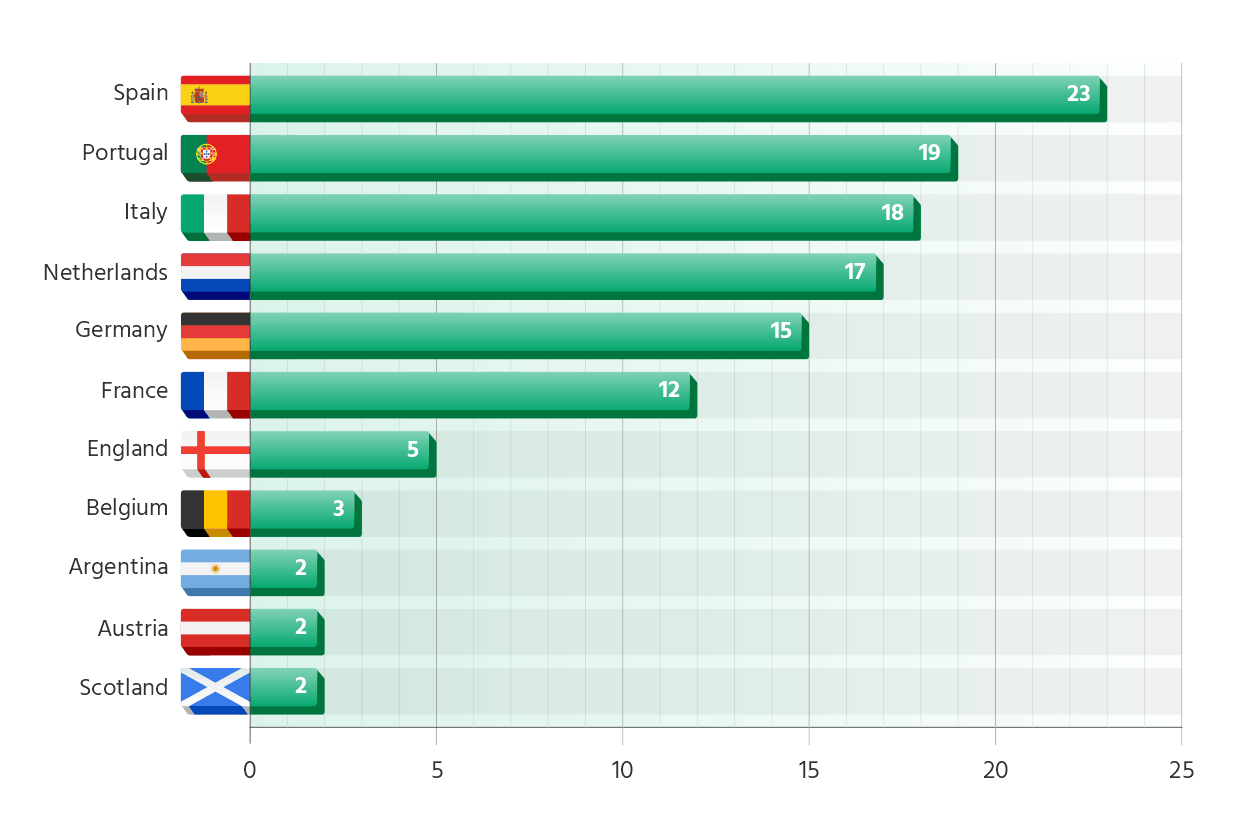
Sportingpedia looked at the nationalities of managers and head coaches across Europe’s top 7 leagues to see which countries dominate the dugouts. In total, 25 different nationalities are represented, but the overall picture is far less balanced than that number first suggests. Spain leads the ranking with 23, followed by Portugal on 19 and Italy on 18, while the Netherlands, Germany and France also reach double figures on 17, 15 and 12 respectively.
After that leading group, the drop is sharp. England is next on just 5, Belgium follows with 3, and 14 different countries are represented by only one manager each, including Denmark, Romania, Senegal, Uruguay, the USA and Wales. That diversity is not shared evenly across the seven leagues. The Premier League stands out as the most internationally mixed with 11 different nationalities, while the Eredivisie is the most domestically concentrated, featuring managers from only 3 countries.
Number of managers/head coaches in Europe’s top 7 leagues by nationality
Data Source: Flashscore
Spain, Portugal and Italy set the pace
The top of the ranking is controlled by three countries. Spain leads with 23 head coaches, Portugal follows on 19, and Italy sits close behind on 18. That leaves just five managers between first and third, which keeps the top end competitive even if Spain remains out in front.
Those three countries already establish a clear southern European core at the top of the table. Their combined total reaches 60, before the ranking even moves on to the Netherlands in fourth. That concentration becomes even more striking when Portugal is paired with Spain, as the two Iberian nations alone account for 42 managers by nationality.
The upper tier does not end with the top three. The Netherlands place 17 managers, Germany add 15, and France contribute 12, which means the first six nationalities all reach double figures. There is no other part of the table with that kind of density.
The real break comes immediately after France. England is seventh on 5, which leaves a gap of 7 between sixth and seventh. That drop is larger than the distance between Spain in first and Italy in third. In other words, the ranking is far more compressed at the top than it is around the cut-off into the lower half.
Beyond the top seven, the ranking thins out quickly. Belgium is the only nationality outside that leading group to place more than two head coaches, with 3. Argentina, Austria and Scotland each have 2, while every other country in the lower half appears just once.
That one-manager group is extensive. Bosnia, Chile, Croatia, Denmark, Greece, Ireland, Poland, Romania, Senegal, Sweden, Switzerland, Uruguay, the USA and Wales all have a single representative. So while the overall ranking includes 24 nationalities, most of the depth is concentrated among a small number of countries and the rest are scattered thinly across the table.
At first glance, 24 nationalities suggest a very international coaching picture across Europe’s top 7 leagues. The detail shows something narrower. Spain, Portugal, Italy, the Netherlands, Germany and France alone account for 104 managers by nationality, and once England’s 5 are added, the leading seven countries are responsible for almost the entire shape of the table.
Spain is not only the most represented nationality overall, but also the one with the biggest coaching presence outside its home league. Eleven Spanish managers currently work abroad across Europe’s top 7 leagues, more than double Portugal’s five and comfortably ahead of Germany’s four and Italy’s three. By contrast, the Netherlands, France and England each have just one manager working outside their domestic competition. That makes Spain the clearest exporter of coaching talent in the ranking, with a footprint across Europe that no other country matches.
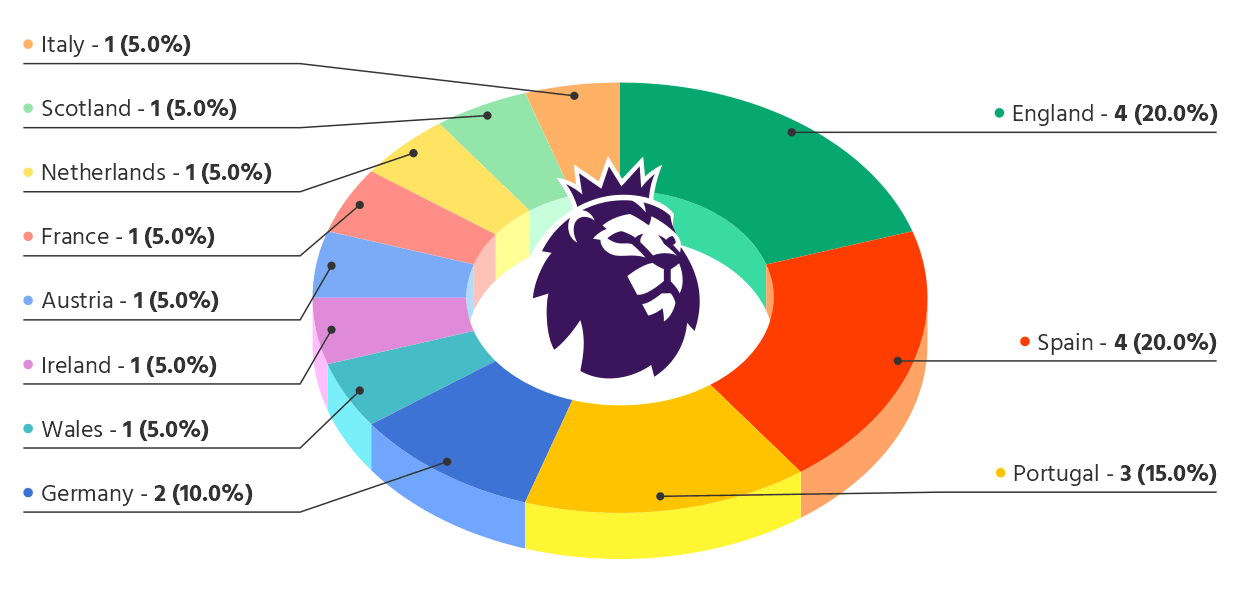
Breakdown of Premier League managers by nationality
Data Source: Flashscore
The Premier League coaching map currently stretches across 11 nationalities, with Spain and England joint-top on four managers each. The Spanish contingent is made up of Mikel Arteta, Unai Emery, Andoni Iraola and Pep Guardiola, while England is represented by Scott Parker, Liam Rosenior, Michael Carrick and Eddie Howe. Portugal follows with three through Marco Silva, Vitor Perreira and Nuno Espirito Santo, which means Spain, England and Portugal alone account for 11 of the league’s 20 head coaches. Germany is the only other country with more than one representative, placing Fabian Hurzeler and Daniel Farke, while Austria, France, Ireland, Italy, the Netherlands, Scotland and Wales each contribute one.
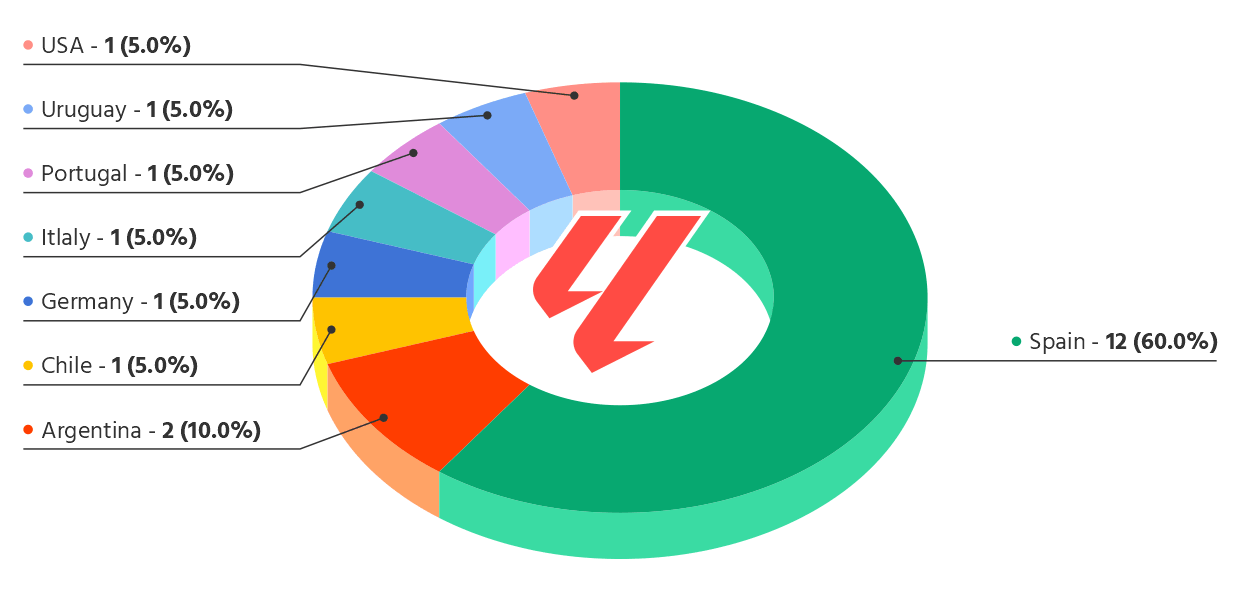
Breakdown of La Liga managers/head coaches by nationality
Data Source: Flashscore
Eight different nationalities are represented among La Liga managers, but Spain dominates the picture with 12 of the league’s 20 head coaches. Those Spanish names are Alvaro Arbeola, Marcelino, Claudio Giraldez, Quique Sanchez Flores, Ernesto Valverde, Jose Bordalas, Manolo Gonzalez, Carlos Corberan, Michel, Inigo Perez, Eder Sarabia and Luis Garcia. Argentina is the only other country with more than one manager, thanks to Diego Simeone and Martin Demichelis, while Portugal, Italy, Germany, Chile, Uruguay and the USA each place one coach.
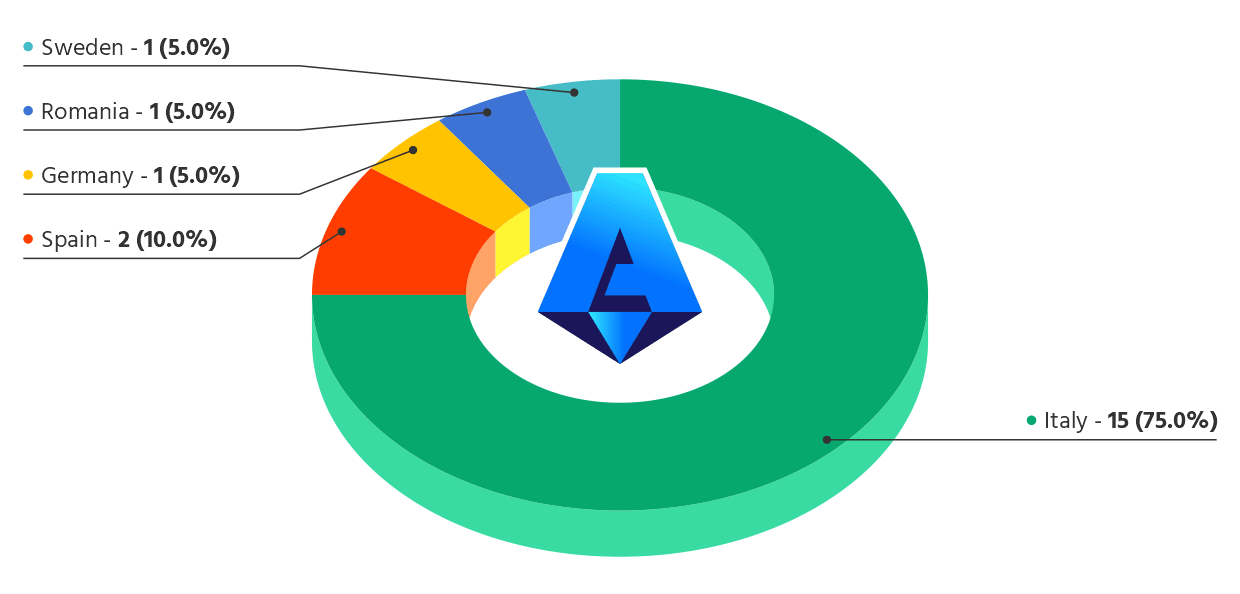
Breakdown of Serie A managers/head coaches by nationality
Data Source: Flashscore
Serie A has the narrowest managerial spread of the major leagues, with coaches from just 5 nationalities and an overwhelming Italian majority of 15. Antonio Conte, Massimiliano Allegri, Luciano Spalletti, Gian Piero Gasperini, Raffaele Palladino, Vincenzo Italiano, Maurizio Sarri, Fabio Grosso, Roberto D’Aversa, Daniele De Rossi, Paolo Vanoli, Fabio Pisacane, Marco Giampaolo, Eusebio Di Francesco and Paolo Sammarco all give Italy a huge hold over the division’s dugouts. Spain is the only other country with more than one representative, through Cesc Fabregas and Carlos Cuestra, while Sweden, Romania and Germany each contribute one manager through Oscar Hiljemark, Cristian Chivu and Kosta Runjaic.
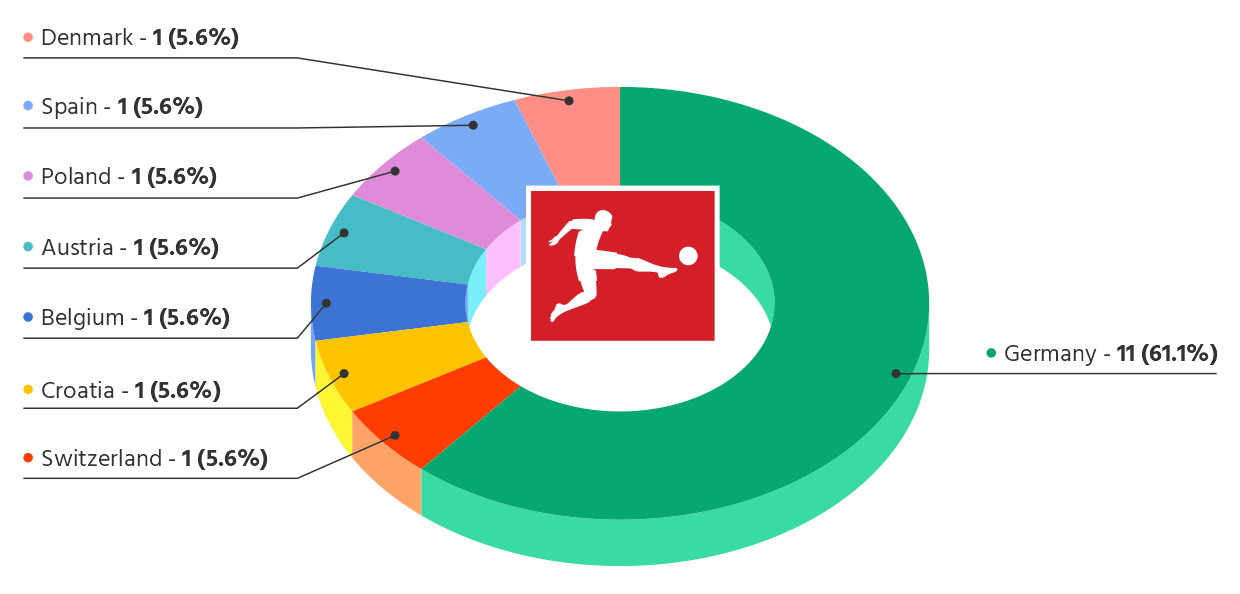
Breakdown of Bundesliga managers/head coaches by nationality
Data Source: Flashscore
Managers from 8 different nationalities are currently working in the Bundesliga, led by Germany with 11 representatives. Sebastian Hoeness, Ole Werner, Julian Schuster, Manuel Baum, Eta Marie-Louise, Merlin Polzin, Lukas Kwasniok, Daniel Thioune, Alexander Blessin, Dieter Hecking and Frank Schmidt make up that domestic core. Eta Marie-Louise also gives the league its most distinctive story, after Union Berlin appointed her interim head coach on 11 April following Steffen Baumgart’s dismissal, making her the first woman to lead a men’s team in Bundesliga history and the first appointed to a men’s side in one of Europe’s top five leagues. The remaining seven nationalities all appear once each: Spain through Albert Riera at Eintracht Frankfurt, Switzerland through Urs Fischer at Mainz, Poland through Eugen Polanski at Borussia Monchengladbach, Denmark through Kasper Hjulmand at Bayer Leverkusen, Croatia through Niko Kovac at Borussia Dortmund, Belgium through Vincent Kompany at Bayern Munich, and Austria through Christian Ilzer at Hoffenheim.
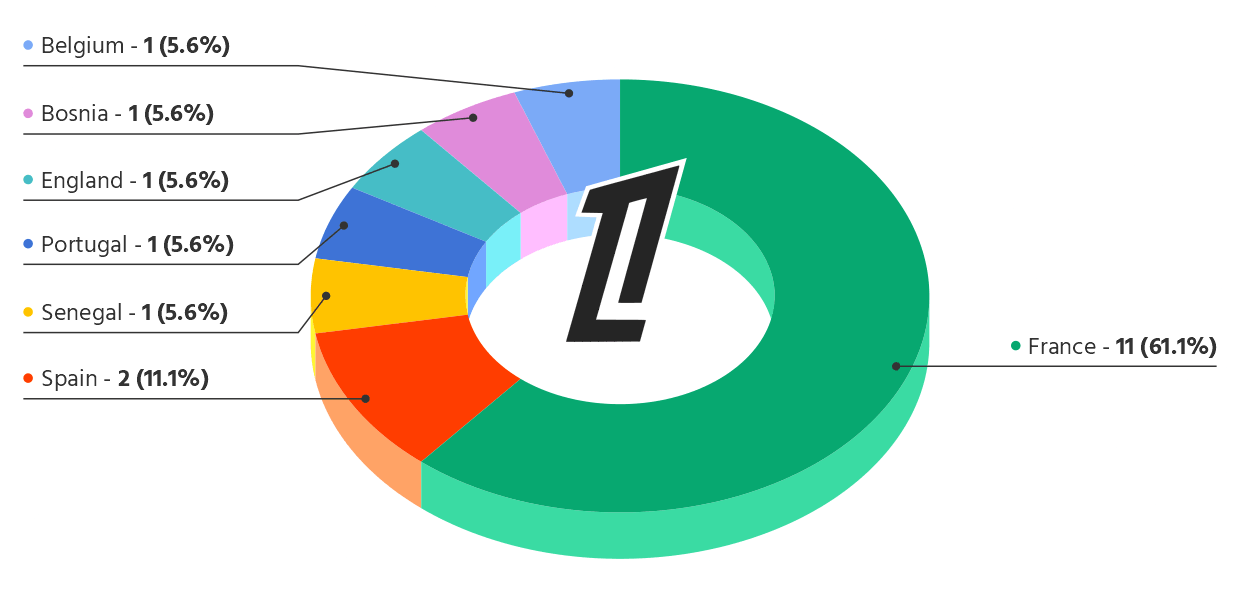
Breakdown of Ligue 1 managers/head coaches by nationality
Data Source: Flashscore
Ligue 1’s benches are occupied by coaches from 6 different nationalities, but France dominates the league with 11 of the 18 managers. Pierre Sage, Bruno Genesio, Franch Haise, Olivier Pantaloni, Eric Roy, Antoine Kombouare, Alexandre Dujeux, Didier Digard, Claude Puel, Christophe Pelissier and Benoit Tavenot give the host nation a clear grip on the division. Spain is the only other country with more than one representative, through Luis Enrique and Carles Martinez, while Portugal, Senegal, England, Belgium and Bosnia & Herzegovina each place one manager.
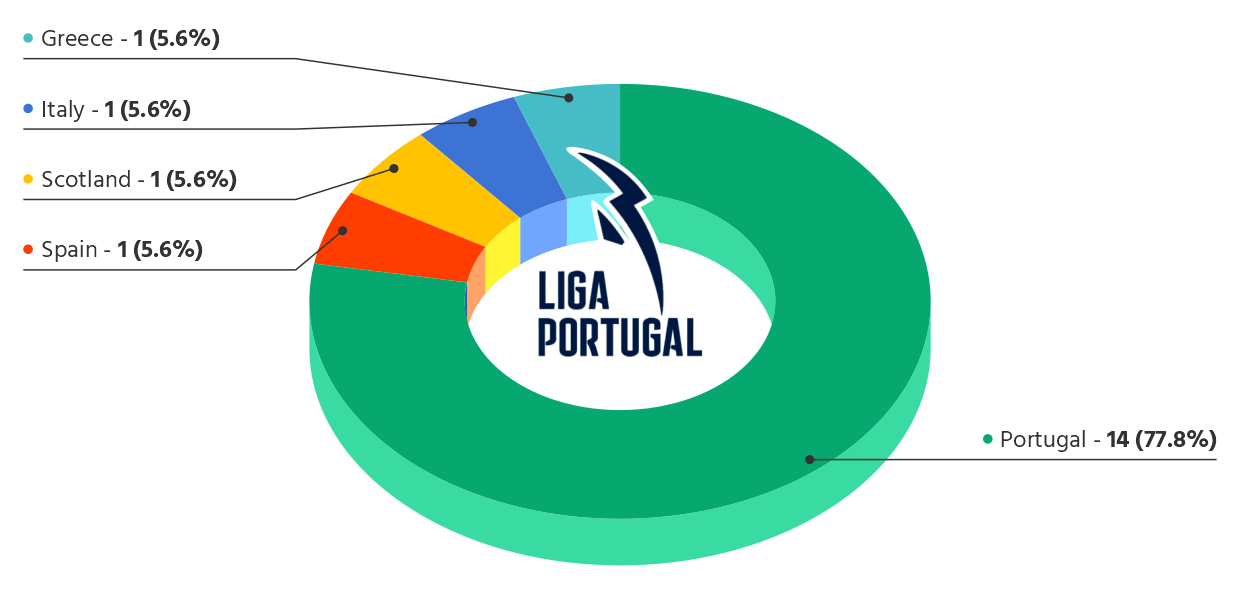
Breakdown of Liga Portugal managers/head coaches by nationality
Data Source: Flashscore
Liga Portugal is represented by managers from 5 different nationalities, though Portugal overwhelmingly leads the way with 14 of the league’s 18 head coaches. Rui Borges, Jose Mourinho, Hugo Oliveira, Cesar Peixoto, Luis Pinto, Vasco Costa, Custodio, Vasco Seabra, Petit, Joao Nuno, Tiago Margarido, Joao Pereira, Goncalo Feio and Joao Henriques give the host nation a firm hold over the competition’s dugouts. Spain, Scotland, Italy and Greece each provide one manager, through Carlos Vincent, Ian Cathro, Francesco Farioli and Sotiris Sylaidopoulos respectively.
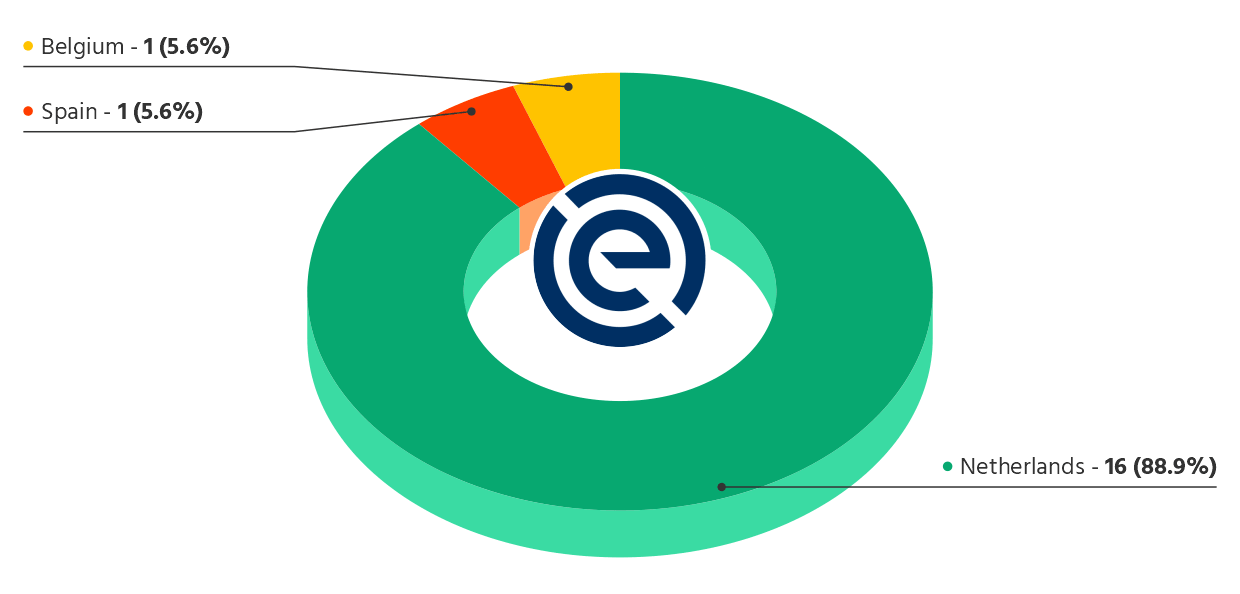
Breakdown of Eredivisie managers/head coaches by nationality
Data Source: Flashscore
The Eredivisie has the most nationally concentrated coaching picture of the seven leagues, with managers from just 3 countries and an overwhelming Dutch majority of 16. Peter Bosz, Robin van Persie, Dick Schreuder, John van den Brom, Leeroy Echteld, Ron Jans, Robin Veldman, Dick Lukkien, Maurice Steijn, Melvin Boel, Danny Buijs, Henry Van Der Vegt, Rick Kruys, Ruben den Uil, Anthony Correia and Ernest Faber give the Netherlands near-total control of the league’s dugouts. Spain and Belgium are the only foreign nations represented, through Oscar Garcia at Ajax and Carl Hoefkens at NAC Breda.