 | Updated:
Europe’s most prolific goal scorers for 2025/26 are now clear. Harry Kane finishes top of the European Golden Shoe standings after scoring 36 Bundesliga goals for Bayern Munich, ahead of Erling Haaland’s 27 for Manchester City and Kylian Mbappe’s 25 for Real Madrid. Yet while the scoring hierarchy is settled, the financial picture behind those goals looks very different.
The Golden Shoe table puts all the attention on goals and points, but the money behind those goals tells another story. Europe’s leading scorers may sit relatively close to one another in output, yet the financial cost of each strike varies enormously once salaries and bonuses are brought into the picture.
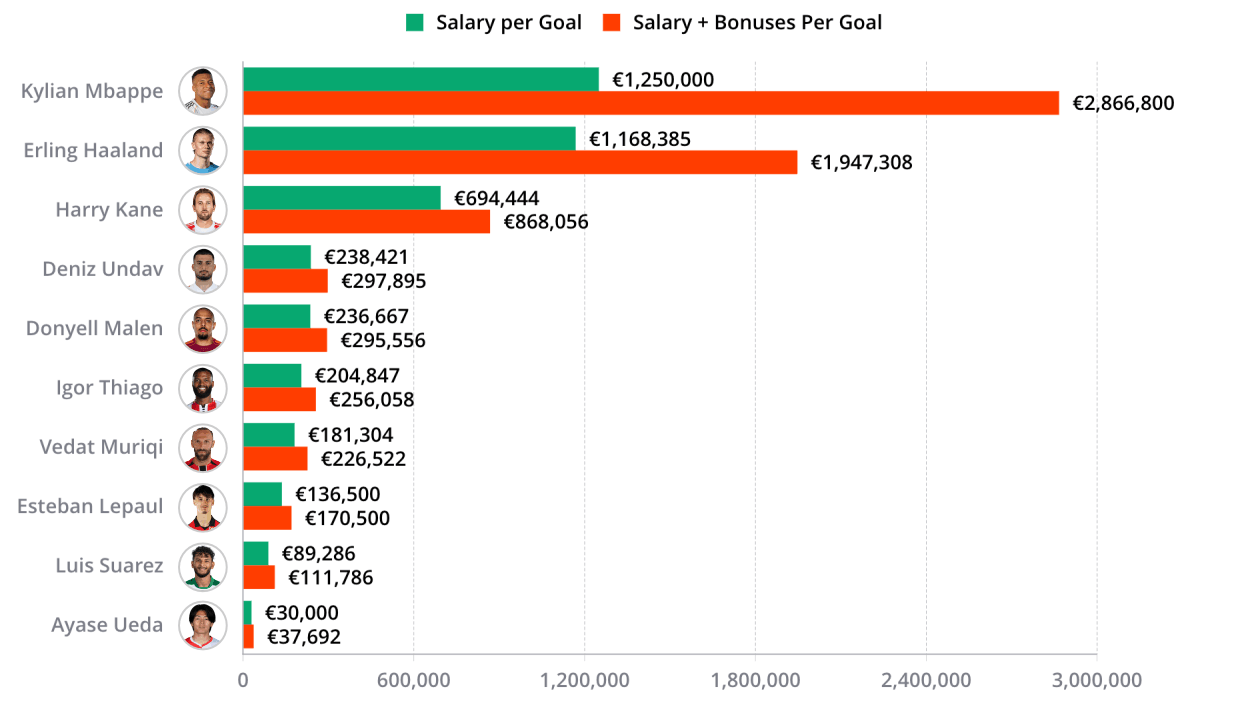
Sportingpedia examined the 2025/26 Golden Shoe leaders for whom both salary and bonus data are available, comparing base salary per goal with total earnings per goal once bonuses are included. Among the most curious revelations is that Kane’s 36 league goals cost almost €2 million less per strike than Mbappe’s once bonuses are added, at €868,056 against €2,866,800. Another striking contrast appears at the lower end, where Feyenoord’s Ayase Ueda stands out as the clear bargain, with his 26 Eredivisie goals costing just €37,692 each.
How Much Europe’s Golden Shoe Leaders Earned
for Scoring a Goal in 2025/26
Data Source: Capology
Kane finished clear on goals with 36, but the rest of the leading scorers were not far behind. Luis Suarez scored 28, Haaland 27, Ueda 26, and Mbappe 25, while even the lower end of the group still ranged from Muriqi’s 23 down to Malen’s 18. On paper, that makes for a relatively tight spread of scorers, but financially, the gap is enormous.
Even before bonuses are added, Mbappe already sits alone at the top of the earnings-per-goal table. His 25 goals come at €1,250,000 each, putting him ahead of Haaland on €1,168,385 and well clear of Kane on €694,444. After those three, the numbers fall sharply. Undav’s goals cost €238,421 each, Malen’s €236,667, Igor Thiago’s €204,847, and Muriqi’s €181,304. Lepaul comes in at €136,500, Luis Suarez at €89,286, and Ueda all the way down at €30,000 per strike.
The gap widens far more once bonuses are included. Mbappe’s total cost per goal rises to €2,866,800, making him comfortably the most expensive scorer. Haaland remains second on €1,947,308, but even that leaves Mbappe’s goals costing roughly 1,47 times more than the Manchester City striker’s. Kane remains third at €868,056, which means each of his goals costs almost €2 million less than Mbappe’s.
After those three, the numbers drop away again. Undav’s goals cost €297,895 each once bonuses are included, Malen’s €295,556, Igor Thiago’s €256,058, and Muriqi’s €226,522. Lepaul’s 20 Ligue 1 goals cost Rennes €170,500 each, Luis Suarez’s 28 for Sporting come in at €111,786, and Ueda remains far clear as the cheapest at €37,692. The most expensive scorers are not simply ahead of the rest. They are operating on another scale entirely.
The key reason is the size of the bonus packages attached to the biggest stars. Mbappe’s bonuses reach €40,42 million, which is even higher than his €31,25 million salary. That is why his cost per goal does not just rise, but more than doubles, increasing by 129,3%. Haaland is the only other player to see anything close to that kind of jump, with his €21,03 million in bonuses pushing his cost per goal up by 66,7%.
Nobody else sees anything close to that kind of distortion. Kane’s total rises by 25%, and much the same pattern appears across the rest of the group. Undav, Malen, Igor Thiago, Muriqi, Lepaul, Luis Suarez, and Ueda all see their cost per goal increase by roughly a quarter once bonuses are added. That leaves Mbappe and Haaland as the two clear exceptions, with add-ons inflating the real cost of each goal far more sharply than anyone else’s.
This is what makes Mbappe’s position so striking. His goals cost more than three times Kane’s, nearly 26 times Luis Suarez’, and just over 76 times Ueda’s once bonuses are included. No one else opens that kind of gap over the rest of Europe’s leading scorers.
At the opposite end, Ueda’s value stands out because the output remains fully competitive. His 26 league goals leave him only one behind Haaland and one ahead of Mbappe, yet nobody else comes remotely close to matching his efficiency. Even Luis Suarez, the second-cheapest scorer, still costs almost three times more per goal than the Feyenoord forward. That makes Ueda the clear bargain.
Kane, meanwhile, occupies the middle ground. He scored more league goals than anyone else, but never came close to Mbappe or Haaland in financial cost. At the same time, he is nowhere near the bargain territory occupied by Suarez and Ueda. That makes him the clearest balance point in the study: elite output, elite wages, but without the same explosive jump in cost per goal caused by bonus-heavy deals at the very top.
Conclusion
The contrast is not just financial, but structural. Mbappe, Haaland, and Kane play for European giants expected to challenge for league titles and the Champions League every season, while the rest of the list is made up of forwards operating in very different financial environments, at clubs with far smaller budgets and much lower ambitions. That is what makes the gap so striking. The goal returns may look relatively close on paper, but the money behind them tells a completely different story. Even within La Liga, Mbappe’s 25 goals cost Real Madrid €2,866,800 each once bonuses are included, while Muriqi’s 23 for relegated Mallorca come in at €226,522 apiece, leaving Mbappe’s goals around 12,7 times more expensive.
Methodology
The analysis covers leading Golden Shoe scorers from Europe leagues for whom both salary and bonus data are available. Because salary figures could not be verified for Dion Beljo of Dinamo Zagreb and Ryan Mmaee of Omonia Nicosia, both were excluded, which brought Ayase Ueda and Donyell Malen into the group. Two measures were used: base salary per league goal and total earnings per league goal once bonuses are added.