 | Updated:
When the 2026 World Cup kicks-off later today, the spotlight will naturally fall on the footballers chasing glory, scoring goals and deciding matches. But match officials and referees will have decisive roles of their own, from awarding penalties and disallowing goals to issuing red cards in the tournament’s biggest moments. Their calls will shape the story of the World Cup just as much as the players’ finishing or the managers’ tactics.
That makes the composition of FIFA’s officiating team an important part of the build-up to the tournament. In April, FIFA unveiled a 170-strong group made up of 52 referees, 88 assistant referees and 30 VAR officials from 50 member associations. Just days before kick-off, however, that list has already been affected, with Somali referee Omar Abdulkadir Artan denied entry into the United States and later ruled out of the competition.
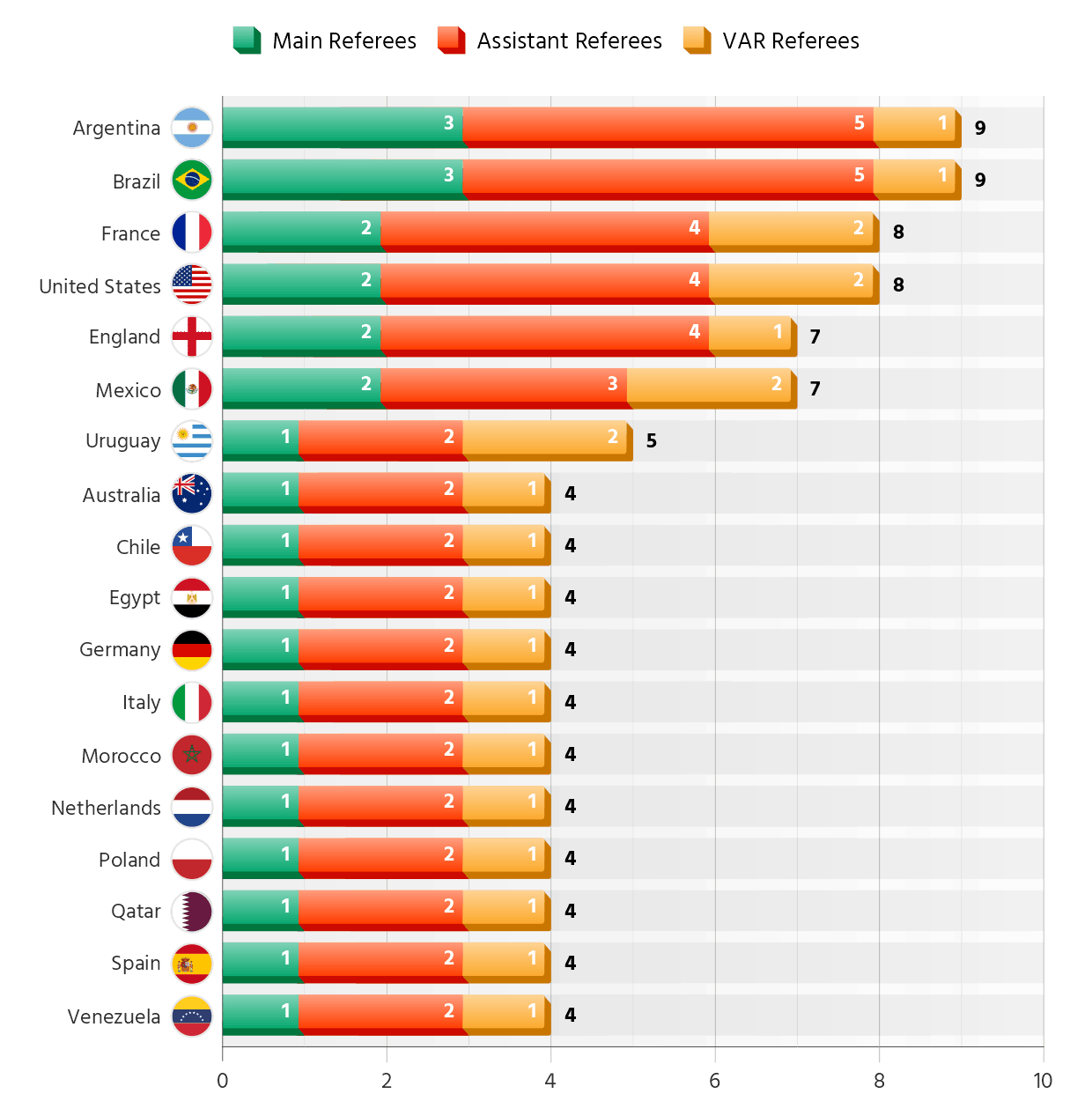
That is what led Sportingpedia to rank the countries supplying those officials, combining main referees, assistant referees and VAR specialists into one country-by-country table. The result shows a clear pair at the top, a strong second tier just behind them, and a sharp drop once the leading nations are stripped away.
The Countries with the Most Referees at the 2026 World Cup
Data Source: FIFA
At the top, Argentina and Brazil stand alone. Both countries contribute three main referees, five assistant referees and one VAR official, giving them identical totals of nine. That leaves them one ahead of France and the United States on eight, and two ahead of England and Mexico on seven. In other words, just six countries supply nearly three in every ten officials selected for the tournament.
France and the United States get to eight in the same way, through a balanced spread of two main referees, four assistants and two VAR officials each. Mexico also stands out for its balance, reaching seven with two main referees, three assistants and two VAR officials. England’s seven is built differently, with two main referees, four assistants and only one VAR representative.
After the top six, Uruguay sits alone in seventh place with five officials. Then comes the biggest cluster in the table, with Australia, Chile, Egypt, Germany, Italy, Morocco, the Netherlands, Poland, Qatar, Spain and Venezuela all supplying four officials each. That group forms the broad middle of the World Cup refereeing map, well clear of the long list of countries on three or fewer.
The host-country picture is especially revealing. The United States ranks joint-second overall with eight officials, while Mexico also makes the leading group on seven. Canada, however, is much further back on three, with one main referee and two assistant referees but no VAR representative. So although all three host nations are well represented, the distribution is far from even.
There are also sharp differences in how countries appear on the list. Belgium and Croatia are represented only through VAR, while Angola, Cameroon and Trinidad and Tobago appear only through assistant referees. Jamaica, Mauritania and Somalia, by contrast, feature only through main referees. Somalia’s case is the most striking of all, because its single selected official, Artan, has already been lost before the tournament even begins.
Methodology
Sportingpedia combined the totals for main referees, assistant referees and VAR referees selected for the 2026 World Cup and ranked countries by their overall number of officials. The underlying FIFA selection consisted of 52 referees, 88 assistant referees and 30 VAR officials, for a total of 170 match officials.