 | Updated:
The 2026 World Cup will stretch across a vast North American map, with countries moving between Canada, the United States, and Mexico before the knockout stage even begins. For some, the group phase will mean little more than short hops between nearby host cities. For others, it will involve thousands of kilometres in the air before the tournament has barely settled into rhythm.
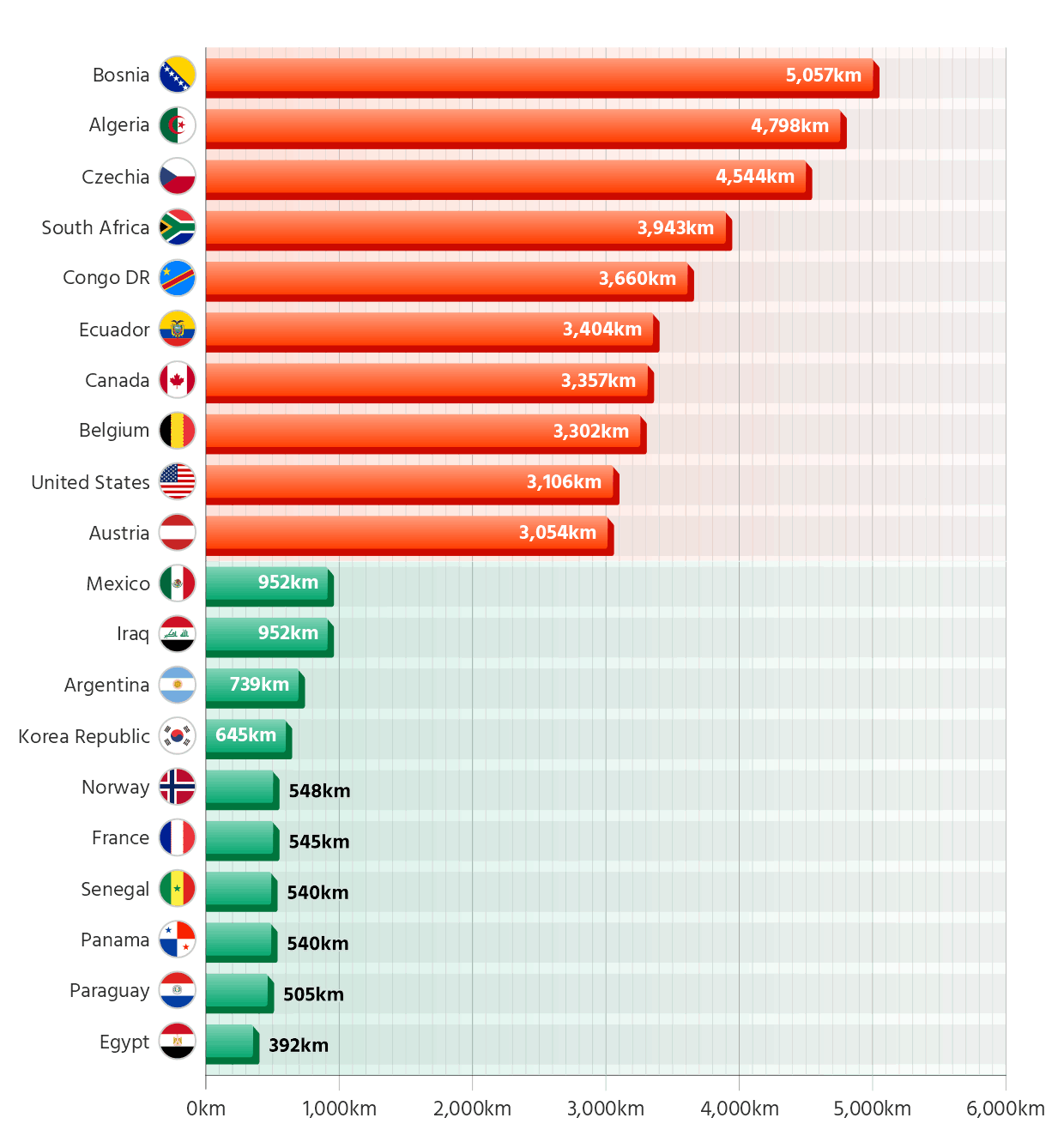
That is what led Sportingpedia to rank all 48 countries by the total distance they will cover between their three group-stage matches. The spread is enormous. Bosnia and Herzegovina faces the heaviest travel load of any side in the tournament at 5,057 km, while Egypt has the lightest route at just 392 km. In other words, Bosnia and Herzegovina will travel nearly 13 times more than Egypt during the group stage alone.
The gap is not only visible at the two extremes. The 10 most-travelled countries combine for 38,225 km between their group-stage matches, just over six times more than the 6,358 km covered by the 10 least-travelled countries. Bosnia and Herzegovina on its own will travel farther than the bottom five countries in the table combined, underlining just how uneven the logistical burden of the 2026 World Cup really is.
2026 World Cup Group Stage Travel Rankings: The 10 Teams with the Longest and Shortest Distance to Cover
Data Source: FIFA
Bosnia and Herzegovina sits alone at the top of the travel table. Its route from Toronto to Los Angeles and then on to Seattle adds up to 5,057 km, making it the only country in the tournament forced to clear the 5,000 km barrier before the group stage is even over. Algeria follows on 4,798 km, with Czechia next on 4,544 km, while South Africa and Congo DR also go well beyond the 3,500 km mark. Ecuador, Canada, Belgium, the United States, Austria, and Colombia complete the long-travel group, meaning 10 countries in total will have to cover more than 3,000 km between their three group matches.
That makes the contrast at the other end especially striking. Egypt will travel only 392 km across its full group-stage schedule, the lowest total of any country in the tournament. Paraguay is next on 505 km, while Senegal and Panama are both on 540 km. France will cover 545 km, Norway 548 km, Korea Republic 645 km, and Argentina 739 km, with Mexico and Iraq both on 952 km. In total, 10 countries will stay below 1,000 km, which means the World Cup draw and venue allocation have created two completely different travel realities before a ball has even been kicked.
The favourites do not all benefit equally. France has the shortest route of the leading contenders at 545 km, followed by Argentina at 739 km. Portugal also avoids a demanding schedule at 1,547 km, while Brazil sits on 1,757 km. Spain faces 2,373 km, Germany 2,640 km, and England 2,768 km, so the travel picture among the strongest countries varies much more than their status or market-value tables would suggest.
The contrast becomes even sharper when the longest and shortest routes are placed side by side. Bosnia and Herzegovina’s 5,057 km is nearly 13 times Egypt’s 392 km, more than nine times France’s 545 km, and almost seven times Argentina’s 739 km. Even among the favourites, the travel gap is striking: England’s 2,768 km is more than five times France’s total, while Germany’s 2,640 km is almost five times greater. So the 2026 World Cup is not only split by quality of opposition and venue, but also by how much physical movement each country will have to absorb before the group stage is over.
Some individual journeys stand out even more than the totals. Bosnia and Herzegovina also has the longest single trip of the entire group stage, having to travel from Toronto to Los Angeles for its second match against Switzerland. Colombia and Uruguay, meanwhile, share the longest trip between the second and third group games at 2,439 km, with Colombia travelling from Guadalajara to Miami and Uruguay making the same journey in reverse, from Miami to Guadalajara. Those routes show how some countries will deal not just with heavy overall travel, but with one especially punishing leg in the middle of the group phase.
There are also some unexpected host-nation contrasts. Canada will still travel 3,357 km despite playing on home soil, while the United States will cover 3,106 km, both figures higher than several of the tournament favourites. Mexico, by contrast, is among the least affected countries at 952 km. So even host status does not guarantee an easy schedule once the full route is mapped out.
The broader picture is clear. The 2026 World Cup may be one tournament, but the logistical burden it places on countries is far from equal. Bosnia and Herzegovina will carry by far the heaviest travel load, Egypt the lightest, and the gap between them shows just how differently the group stage is set up depending on where countries are placed. For some, the World Cup journey begins with football alone. For others, it starts with thousands of kilometres on the road.
Methodology
All travel distances are based on straight-line air-distance estimates between host cities, calculated along the Earth’s surface and rounded to the nearest kilometre and mile.