 | Updated:
Watching Argentina’s 2-0 win over Austria, one thing was clear even before checking the numbers: Lionel Messi barely moved through long stretches of the match. He walked, drifted, waited, and rarely seemed like one of the most active players on the pitch. Then he scored twice.
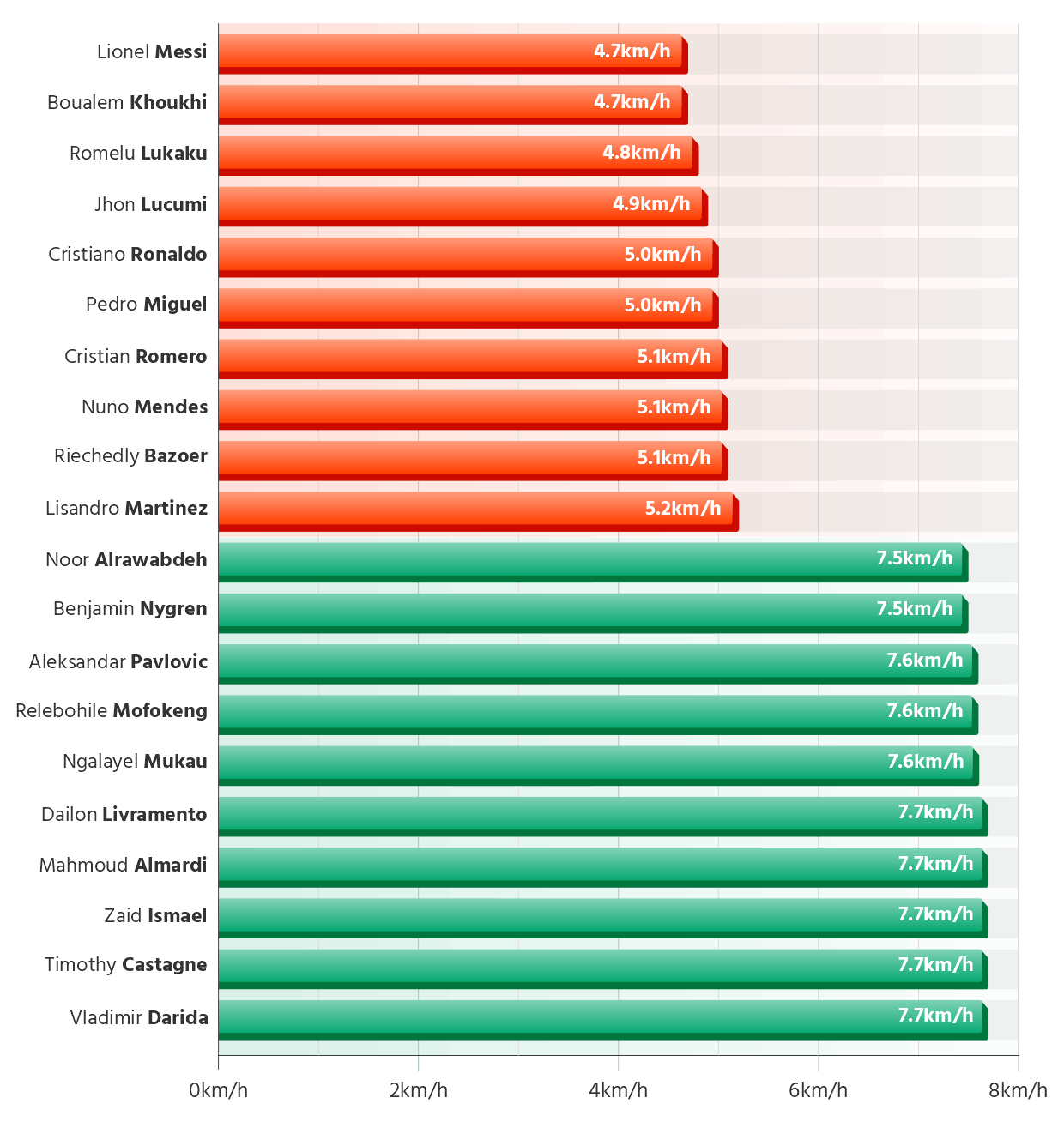
This led Sportingpedia to look at the FIFAphy database and investigate the outfield players with the lowest and highest average speeds at the 2026 World Cup so far. The numbers match the eye test as Messi is currently the joint-slowest outfield player in the tournament ranking, averaging just 4.7 km/h. Even more striking, he is moving only 1.1 km/h faster than England goalkeeper Jordan Pickford, whose 3.6 km/h is the highest average recorded by any goalkeeper at the tournament.
The same match that made Messi’s lack of movement so visible also put him clear at the top of World Cup history. His brace against Austria takes him to 18 World Cup goals, making him the competition’s all-time leading scorer. Cristiano Ronaldo, meanwhile, averages 5.0 km/h, only slightly faster than Messi, but his tournament has produced a completely different attacking picture so far.
The Slowest and Fastest Outfield Players at the 2026 World Cup
(Average Speed km/h)
Data Source: Fifaphy
Messi moves barely above goalkeeper pace but keeps rewriting World Cup history
Messi’s 4.7 km/h average puts him at the very bottom of the outfield-player list, alongside Qatar’s Boualem Khoukhi. The number is close to normal adult walking pace, which usually sits around 5 km/h, and it is only slightly higher than the 3.6 km/h recorded by Jordan Pickford as the fastest-moving goalkeeper at the 2026 World Cup.
That should make Messi look passive. Instead, it makes his tournament even more unusual. He is not dominating through constant running, pressing or high-speed work. He is doing it through timing, positioning and finishing. His brace against Austria lifts him to 18 World Cup goals, making him the competition’s all-time top scorer while he remains one of the slowest movers on the pitch.
Ronaldo is slightly faster, but the output is completely different. Ronaldo’s figure is only marginally higher. He averages 5.0 km/h, just 0.3 km/h above Messi, placing him among the slowest outfield players in the dataset as well.
Messi’s low average speed comes with goals. Hat-trick in the first match against Algeria, and a brace against Austria. Ronaldo’s low average speed comes with a less convincing attacking picture so far. In Portugal’s 1-1 draw with DR Congo, he failed to register a shot on target, making his average-speed figure look much less flattering.
The numbers do not say Ronaldo cannot still influence the tournament. They do show that, at this stage, two of football’s biggest names are operating at similar average speeds, but only one is turning that movement into production.
Romelu Lukaku also appears near the bottom of the average-speed ranking. The Belgium striker averages 4.8 km/h across 110 minutes, placing him below Ronaldo and only above Messi and Khoukhi among the slowest listed outfield players.
Jhon Lucumi of Colombia follows at 4.9 km/h, while Ronaldo and Pedro Miguel both sit at 5.0 km/h. Cristian Romero, Nuno Mendes and Riechedly Bazoer each average 5.1 km/h, before Lisandro Martinez completes the slowest 10 at 5.2 km/h.
Argentina’s team profile is just as eye-catching as Messi’s individual number. The world champions have 3 of the 10 slowest outfield players at the 2026 World Cup so far: Messi at 4.7 km/h, Romero at 5.1 km/h and Martinez at 5.2 km/h.
That has not stopped them from controlling matches. Argentina have beaten Algeria 3-0 and Austria 2-0, scoring 5 goals and conceding none across their first two games. Argentina are not simply carrying one low-speed veteran in attack. They also have two defenders among the slowest 10, yet still have back-to-back clean sheets.
Qatar are the other team with multiple players near the bottom. Khoukhi is joint-slowest with Messi at 4.7 km/h, while Pedro Miguel averages 5.0 km/h. Both have played 209 minutes, giving their figures heavier context than short-sample entries.
The fastest players are closer to light jogging than walking
The fastest group adds the visual contrast. Five players lead the dataset at 7.7 km/h: Cape Verde’s Dailon Livramento, Jordan’s Mahmoud Almardi, Iraq’s Zaid Ismael, Belgium’s Timothy Castagne and Czech Republic’s Vladimir Darida.
That pace is not sprinting. It is closer to very fast walking or light jogging, which makes the comparison with Messi and Ronaldo easier to understand. The slowest elite attackers are moving around normal walking pace on average, while the fastest players in the dataset are operating roughly three km/h higher.
Aleksandar Pavlovic, Relebohile Mofokeng and Ngalayel Mukau follow on 7.6 km/h, while Noor Alrawabdeh and Benjamin Nygren sit on 7.5 km/h. These players are not necessarily the fastest sprinters at the tournament, but they are the ones with the highest average movement in the provided data.
Methodology:
Sportingpedia ranked the footballers by average speed at the 2026 World Cup. The figures reflect average movement across playing time, not top sprint speed. This means the data measures general movement profile rather than one isolated burst.