 | Updated:
The top of the 2026 World Cup scoring chart reads like a roll call of modern football’s biggest names. Kylian Mbappé and Lionel Messi are level at the front, with Harry Kane and Erling Haaland close behind, while Vinícius Júnior and Ousmane Dembélé are also among the tournament’s leading scorers. That raised a different question: once the national shirts are set aside, which clubs are actually behind most of the goals at this World Cup?
SportingPedia analysed the tournament’s goalscorer data and mapped every scorer back to the club listed for him in FIFA’s official squad records. After some contracts had expired or been terminated by mutual consent, players listed as free agents were assigned to their most recent club.
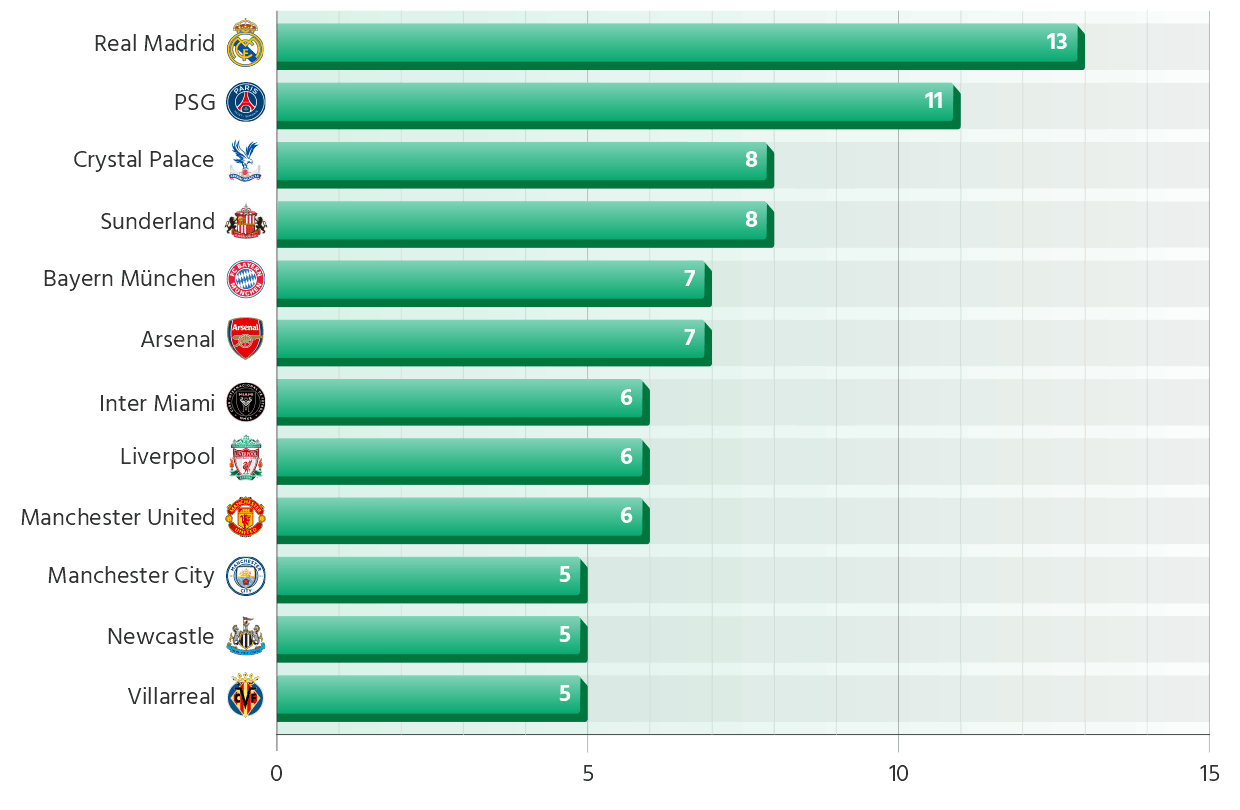
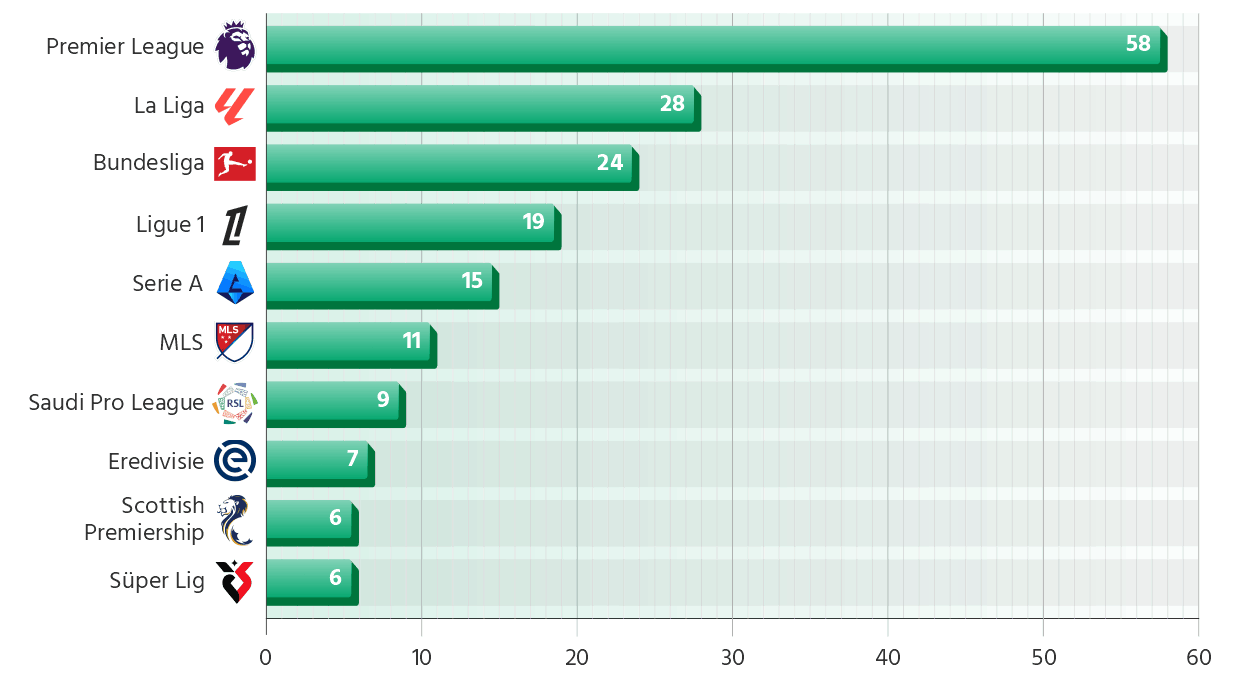
The report reveals that players from Real Madrid lead the club ranking with 13 goals, followed by Paris Saint-Germain players with 11. At league level, players from Premier League clubs have created the biggest gap, scoring 58 goals so far. That is more than double La Liga’s total of 28 and six more than La Liga and Bundesliga players combined.
Clubs With the Most Goals Scored by Their Players
at the 2026 World Cup
Data Source: FIFA
Players listed at Real Madrid have produced the highest club total at the 2026 World Cup so far. Their 13 goals have come from four players: Kylian Mbappé, Vinícius Júnior, Jude Bellingham and Arda Güler. Mbappé leads the group with six goals, while Vinícius has added four.
Paris Saint-Germain players rank second with 11 goals. Their total is built differently from Real Madrid’s, with goals spread across seven different players. Ousmane Dembélé has scored four, Bradley Barcola has two, while Achraf Hakimi, Désiré Doué, Ibrahim Mbaye, João Neves and Nuno Mendes have each scored once.
Among English clubs, players listed at Crystal Palace and Sunderland have produced the highest totals, with eight goals each. Palace’s goals have come from Ismaïla Sarr, Daichi Kamada and Daniel Muñoz. Sunderland’s total is spread across Brian Brobbey, Habib Diarra, Granit Xhaka, Nilson Angulo and Wilson Isidor.
Bayern Munich have moved level with Arsenal on seven goals after Harry Kane scored twice for England against DR Congo. Kane now accounts for five of Bayern’s seven goals at the tournament, with Jamal Musiala and Luis Díaz adding one each.
Inter Miami are the clearest single-player case in the top 10. Their players have scored six goals at the World Cup, and all six have come from Lionel Messi. No other club near the top of the ranking depends on one scorer to the same extent. Liverpool players have also scored six, but their total is spread across Cody Gakpo, Alexander Isak, Mohamed Salah and Virgil van Dijk.
Manchester United players complete the group on six goals, led by Matheus Cunha with three and Amad Diallo with two, while Casemiro has added one. Manchester City and Newcastle United players have scored five goals each. City’s total comes entirely from Erling Haaland, while Newcastle’s has been split between Yoane Wissa and Anthony Elanga.
Villarreal complete the top 12 with five goals from three players. Nicolas Pépé and Pape Gueye have scored twice each, while Alex Freeman has added one.
Leagues With the Most Goals Scored by Their Players
at the 2026 World Cup
Data Source: FIFA
The Premier League total is not driven by one club alone. Players listed at 13 different Premier League clubs have scored, with Crystal Palace and Sunderland leading the way on eight goals each. Arsenal players have scored seven, Liverpool and Manchester United players have six each, while Manchester City and Newcastle United players have five each.
La Liga’s total is more concentrated. Real Madrid players account for 13 of the league’s 28 goals, almost half of the Spanish top flight’s total. Villarreal players follow with five, while Barcelona, Real Betis and Real Sociedad players have scored two each.
Bundesliga players rank third with 24 goals. Bayern Munich players lead the German league’s contribution with seven, followed by Borussia Dortmund, Freiburg and Stuttgart players on three each. The Bundesliga total is spread across 12 scoring clubs, but no German club is close to Real Madrid or PSG at the top of the club ranking.
Ligue 1 players rank fourth with 19 goals, and Paris Saint-Germain are responsible for most of that total. PSG players have scored 11 times, while AS Monaco players have added three. Strasbourg and Rennes players have scored two each, with Marseille adding one.
Serie A completes the top five with 15 goals from players listed at Italian clubs. Juventus and Napoli players lead the league’s contribution with three goals each, while AC Milan, Inter and Torino players have scored two each. Compared with La Liga and Ligue 1, Serie A’s total is more evenly spread but lacks one dominant club contribution.
Major League Soccer ranks sixth with 11 goals. Inter Miami account for more than half of the total, with all six of their goals coming from Lionel Messi. Players from five other MLS clubs have also scored, but none of those clubs has contributed more than one goal.
Players from Saudi Pro League clubs have scored nine goals, placing the league seventh. The total is evenly split between three clubs: Al Ahli, Al Nassr and Al Qadsiah, whose players have scored three goals each.
Eredivisie players rank eighth with seven goals, led by Feyenoord and PSV Eindhoven players with three each. AZ Alkmaar players have added one goal.
The Scottish Premiership and Süper Lig complete the top 10 with six goals each. Motherwell players lead the Scottish Premiership total with three goals, followed by Celtic players with two and Rangers players with one. In Turkiye, Galatasaray players have scored three, Basaksehir players two, and Besiktas players one.
The gap at the top underlines the Premier League’s depth at this World Cup. Players from Premier League clubs have scored more goals than players from La Liga and Bundesliga clubs combined, and their total is spread across a wider group of clubs than any other league.