 | Updated:
 The 36 clubs entering the 2026/27 Champions League league phase may all have eight opponents to navigate, but the combined market value of those teams differs enormously. SportingPedia analysed every club’s draw using current Transfermarkt squad values to reveal which teams face the most and least valuable set of opponents on their way to the knockout rounds.
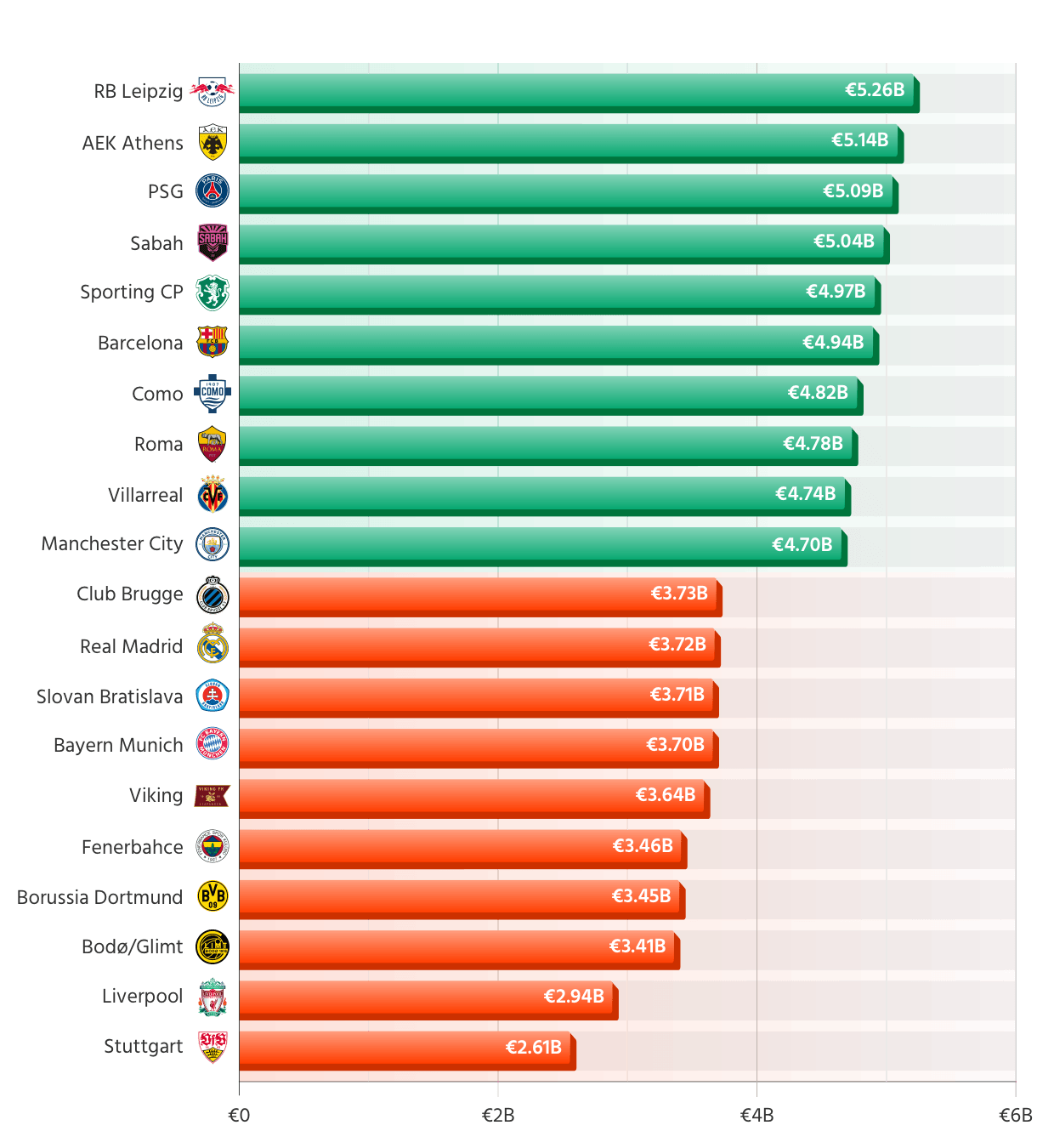
RB Leipzig face the most valuable set of opponents in the competition, valued €5.26 billion combined. AEK Athens follow closely at €5.14bn, while Paris Saint-Germain rank third at €5.09bn. Sabah are the only other club whose eight opponents exceed €5bn in combined market value.
At the other end, Stuttgart face the least valuable opposition at €2.61bn, followed by Liverpool at €2.94bn and Bodø/Glimt at €3.41bn. The gap between Leipzig and Stuttgart reaches €2.65bn, meaning the teams drawn against Leipzig are worth just over twice as much.
Curiously, the two absolute extremes happen to be German clubs, although substantial differences also emerge within several other domestic leagues. Manchester City’s opponents are worth €1.76bn more than Liverpool’s, while Barcelona face €1.23bn more in opponent market value than Real Madrid. Sporting CP and Porto are separated by €1.15bn , and the difference between Galatasaray and Fenerbahce is just over €1bn.
Across all 36 teams, the average combined value of the eight opponents stands at €4.15bn. The ten clubs facing the most valuable opposition average €4.95bn, compared with €3.44bn for the ten at the lower end, highlighting how differently the league-phase draw can look even within the same competition format.
From Over €5.2bn to €2.6bn:
Teams Facing the Most and the Least Valuable Champions League Opponents
Data Source: Transfermarkt
RB Leipzig face opponents valued at more than €5.25bn
No team in the 2026/27 Champions League faces a more valuable collection of league-phase opponents than RB Leipzig.
Their eight opponents – Manchester City, PSV Eindhoven, Shakhtar Donetsk, RC Lens, Real Madrid, Manchester United, Feyenoord and Como – have a combined market value of €5.26bn. Three clubs account for the majority of that figure. Manchester City and Real Madrid are each valued at €1.46bn, while Manchester United are worth €924.30 million. Those three squads alone are therefore worth €3.84bn, representing approximately 73% of the total market value of Leipzig’s eight opponents.
AEK Athens sit immediately behind RB Leipzig. Their league-phase rivals are valued at €5.14bn, while Paris Saint-Germain follow at €5.09bn. Sabah complete the group of four teams whose opponents are worth more than €5bn, with a combined total of €5.04bn. Sporting CP narrowly miss that threshold at €4.97bn, followed by Barcelona at €4.94bn.
Bundesliga fellows Stuttgart sit at the opposite end
At the other end of the comparison, Stuttgart face opponents worth €2.61bn combined, the lowest total among all 36 teams. Their eight league-phase opponents are Atlético de Madrid, Club Brugge, Lille, Viking, Inter, PSV Eindhoven, Galatasaray and Slovan Bratislava.
Their combined value is €2.65bn less than Leipzig’s rivals, despite both clubs competing under exactly the same league-phase draw structure.
The fact that the highest and lowest totals happen to belong to two Bundesliga clubs makes the contrast particularly unusual, but it is not an isolated example of clubs from the same domestic competition receiving very different sets of opponents.
Liverpool have the second-lowest total at €2.94bn, followed by Bodø/Glimt at €3.41bn, Borussia Dortmund at €3.45bn and Fenerbahce at €3.46bn.
Liverpool’s set of opponents is worth €1.76bn less than Manchester City’s
The Premier League produces the next-largest difference between clubs from the same domestic competition.
Manchester City’s eight opponents are worth €4.70bn combined, placing them among the teams facing the more valuable schedules.
Liverpool, by comparison, sit almost at the opposite end of the ranking with a €2.94bn combined value of their rivals. The difference between the two English clubs is €1.76bn.
The contrast is notable because Liverpool themselves remain one of the most valuable squads in the Champions League, yet the combined value of the clubs they will face is well below the competition average.
Aston Villa, Arsenal and Manchester United fall between the two, demonstrating just how widely the value of the rivals can vary even among teams from the same league.
Barcelona’s eight opponents are valued €1.23bn more than Real Madrid’s set of rivals
A similar pattern appears among the Spanish representatives. Barcelona’s opponents have a combined value of €4.94bn, putting them among the six highest totals in the competition. Real Madrid’s eight opponents, meanwhile, are worth €3.72bn. That creates a difference of €1.23bn between the two Spanish giants.
Villarreal also sit towards the upper end with opponents valued at €4.74bn, while Real Betis are at €4.45bn and Atlético Madrid at €4.08bn.
The gap between Barcelona and Real Madrid is therefore not merely the result of comparing clubs at opposite ends of the overall table, but another example of how differently the league-phase draw can work out for teams coming from the same domestic competition.
Sporting and Porto are separated by more than €1.1bn
Portugal produces another substantial same-league difference. Sporting CP face opponents worth €4.97bn, the fifth-highest total among all 36 teams. Porto’s league-phase opposition is valued at €3.82bn, leaving a gap of €1.15bn between the two Portuguese clubs.
The Turkish representatives show a similar pattern. Galatasaray face set of opponents valued €4.51bn, compared with €3.46bn for Fenerbahce – a difference of €1.05bn.
In France, Paris Saint-Germain’s €5.09bn total stands €1.04bn above Lille’s €4.06bn.
The equivalent difference among the Italian clubs is smaller. Como face rivals with combined valuation of €4.82bn, while Napoli’s are valued at €3.94bn, producing a gap of €877 million.
The Netherlands shows the smallest difference among leagues with multiple representatives in the competition: Feyenoord’s set opponents is worth €4.20bn compared with €3.95bn for PSV, a gap of only around €256 million.
The top ten face rivals valued €1.51bn more on average
The disparity remains substantial even when the comparison is expanded beyond individual clubs. The ten teams facing the most valuable opposition have rivals worth €4.95bn on average. For the ten teams at the other end of the ranking, the corresponding average is €3.44bn, creating an average difference of €1.51bn between the two groups.
The top ten therefore face opponents worth approximately 44% more than those drawn against the bottom ten. Across the entire 36-team field, the average combined value of the eight opponents is €4.15bn, while the median stands at approximately €4.08bn.
Big names appear at both ends of the comparison
The results also show little connection between the value of a club itself and where it lands in this comparison.
Paris Saint-Germain and Barcelona are close to the top, but so are AEK Athens and Sabah. Liverpool, meanwhile, sit second from bottom despite having one of the most valuable squads in the tournament.
Real Madrid and Bayern Munich are also positioned in the lower part of the table, while Manchester City sit much higher.
The ranking therefore reflects the particular combination of eight teams each club was assigned rather than the financial strength of the club being assessed.
Market value shows one side of the draw, not its full difficulty
The analysis compares the market value of the opposition, rather than attempting to determine which club objectively has the hardest or easiest path to the knockout rounds.
Squad value can provide an indication of the amount of playing talent and financial resources available to a club, but it does not account for current form, injuries, tactical matchups, home advantage, European experience or how teams perform once the competition begins.
For that reason, the results should be viewed as a comparison of the financial strength of each team’s league-phase rivals, rather than a prediction of qualification.
What the figures do show clearly is how widely the value of eight opponents can differ even within the same Champions League format. At the two extremes, that difference reaches €2.65bn.