 | Updated:
 Transfer activity in 2026 produced enormous differences between what clubs earned from outgoing players and what they invested in new signings. At one extreme, Paris Saint-Germain generated €375m from sales while spending €168m for a €207m net profit. At the other, Al-Hilal committed €308m to signings but received only €21m from departures.
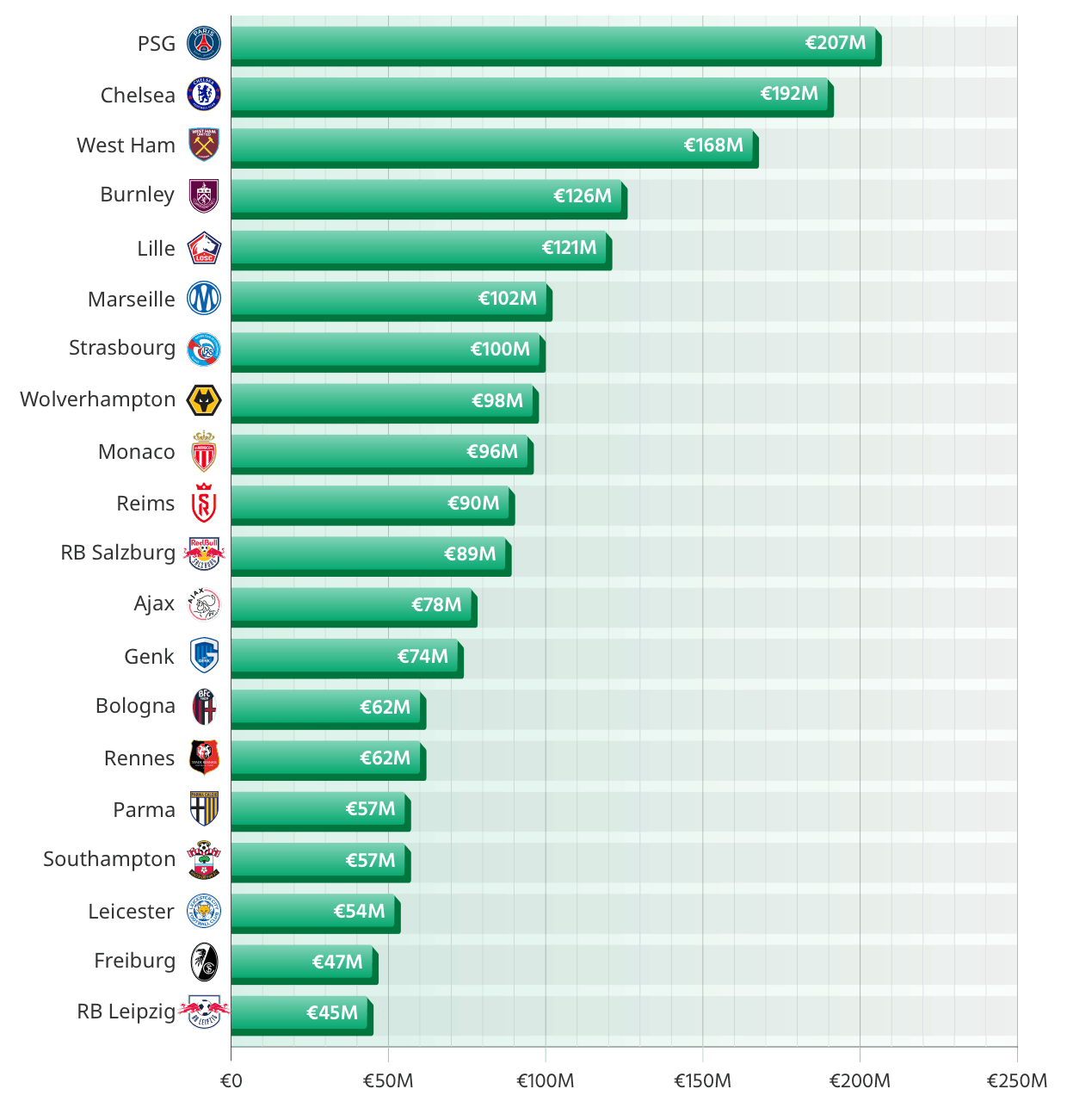
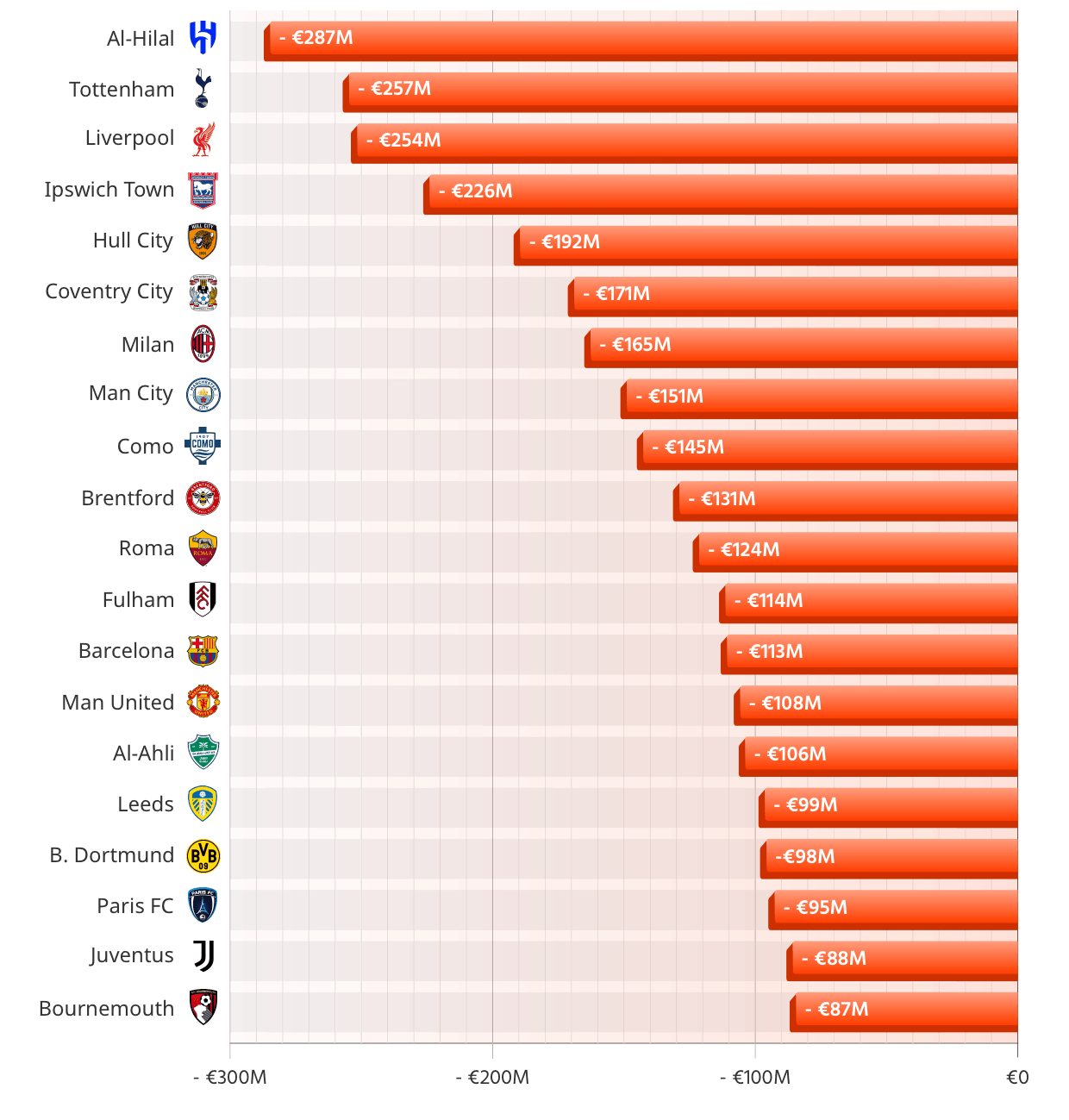
SportingPedia analysed clubs’ transfer spending and income from player sales during 2026, ranking the 20 teams with the highest net profits and the 20 with the largest net losses. PSG lead the profit ranking with €207m, followed by Chelsea with €192m and West Ham with €168m. Al-Hilal have the largest deficit at €287m, ahead of Tottenham at €257m and Liverpool at €254m.
The rankings also expose broader differences between markets. Six French clubs occupy places in the profit top 10, while seven feature in the top 20. English clubs are much more prominent on the opposite side, accounting for 11 of the 20 largest net losses, although Chelsea, West Ham, Burnley, Wolves, Southampton and Leicester also appear among the biggest profits.
Teams with the highest net profit
from player sales in 2026 (million)
Data Source: CIES Football-Observatory
Five Major Sales Put PSG at the Top
PSG lead the ranking after recording €375m in sales against €168m in expenditure, leaving a €207m surplus.
Most of that income can be traced to five major summer departures. Bradley Barcola moved to Liverpool for a €125m fixed fee, Gonçalo Ramos joined Milan for €74m, Ibrahim Mbaye went to Aston Villa for €55m, Randal Kolo Muani joined Juventus for €41.2m and Lee Kang-in moved to Atlético Madrid for €35m. Together, those five sales generated €330.2m. Barcola’s deal could eventually rise to €145m with bonuses.
PSG also reinvested substantially rather than simply reducing their squad. Maghnes Akliouche cost €50m, Ferran Torres €48.5m and Mika Godts €45m, meaning those three arrivals alone required €143.5m. Even after that recruitment, the volume of outgoing business left PSG with the largest positive balance of any club in the ranking.
Chelsea Generate €540m From Sales Despite Spending €348m
Chelsea’s second-place position is particularly notable because it did not result from restrained spending. The London club invested €348m in players but generated €540m from departures, the highest sales total among all 40 clubs in the two rankings.
Several major exits drove that figure. Enzo Fernández joined Manchester City for €145m, Marc Cucurella moved to Real Madrid for €55m, while Andrey Santos’ transfer to Manchester United was reported at €56m with further bonuses possible. Those three deals alone generated more than €250m.
West Ham follow Chelsea with a €168m surplus after selling €284m worth of players against €116m spent. Mateus Fernandes’ €99m transfer to Tottenham and Crysencio Summerville’s €64.5m move to Al-Hilal were two of the largest departures, contributing €163.5m between them.
Six French Clubs Occupy the Profit Top 10
PSG are joined by Lille, Marseille, Strasbourg, Monaco and Reims inside the top 10. Lille rank fifth with a €121m surplus, Marseille sixth with €102m, Strasbourg seventh with €100m, Monaco ninth with €96m and Reims tenth with €90m.
Rennes add another French club in 15th place with €62m, giving France seven representatives among the 20 highest net profits.
The individual balances were achieved in very different ways. Marseille spent only €19m while bringing in €121m, whereas Strasbourg remained highly active in both directions, spending €113m and receiving €213m. Reims generated €103m while spending only €13m.
Teams with the largest net losses
from player sales in 2026 (million)
Data Source: CIES Football-Observatory
Al-Hilal Spend €308m and Bring in Only €21m
The largest negative balance belongs to Al-Hilal. The Saudi club spent €308m while receiving just €21m from player sales, producing a €287m deficit.
Three Premier League attackers accounted for a large portion of that investment. Gabriel Martinelli joined from Arsenal for around €70m, Crysencio Summerville cost €64.5m from West Ham and Ollie Watkins arrived from Aston Villa for approximately €58.4m. Combined, those three deals alone were worth almost €193m.
Unlike PSG or Chelsea, Al-Hilal had little outgoing income to counter that expenditure. Their €21m in sales represented less than one-tenth of the amount committed to incoming players.
Tottenham Spend €518m Despite €261m in Sales
Tottenham sit second with a €257m net loss, but their position was not caused by a lack of outgoing business. Spurs generated €261m from sales – more than PSG received – only for their expenditure to reach €518m.
Some of the biggest investments came in midfield. Sandro Tonali joined from Newcastle for €108m, while Tottenham paid €99m for Mateus Fernandes. Jan Paul van Hecke cost €60m, while Savinho’s transfer from Manchester City was valued at about €87m. Those four additions alone account for €354m of the club’s annual expenditure.
Tottenham therefore provide one of the clearest examples of why a large sales figure does not necessarily produce a positive balance. Their €261m in outgoing income would rank fourth on the profit table if viewed in isolation, but the scale of their recruitment pushed the final balance €257m into negative territory.
Liverpool Finish Only €3m Behind Tottenham With Far Less Sales Income
Liverpool’s €254m deficit is almost identical to Tottenham’s despite a very different transfer profile. They spent €294m, €224m less than Spurs, but recovered only €40m from outgoing players.
Bradley Barcola was the Reds’ largest purchase. Liverpool also paid €63.6m for Jérémy Jacquet and €40m for Víctor Muñoz. Those three signings account for €228.6m of Liverpool’s €294m spending.
The comparison with Tottenham is particularly revealing. Spurs spent far more, but their €261m in sales compensated for a substantial part of that expenditure. Liverpool’s much smaller €40m sales return left the two clubs separated by only €3m in net loss.
Manchester City Receive €500m and Still Finish €151m Down
Manchester City’s figures show the greatest overall transfer turnover in the dataset. The club generated €500m from sales, second only to Chelsea, but expenditure reached €651m, leaving City with a €151m deficit.
Much of the spending went into a major midfield rebuild. Enzo Fernández arrived from Chelsea for €145m, Elliot Anderson cost around €136m and Ayyoub Bouaddi approximately €96m. Those three players required around €377m between them.
City also generated major fees themselves, including around €87m from Savinho’s move to Tottenham. Yet even half a billion euros in sales was not enough to offset their purchases.
That makes the contrast with Chelsea especially sharp. Chelsea generated €40m more from sales while spending €303m less. The result was a €192m surplus for Chelsea against City’s €151m deficit – a €343m difference in their final transfer balances.
English Clubs Appear at Both Extremes, but Dominate the Loss Ranking
England supplies 11 of the 20 clubs with the largest net losses: Tottenham, Liverpool, Ipswich Town, Hull City, Coventry City, Manchester City, Brentford, Fulham, Manchester United, Leeds and Bournemouth.
English clubs are also prominent among the biggest profits, although in smaller numbers. Chelsea rank second, West Ham third, Burnley fourth and Wolves eighth, while Southampton and Leicester complete the country’s six representatives on the positive side.
There is also a notable, but secondary, pattern among clubs moving between England’s top two divisions. Relegated West Ham, Burnley and Wolves occupy third, fourth and eighth in the profit ranking, while promoted Ipswich, Hull and Coventry rank fourth, fifth and sixth for net losses. The broader rankings, however, show that heavy selling and spending were far from limited to clubs changing divisions.
From PSG’s €207m Profit to Al-Hilal’s €287m Loss
The distance between the two ends of the ranking is substantial. PSG finished €207m ahead on transfer activity, while Al-Hilal finished €287m behind, creating a €494m gap between the highest positive and largest negative balances.
The figures also show that neither heavy spending nor large sales determine the final ranking on their own. Chelsea spent €348m and still posted the second-highest profit because their sales reached €540m. Tottenham received €261m but spent more than twice that amount. Manchester City sold €500m worth of players and nevertheless finished €151m down.
The defining figure is the relationship between the two sides of the market: how much clubs were able to recover through departures relative to what they committed to new players.