 | Updated:
 The English Premier League is often perceived as the strongest domestic football competition in the world, but its financial power operates on a different scale altogether. Premier League clubs dominate many of the biggest transfers, carry some of football’s most expensive squads and regularly compete for players with teams across Europe and beyond. When an English club enters the race for a footballer, the financial context of the deal can change considerably simply because of the spending power associated with the competition.
That dominance is easy to see when leagues are compared by the combined market value of all their players, but the overall figure tells only part of the story. Some competitions contain several hundred more registered footballers than others, meaning that two leagues with similar totals can look very different once the size of their respective player pools is taken into account. To examine both sides of the picture, SportingPedia analysed 38 top-flight domestic leagues using Transfermarkt data, comparing their total player valuations before dividing each figure by the number of registered footballers to calculate players’ average market value.
Only the highest domestic division from each country was included in the study. This excludes competitions such as the English Championship, despite its considerable financial scale. Valued at €2.24bn across 666 players, the Championship would rank sixth by total market value among the leagues analysed and seventh by players’ average market value, at approximately €3.36m.
Top-Flight Football Leagues Worldwide
Valued Above €500 Million
Data Source: Transfermarkt
The Premier League Is Valued Higher Than La Liga and Serie A Combined
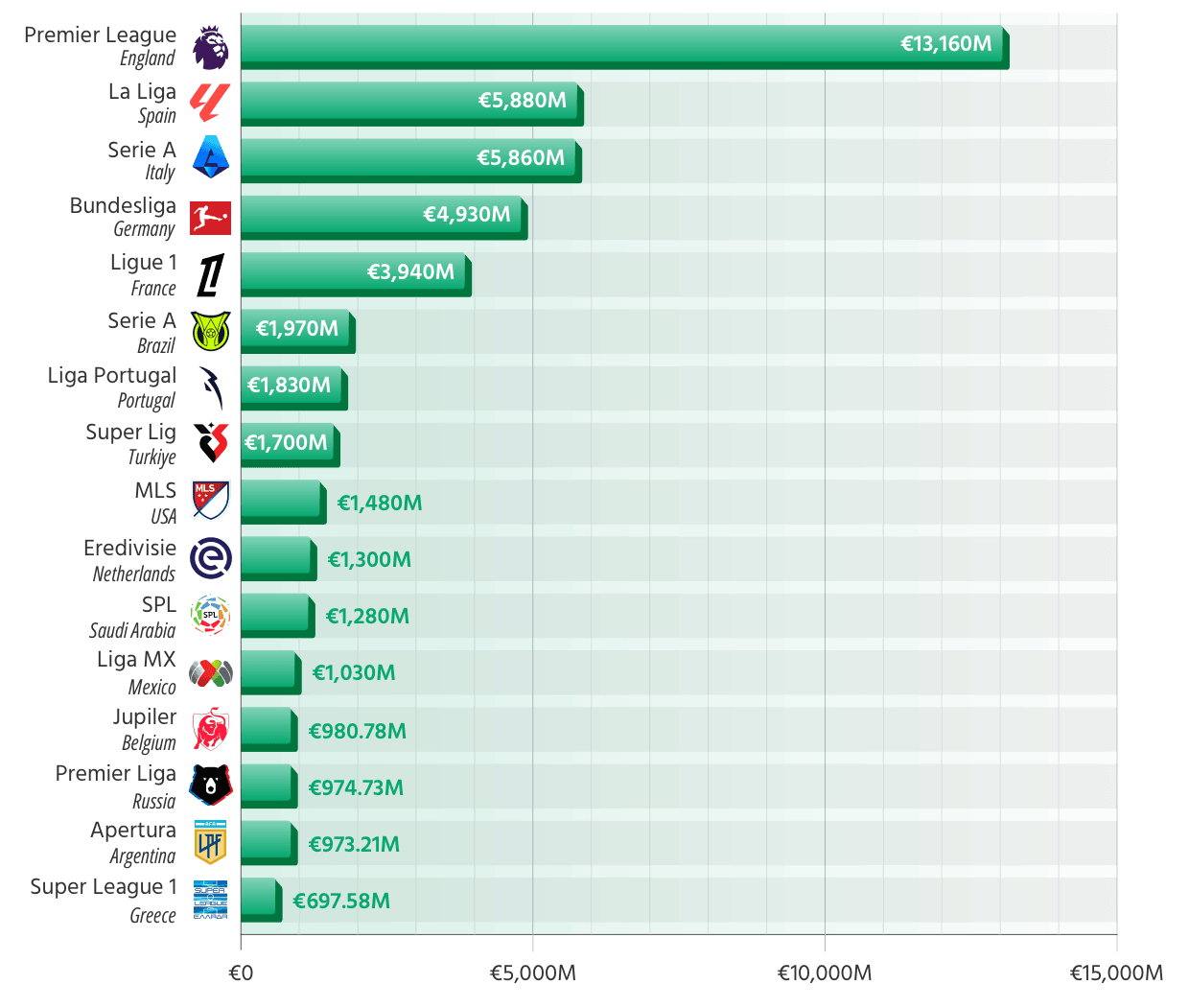
The gap at the top is enormous. The Premier League’s 544 players have a combined market value of €13.16bn, putting England comfortably ahead of La Liga at €5.88bn and Serie A at €5.86bn. Spain and Italy are effectively level, separated by only €20m, while the Bundesliga follows at €4.93bn and Ligue 1 completes the traditional European big five at €3.94bn. Even when La Liga and Serie A are combined, their €11.74bn total remains €1.42bn below the Premier League alone.
There is then a major drop before the rest of the world begins to appear. Brazil’s Serie A ranks sixth with €1.97bn, exactly half the valuation of Ligue 1, and is the highest-ranked competition from outside Europe. Liga Portugal follows on €1.83bn, Türkiye’s Süper Lig stands at €1.70bn and MLS comes next with €1.48bn, while the Eredivisie and Saudi Pro League are valued at €1.30bn and €1.28bn respectively. Liga MX is the final competition above €1bn, with €1.03bn.
The middle of the ranking becomes considerably tighter. Belgium’s Jupiler Pro League is valued at €980.78m, Russia’s Premier Liga at €974.73m and Argentina’s Apertura at €973.21m, meaning less than €8m separates three competitions from three different continents. Greece, meanwhile, sits 16th at €697.58m and is the last of the 16 top flights valued above €500m.
Top-Flight Football Leagues Worldwide
Where the Players’ Average Market Value is Over €1 Million
Data Source: Transfermarkt
The Average Value of a Premier League Player is €24.19m, More Than Twice La Liga
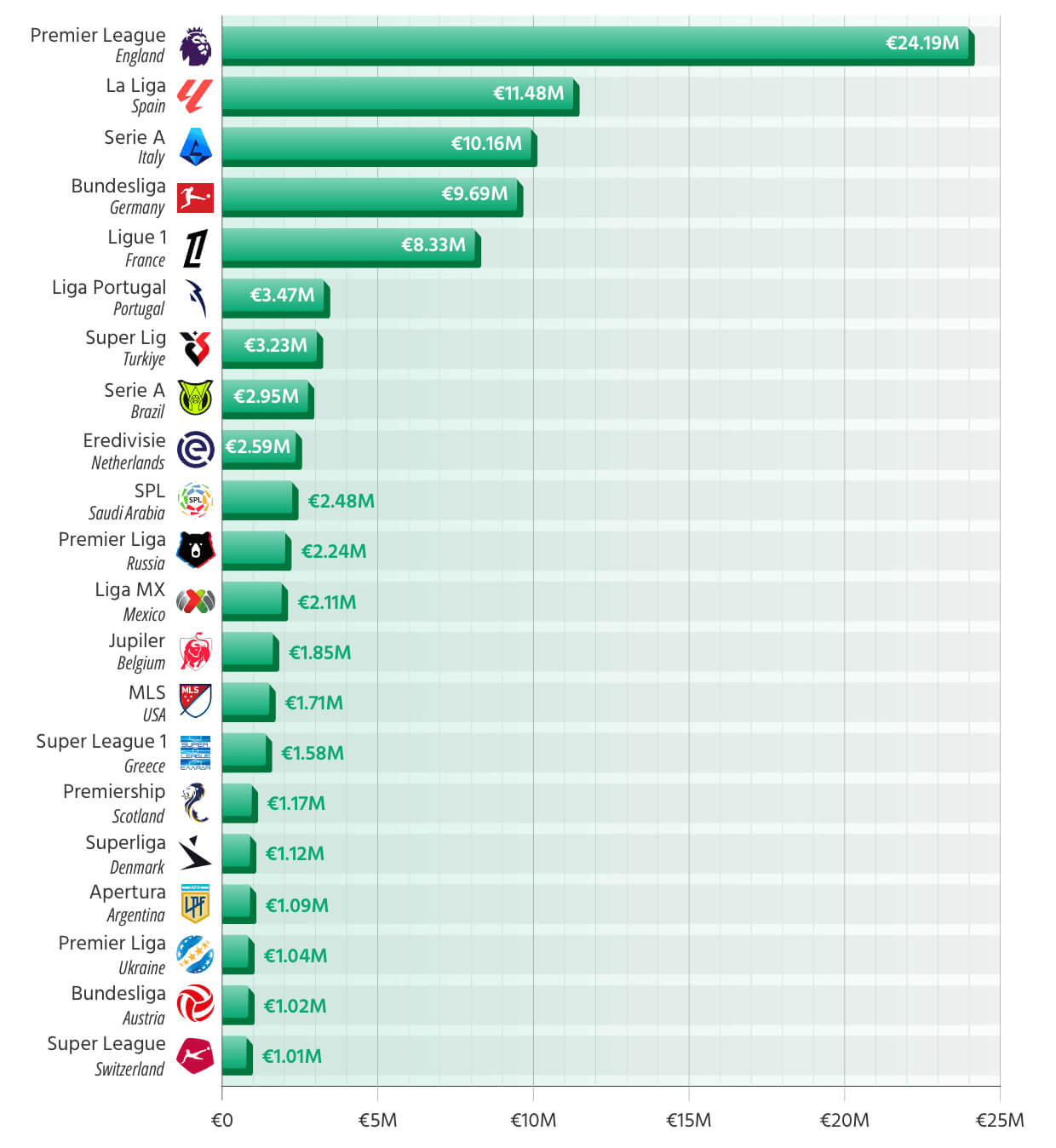
Changing the calculation from the total value of a competition to the average across its registered footballers does nothing to disturb the top five, but it makes the scale of England’s advantage even clearer. Premier League players average €24.19m, compared with €11.48m in La Liga, meaning the English figure is more than double that of its nearest rival. Serie A remains third at €10.16m, followed by the Bundesliga at €9.69m and Ligue 1 at €8.33m.
What changes dramatically is the distance between fifth place and everyone below it. France’s €8.33m average is followed by just €3.47m in Liga Portugal, a gap of €4.86m between fifth and sixth. Türkiye follows at €3.23m, while Brazil slips from sixth in the overall ranking to eighth at €2.95m because its €1.97bn total is spread across 667 players. The Netherlands comes next at €2.59m, with Saudi Arabia completing the top 10 at €2.48m.
Russia rises to 11th with €2.24m, ahead of Mexico at €2.11m, Belgium at €1.85m and MLS at €1.71m. Greece follows at €1.58m, while Scotland, Denmark, Argentina, Ukraine, Austria and Switzerland also remain above seven figures. In total, 21 of the 38 competitions have an average above €1m, with Switzerland narrowly clearing the threshold at €1.01m and Qatar immediately below it at €0.95m.
Comparison of Each League’s Rank
by Total Market Value and by Players’ Average Market Value
Data Source: Transfermarkt
MLS Falls Behind Liga MX Once Player Numbers Enter the Comparison
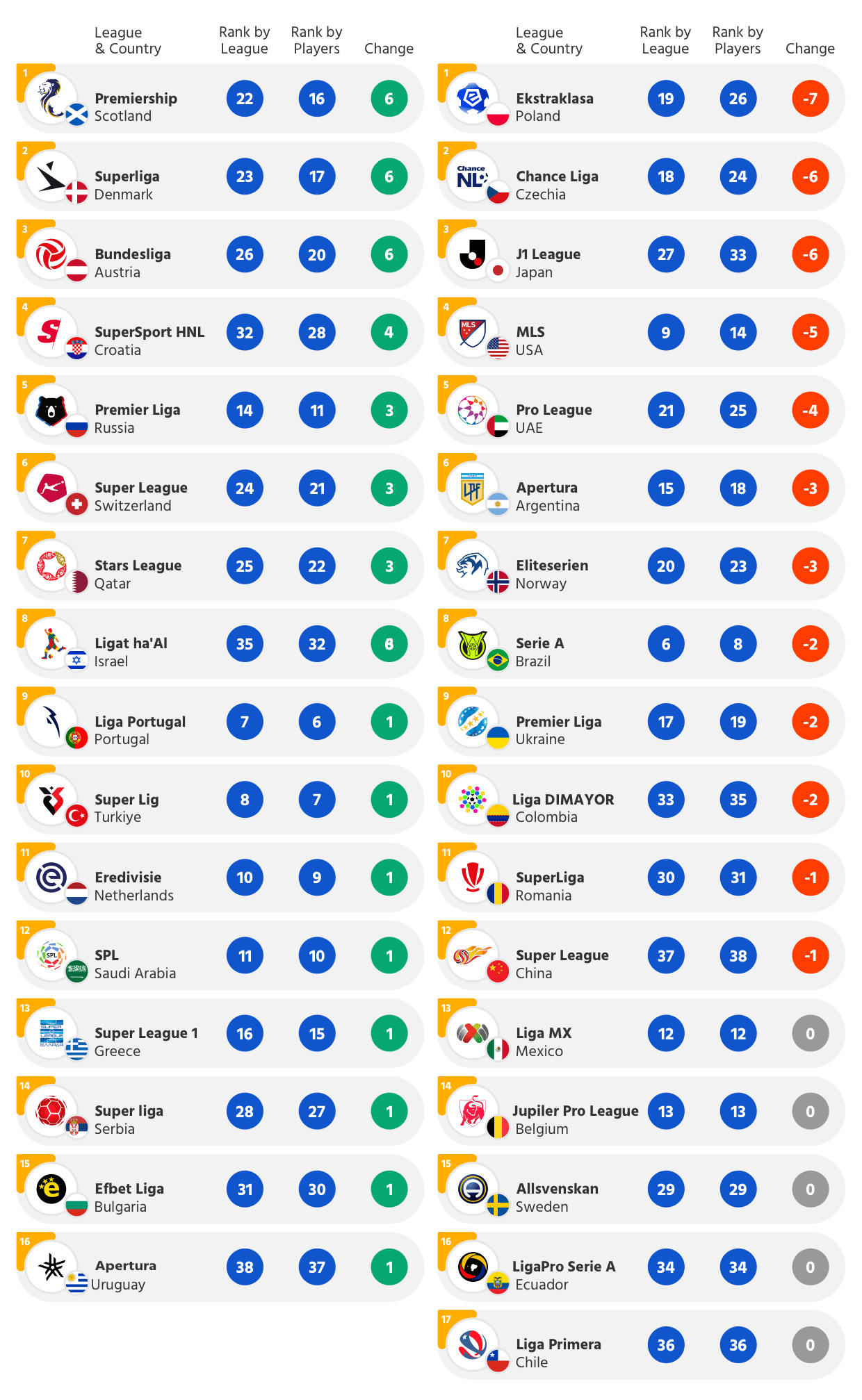
The contrast between MLS and Liga MX is one of the clearest examples of why the two rankings do not tell the same story. MLS is valued at €1.48bn overall, substantially above Liga MX’s €1.03bn, and therefore starts ninth compared with Mexico’s 12th place. The American competition, however, contains 868 registered players, while Liga MX has 487, so that considerably larger player pool reduces the MLS average to €1.71m.
As a result, MLS drops five positions to 14th, while Liga MX stays 12th at €2.11m and moves ahead of its North American rival. Argentina experiences a similar effect. Its €973.21m total is enough for 15th place overall, but the competition has 893 players, the largest number among all 38 leagues, bringing the average down to €1.09m and moving Argentina three places lower to 18th.
Japan is affected even more heavily. The J1 League ranks 27th by total valuation at €309.95m, but that figure is distributed among 684 footballers, leaving an average of €0.45m and pushing the competition down six places to 33rd. Brazil also loses ground, although less dramatically, moving from sixth to eighth as Portugal and Türkiye pass it.
Scotland, Denmark and Austria Each Climb Six Places
The same calculation works strongly in the opposite direction for competitions with smaller player pools. Scotland’s Premiership is valued at €386.48m and ranks only 22nd overall, but its 329 footballers produce an average of €1.17m. That lifts Scotland to 16th, a six-place gain and one of the largest upward movements in the study.
Denmark follows an almost identical pattern. Its €363.98m total places the Superliga 23rd, yet with only 324 players the average reaches €1.12m, moving Denmark six positions higher to 17th. Austria also gains six, climbing from 26th to 20th after its €338.14m valuation is spread across 332 footballers.
These movements underline just how much league size can reshape the comparison. Argentina is valued at more than two and a half times as much as Scotland overall, yet Scotland finishes above it on the second measure because Argentina’s player pool is nearly three times larger. Croatia offers another example: with just 321 registered footballers, the smallest number in the study, it moves from 32nd to 28th despite having a combined valuation of only €203.04m.
Russia, Switzerland, Qatar and Israel also benefit noticeably, each climbing three positions. Their gains are less dramatic than those of Scotland, Denmark and Austria, but together they show that a relatively modest league total does not necessarily translate into the same position once the number of players behind that figure is considered.
Poland Records the Biggest Fall, Dropping Seven Positions
Poland moves further in the opposite direction than any of the other 38 competitions. The Ekstraklasa ranks 19th by combined valuation at €413.30m, but with 532 registered players its average falls to €0.78m. That leaves Poland 26th on the second ranking, a seven-place decline.
Czechia and Japan are close behind with six-place drops. The Chance Liga falls from 18th to 24th, while Japan moves from 27th to 33rd. MLS loses five places and the UAE Pro League four, while Argentina and Norway each move down three positions. Brazil, Ukraine and Colombia decline by two, with Romania and China slipping one place each.
There are also 10 competitions whose positions do not change at all. England, Spain, Italy, Germany and France remain locked into the first five places regardless of which measure is used, while Mexico and Belgium also stay 12th and 13th respectively. Further down the table, Sweden, Ecuador and Chile likewise retain their original positions.
Player Pools Range From 321 in Croatia to 893 in Argentina
The scale of the differences in player numbers helps explain why some leagues move so sharply while others barely change. Argentina has 893 registered footballers, the largest player pool in the study, with MLS close behind on 868. Japan has 684 and Brazil 667, meaning all four competitions spread their overall valuations across substantially more players than most of the leagues around them.
At the other end, Croatia has just 321 players, followed by Denmark with 324, Scotland with 329 and Austria with 332. It is therefore no coincidence that these competitions feature prominently among the biggest upward movers. Croatia has 572 fewer registered footballers than Argentina, while Argentina’s player pool is almost 2.8 times as large.
Looking at both rankings therefore reveals two different aspects of football’s financial landscape. The overall valuation reflects the scale of the entire player pool in each competition, while the second comparison shows how concentrated that value is once the number of registered footballers is taken into account. At the very top, the result does not change at all: the Premier League remains far ahead and Europe’s big five preserve exactly the same order. Beneath them, however, the picture becomes far less stable, with differences in player numbers enough to move individual competitions by as many as seven places.