 | Updated:
 A World Cup year can reshape a footballer’s status faster than almost any other point in the calendar. Breakout club seasons, international exposure and major summer transfers can send young players sharply upward, while injuries, long absences and declining form can erase tens of millions from the valuations of established stars.
Sportingpedia compared footballers’ market values on 1 January 2026 with their current valuations in October, measuring both the absolute change in euros and the percentage movement over the period. The biggest gains are dominated by players still at the beginning of their careers, while many of the steepest falls belong to footballers whose 2026 has been interrupted by injuries or reduced availability.
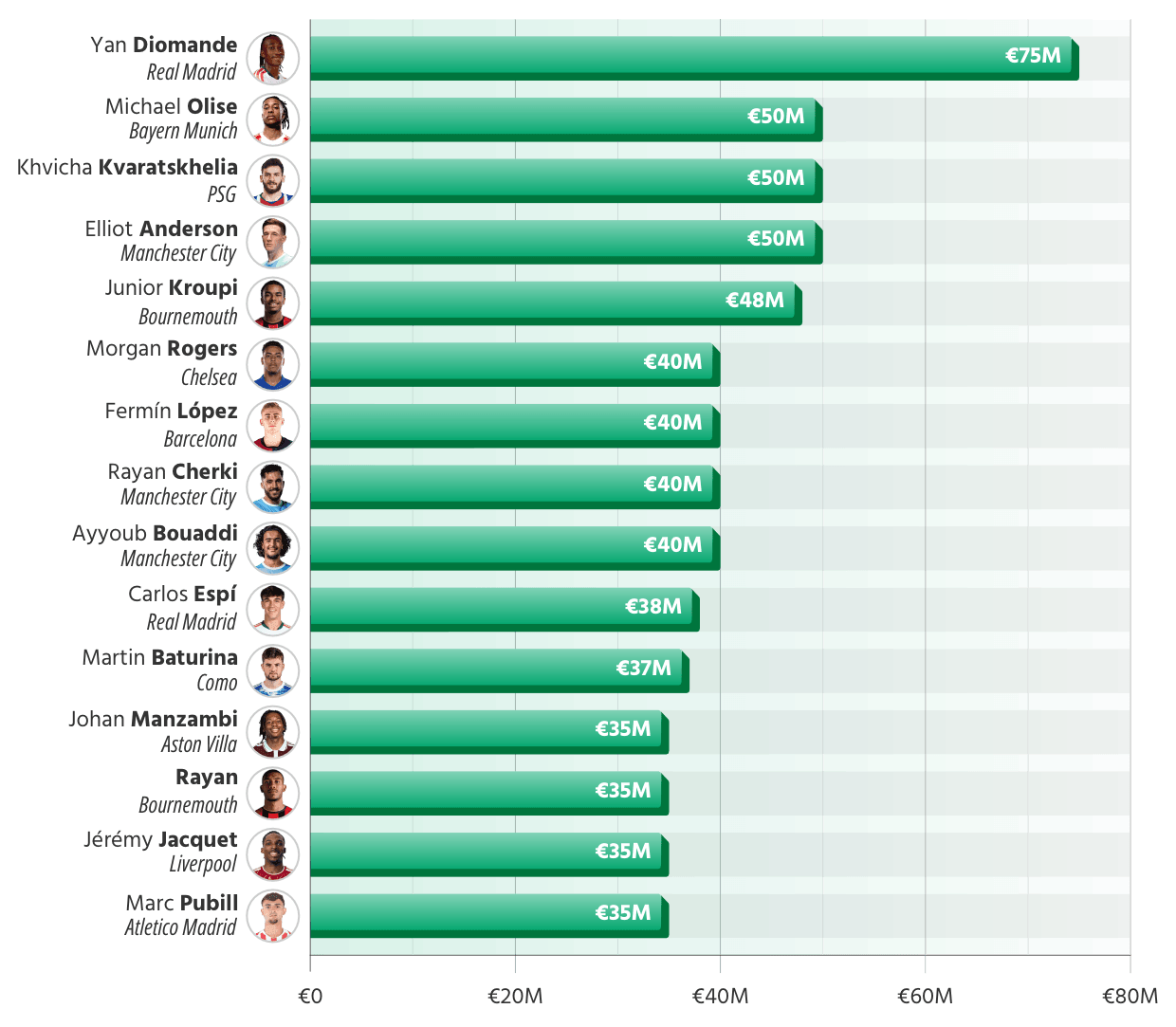
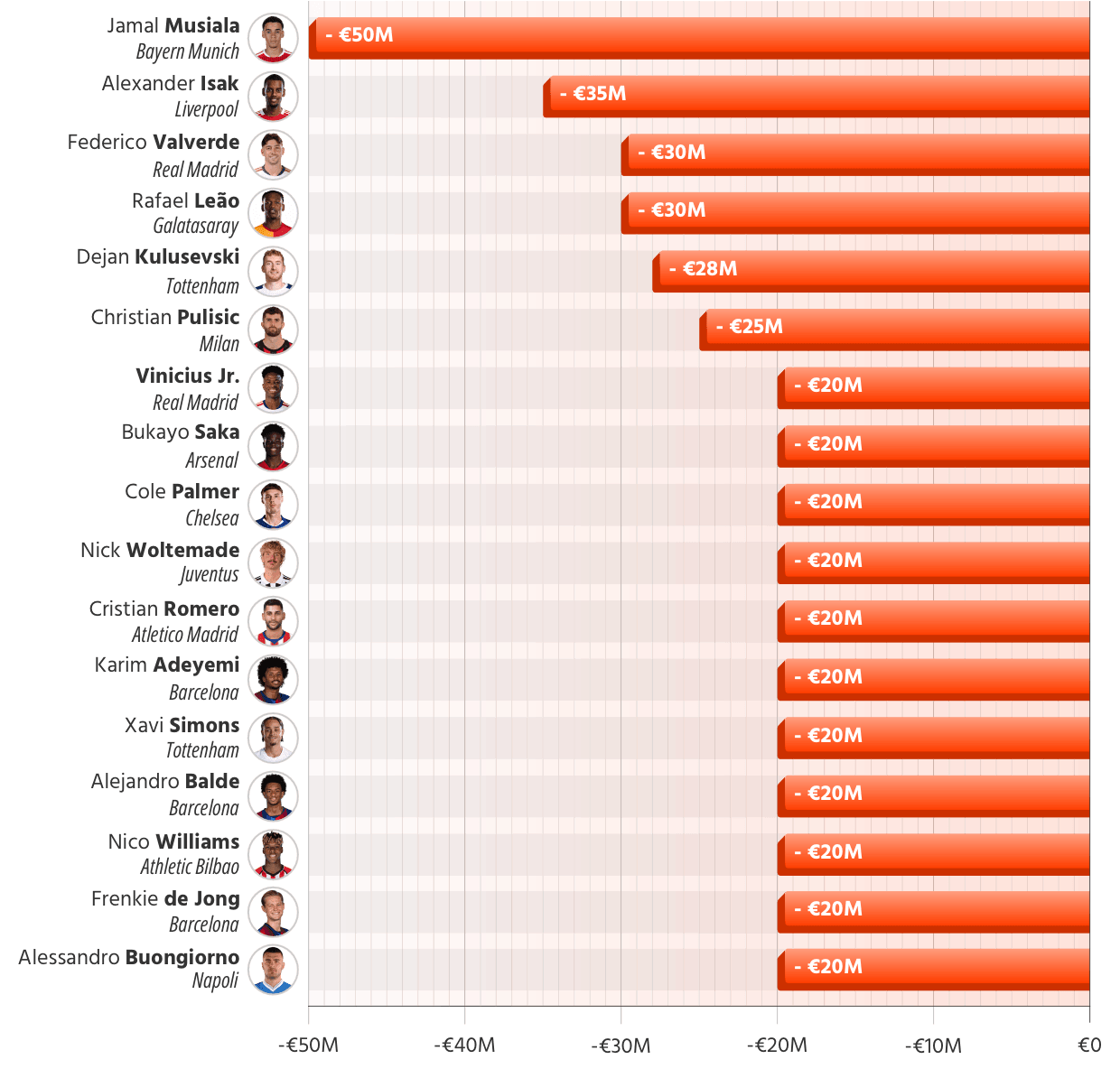
Yan Diomande leads all increases after climbing from €45m to €120m, a gain of €75m. Michael Olise, Khvicha Kvaratskhelia and Elliot Anderson have each added €50m, while Junior Kroupi follows at +€48m. At the opposite end, Jamal Musiala has fallen by €50m, Alexander Isak by €35m, and Federico Valverde and Rafael Leão by €30m each.
Footballers with the largest market value gains in 2026 (million)
Data Source: Flashscore
Diomande turns one breakthrough season into a €75m rise
Yan Diomande started 2026 at €45m after only a few months of top-level football in Germany. By the end of his first season with RB Leipzig, the Ivorian winger had produced 13 goals and 10 assists in 36 competitive appearances, including 12 Bundesliga goals, and was named the league’s Rookie of the Season. He then represented Côte d’Ivoire at the World Cup before Real Madrid signed him in August on a seven-year contract. His valuation now stands at €120m, 166.7% higher than on New Year’s Day.
Michael Olise follows with a €50m increase, but his route is different. The Bayern winger was already worth €130m in January and has moved to €180m after being named Bundesliga Player of the Season for 2025/26, a campaign in which no player registered more league assists and only Harry Kane recorded more combined goals and assists. Olise also remained part of France’s attack through the World Cup and has carried that form into the new season, making his rise one of consolidation at the very top rather than a sudden breakthrough.
Khvicha Kvaratskhelia and Elliot Anderson complete the group of three players gaining exactly €50m. Kvaratskhelia has moved from €90m to €140m at PSG, while Anderson has jumped from €60m to €110m after establishing himself with England and completing a blockbuster move from Nottingham Forest to Manchester City following the World Cup. City agreed the transfer while Anderson was still with England in North America, with the deal reported at up to £116m.
The World Cup fed straight into the summer transfer market
For several of the biggest risers, the 2026 World Cup sat directly between a strong club season and a major transfer. Diomande moved to Real Madrid after representing Côte d’Ivoire, Anderson joined Manchester City after playing for England, and Morocco midfielder Ayyoub Bouaddi moved from Lille to City after helping his country reach the quarter-finals. Bouaddi has doubled from €40m to €80m, completing one of the nine increases of 100% or more.
Morgan Rogers also converted an important club season and World Cup into a summer move. He helped Aston Villa win the Europa League, represented England seven times as they reached the World Cup semi-finals and won the third-place play-off, then signed for Chelsea in July. His market value has risen from €70m to €110m, putting him alongside Fermín López, Rayan Cherki and Bouaddi on a €40m increase.
The World Cup was not the sole reason for those increases, but it arrived at the perfect moment for players whose reputations were already accelerating. A strong domestic campaign could be followed immediately by global exposure and then a transfer to one of Europe’s wealthiest clubs, compressing several career-changing events into a matter of months.
Nine players have doubled their value — all are 23 or younger
The largest percentage gains reveal an even stronger youth pattern. Nine of the 15 biggest risers have at least doubled their January valuation, and not one of those nine is older than 23: Diomande, Junior Kroupi, Ayyoub Bouaddi, Carlos Espí, Martin Baturina, Johan Manzambi, Rayan, Jérémy Jacquet and Marc Pubill.
Carlos Espí is the extreme case. The Spanish striker began the year at just €2m and is now valued at €40m, producing an increase of 1,900%. Real Madrid signed the 21-year-old from Levante in July after he had scored 20 goals in 66 senior appearances and been named the league’s best U23 player in 2025/26.
Marc Pubill has risen 233.3% from €15m to €50m, Junior Kroupi 218.2% from €22m to €70m and Martin Baturina 205.6% from €18m to €55m. Jérémy Jacquet has climbed from €20m to €55m before and after his move to Liverpool, while Rayan has gone from €25m to €60m at Bournemouth. In absolute terms those increases sit below Diomande or Olise, but relative to where the players started 2026, their status has changed far more dramatically.
Twelve of the 15 biggest gainers are 23 or younger
The age split extends beyond the players who doubled their value. Twelve of the 15 biggest gainers are no older than 23, with Diomande and Bouaddi aged 19, Junior Kroupi, Johan Manzambi and Rayan aged 20, and Espí and Jacquet aged 21. Only Michael Olise, Morgan Rogers and Khvicha Kvaratskhelia are older than 23.
The average age of the biggest gainers is 21.9, compared with 25.6 for the biggest fallers. Only Musiala, Xavi Simons and Alejandro Balde are 23 or younger on the losses side, while nine of the 17 players losing the most value are already 26 or older. The movement therefore runs in opposite directions across two very different career stages: rapid appreciation among players establishing themselves at elite level and downward revisions among several already-established names.
Footballers with the largest market value losses in 2026 (million)
Data Source: Flashscore
Musiala loses €50m after spending much of the year fighting back from injury
Jamal Musiala entered 2026 still rehabilitating the fractured fibula and ankle dislocation suffered against PSG at the 2025 Club World Cup. He finally returned for Bayern against RB Leipzig in January after 196 days out, but another reaction in the same ankle forced him back onto the sidelines in March. His valuation has fallen from €130m to €80m, making his €50m decline the largest absolute loss.
Alexander Isak follows with a €35m fall from €120m to €85m. The Liverpool striker underwent surgery in December 2025 after suffering an ankle injury that included a fibula fracture, meaning the opening months of 2026 were spent in rehabilitation rather than leading the line. His decline is smaller in percentage terms than several players below him, but the starting valuation was high enough for a 29.2% reduction to wipe €35m from his value.
Dejan Kulusevski has lost slightly less in euros but far more proportionally. His valuation has collapsed from €45m to €17m, a 62.2% drop, after a long recovery from right-knee surgery kept him out for an extended period. Tottenham reported in August that he was still training individually as he worked towards a return.
Serious injuries appear repeatedly among the biggest fallers
Xavi Simons has dropped from €60m to €40m after rupturing the ACL in his right knee in April. The injury required surgery, ended his club season and ruled him out of contention for the Netherlands’ World Cup campaign. By July he was still working through rehabilitation at Tottenham, turning what should have been a World Cup summer into months away from competitive football.
Frenkie de Jong has also lost €20m, falling from €45m to €25m, and his 44.4% decline is joint-second only to Kulusevski among the percentage losses. Barcelona confirmed in July that the midfielder had torn the medial collateral ligament in his right knee and would continue with conservative treatment. Cole Palmer’s fall from €120m to €100m came after a season repeatedly disrupted by a groin problem, which also contributed to him missing England’s World Cup squad.
Those cases help explain why the losses cannot simply be read as verdicts on footballing ability. Musiala, Isak, Kulusevski, Xavi Simons, De Jong and Palmer all spent important stretches of 2026 unavailable or working back towards full fitness, reducing the number of matches in which they could defend valuations built during previous seasons.
Leão and Vinicius show that not every drop is injury-driven
Rafael Leão has lost €30m, falling from €70m to €40m, and his summer transfer placed an unusually clear market price beside that revised valuation. Galatasaray paid Milan €38m for the Portuguese winger in August, almost exactly matching his current €40m market value. His 42.9% fall is the fourth-largest percentage decrease among these players.
Vinicius Junior presents a different case. His value has dropped €20m from €150m to €130m after a 2026 in which Real Madrid finished another season without a major trophy and Brazil were eliminated in the World Cup round of 16. Vinicius still scored four goals and supplied one assist at the tournament, but Brazil’s early exit fell well short of expectations for one of the pre-tournament favourites. His slow start to 2026/27 has added to that disappointment, with Brazil coach Carlo Ancelotti publicly calling for patience with the winger at the end of September.
Federico Valverde has lost €30m from €120m to €90m, while Bukayo Saka and Cole Palmer have each fallen €20m despite remaining valued at €110m and €100m respectively. These cases underline the difference between an absolute-value decline and a collapse in status: a €20m fall can still leave a player among football’s most valuable names.
The biggest shifts cluster around City, Barcelona, France and Germany
Manchester City have three of the biggest risers, led by Elliot Anderson’s €50m increase to €110m. Rayan Cherki has added €40m to reach €90m and Ayyoub Bouaddi has doubled to €80m, with Anderson and Bouaddi both arriving after featuring at the World Cup. Their rapid appreciation comes while City await the outcome of their appeal after an independent Premier League commission found the club guilty of serious financial-rule breaches.
Barcelona provide the clearest contrast, with Karim Adeyemi, Alejandro Balde and Frenkie de Jong all losing €20m. Adeyemi and Balde have fallen from €60m to €40m, while De Jong is down 44.4% from €45m to €25m. Real Madrid sit on both sides of the equation: Yan Diomande and Carlos Espí are among the year’s biggest risers, while Vinicius Junior and Federico Valverde have lost €20m and €30m respectively.
The nationality split produces an equally clear divide. France supplies four of the 15 biggest risers – Michael Olise, Junior Kroupi, Cherki and Jérémy Jacquet – whose values have increased by a combined €173m, more than any other nation. Germany leads the losses through Jamal Musiala, Nick Woltemade and Adeyemi, who are down €90m between them, while Sweden follows with Alexander Isak and Dejan Kulusevski losing a combined €63m. Spain and England are represented strongly on both sides, with major gains for Fermín López, Carlos Espí, Marc Pubill, Anderson and Morgan Rogers offset by declines for Alejandro Balde, Nico Williams, Bukayo Saka and Cole Palmer.
Methodology
Using Transfermarkt’s database we compared each player’s market value on 1 January 2026 with their latest available valuation in October 2026. Players are ordered by the absolute change in millions of euros.