Football Betting Odds Explained
 | Updated:
  Wagering on football has become a popular form of entertainment for many gambling enthusiasts. This comes as no surprise, considering that football, or soccer in the USA, is one of the most exhilarating and unpredictable sports. Football remains one of the most intense sports, often creating suspense and keeping fans on the edge of their seats. This unique appeal explains why the sport attracts so much betting activity.
 Best Rated Bookmakers for United States
-
 Claim
Claim
$1000
Match Bonus9.718+ New customers only. 100% match bonus up to $1000. Min deposit $50. 10x rollover requirement. Promocode: MYB100 -
Claim
$250
Match Bonus9.4Join Bovada, make your first deposit and instantly receive a 50% Sports Welcome Bonus up to $250. -
Claim
$500
Match Bonus9.3Get a 100% Bonus, up to $500, to wager in the Xbet Sportsbook when you sign up and fund your new account with minimum of $45. Be sure to use promocode XB100 to claim this offer on your first deposit. 7x rollover requirement prior withdrawal. -
Claim
$200
Match Bonus9.2The bonus and the deposit need to be rolled over 4x at min. odds of -200 (1.5) before a payout is possible Max. $200 of every bet count towards the rollover. -
Claim
$150
Match Bonus9.1Get a 150% Bonus, up to $150, to wager in the BetUSR Sportsbook. Deposit minimum $100 and wager at least $500 within 30 days of registerening your account and you will automatically qualify for $150 CASH BONUS with just 1x wagering requirement.





Football is easily a favorite among punters because it offers a broad variety of betting opportunities. Gambling operators aim to meet bettors’ needs by providing an abundance of wagers. Still, to get the most out of your betting session, you should first familiarize yourself with the specifics of football betting. Therefore, take some time to learn about the basic football wagers.
Additionally, to understand how football betting works, you should learn about the different odds formats. Even a basic knowledge of odds will help you make more informed betting decisions because you will be able to assess the probability of your bet winning and determine whether it offers good value.
Basics of Football Betting Odds
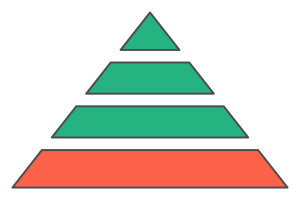 One of the most important things to remember about football betting odds is that they determine the amount you will receive from a winning bet. Thus, the higher the odds on a specific football matchup, the larger the potential payout. Odds also indicate the likelihood of an outcome. A more probable outcome will have lower odds, while a less probable outcome will have higher odds. This is why bettors often refer to odds as the price of a wager.
Football bettors should also know that there are two types of odds: odds-against and odds-on. Odds-against indicate that the potential profit is larger than the stake. With odds-on, the amount you can potentially win is smaller than the amount you stake.
When a bet is more likely to lose, it usually comes with odds-against. Odds-on can be tricky because you risk staking a larger amount than you can win. A common odds-on situation is backing the favorite.
Main Odds Formats
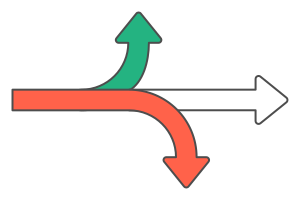 Once you understand the basic principles of odds, you can move on to the details. Odds are displayed in three main formats: decimal, American, and fractional. Remembering the distinctive traits of each format may seem daunting at first, but after a little study, you will see that it is easier than it looks.
Decimal Odds
 Decimal odds are the most widely used of the three formats. Most online bookmakers offer them, except those that focus on the United States. They are popular because they are straightforward and easy to read.
This format is common among bettors in Australia, Europe, and Canada. Odds are shown with two decimal places, such as 2.00 or 1.50. To calculate your potential return, simply multiply your stake by the odds. Remember that the return includes your original stake. For instance, a $100 stake at odds of 1.50 returns $150 (100 x 1.50 = 150).
To calculate profit only, subtract 1 from the odds, then multiply the result by your stake: stake x (odds – 1). Odds of 2.00 represent even money. Odds above 2.00 are odds-against, while odds below 2.00 are odds-on.
Moneyline Odds
Moneyline odds, also known as American odds, are the next  format we will examine. As the name implies, this format is most popular among bettors in the United States. It may be confusing at first because the odds can be positive or negative.
A positive sign shows the profit you would make on a $100 wager. For instance, if a team is listed at +200, a $100 bet would yield $200 in profit. If you stake $200 instead, your total return would be $600. The formula for profit is: stake x (odds / 100).
Conversely, a negative sign indicates how much you must risk to win $100. If the odds are -120, you need to wager $120 to profit $100, for a total return of $220. If you stake $100 at odds of -200, your total return would be $150. The formula for profit is: stake x (100 / the absolute value of the odds).
In this format, even money is represented by +100. A negative sign indicates odds-on, while a positive sign indicates odds-against.
Fractional Odds
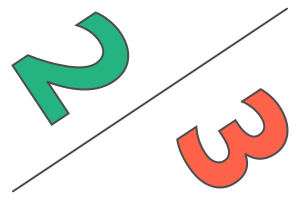 Fractional odds are the traditional format that appears at almost every bookmaker in the United Kingdom. Recently, however, decimal odds have begun to replace them. Some bettors avoid fractional odds because calculating payouts and profits can be tricky. Remember that fractional odds show potential profit only. To find the total payout, add your stake to the profit.
Although the format may look intimidating at first, it becomes easy to understand with practice. Odds are displayed as fractions, such as 5/1, pronounced “five to one.” This means you would profit five units for every one unit staked. Odds of 6/4 mean you would profit six units for every four units staked. To calculate profit, use: stake x (numerator / denominator).
In this format, even money is expressed as 1/1. If the numerator is larger than the denominator, the odds are odds-against, meaning the potential profit exceeds the stake. If the denominator is larger, the odds are odds-on, indicating that you risk more than you can win.
What Is Implied Probability
 Implied probability is another essential concept in football betting. Bettors who want to profit over the long term need to understand the difference between odds and probability. Although the two are related, odds do not always reflect the true chance of an event occurring.
Probability can be expressed as a percentage or a decimal. At 100%, an event is certain to occur, while 0% means it will not occur. In decimal form, probabilities range from 0 to 1.0.
Sometimes, probability is easy to calculate, as with a coin toss, where each of the two outcomes has a 50% chance. Football betting is different because many variables come into play, so bettors cannot estimate probability with complete accuracy.
However, gamblers can use odds to determine the implied probability of a specific outcome. This helps them identify the bookmaker’s margin and decide whether a wager offers good value.
For example, if a match is priced at odds of 2.00, the implied probability is 1 divided by 2.00, which equals 0.5. Multiply this figure by 100 to convert it to a percentage: 50%.
We chose this simple example for clarity. If the true probability were exactly 50%, the bet would have no edge because your chance of winning would equal your chance of losing.
What Is Value in Football Betting
 Expected value is another key concept because it represents how much money bettors can expect to win or lose on a stake over time. If a bet has a better chance of winning than the odds suggest, it carries positive value. If it is less likely to win than the odds imply, it has negative value. To profit over the long term, you need to place bets with positive expected value.
Consider another coin toss with equal chances of heads and tails. Suppose a bookmaker offers odds of 3.00 on heads and 1.50 on tails. If you stake $10, a winning bet on heads returns $30, while a winning bet on tails returns $15.
Which option offers better value? Backing heads is the better choice. The wager has positive value because the implied probability is lower than the actual 50% chance of winning.
The implied probability for heads is 1 / 3.00 = 0.3333, or 33.33%. For tails, it is 1 / 1.50 = 0.6667, or 66.67%.
This example illustrates why identifying wagers with positive value is essential: such bets are expected to generate profit over time.
Finding the Best Value
 Several simple tips can help you find the best value. First, bet on competitions and teams you know well. If you closely follow a particular tournament, you will find it easier to make informed decisions.
Do not automatically dismiss favorites. Some bettors assume that low odds cannot provide positive value, but what matters is the relationship between the odds and the true probability.
When searching for value, consider as many factors as possible that could influence the match. Otherwise, your judgments may be inaccurate. Always factor in injuries, schedules, team form, and other relevant information.
Finally, open accounts with more than one online sportsbook. This way, you can compare the odds each bookmaker offers and choose the most advantageous price. Even small differences can affect your long-term results, so spending a few minutes comparing odds can be worthwhile.