Football Betting Systems Explained
 | Updated:
  Soccer remains one of the most popular sports among bettors. Unsurprisingly, an ever-growing number of bettors choose soccer for their betting sessions, hoping to make successful predictions and earn a profit.
Many bettors find football wagering exciting because the sport is eventful and unpredictable. As a result, betting on soccer has become a hugely popular form of entertainment, especially among bettors willing to devote time to researching matches.
 Best Rated Bookmakers for United States
-
 Claim
Claim
$1000
Match Bonus9.718+ New customers only. 100% match bonus up to $1000. Min deposit $50. 10x rollover requirement. Promocode: MYB100 -
Claim
$250
Match Bonus9.4Join Bovada, make your first deposit and instantly receive a 50% Sports Welcome Bonus up to $250. -
Claim
$500
Match Bonus9.3Get a 100% Bonus, up to $500, to wager in the Xbet Sportsbook when you sign up and fund your new account with minimum of $45. Be sure to use promocode XB100 to claim this offer on your first deposit. 7x rollover requirement prior withdrawal. -
Claim
$200
Match Bonus9.2The bonus and the deposit need to be rolled over 4x at min. odds of -200 (1.5) before a payout is possible Max. $200 of every bet count towards the rollover. -
Claim
$150
Match Bonus9.1Get a 150% Bonus, up to $150, to wager in the BetUSR Sportsbook. Deposit minimum $100 and wager at least $500 within 30 days of registerening your account and you will automatically qualify for $150 CASH BONUS with just 1x wagering requirement.





Few football bettors are comfortable losing money. For this reason, it is important to remember that betting on the sport requires considerable time and effort if you want to make informed decisions. Many betting enthusiasts try to turn the odds in their favor to achieve better results. To improve their chances while backing their preferred teams, bettors may use various systems. Some are based on mathematical progressions, while others are sets of parameters designed to simplify the process of selecting bets.
Football Betting Systems Basics
 Before exploring some of the most common football betting systems, soccer fans should understand that these systems consist of rules and practices that guide them toward the best possible moves in a specific situation. Essentially, when using a sports betting system, you follow a predefined pattern that determines what steps to take after wins and losses.
Some experienced soccer bettors believe that progressive betting systems can help you secure larger wins, provided they are applied correctly. Certain systems require you to reduce your stake after a win and increase it after a loss.
How to Use Betting Progressions
 This section examines two popular betting systems: the Fibonacci system and the Labouchere system. We will explain how they work so soccer bettors can decide whether these approaches could improve their results or prove ineffective.
Fibonacci System
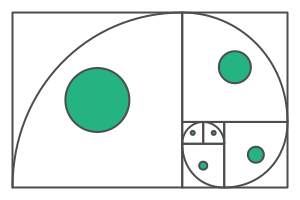 The Fibonacci betting system is one of the most popular systems used in soccer wagering. However, it is also considered one of the steepest progressions, so you should carefully assess whether the potential returns justify the risk. The Fibonacci system operates in a relatively straightforward manner. You place a bet on a match ending in a draw. If the bet loses, you continue wagering on draws until you make a winning prediction.
You might wonder why the system focuses solely on draws. The reason is that a draw is generally one of the hardest outcomes to predict. The core idea behind the system is that a future winning bet will help the bettor recoup previous losses.
There is more to the progression, however. Bettors are advised to use it only when the odds for a draw exceed 2.6. After a losing bet, the next wager increases according to the Fibonacci sequence. The sequence starts with 1, and each subsequent number is the sum of the two preceding numbers: 1, 1, 2, 3, 5, 8, 13, and so on. The Fibonacci system is a negative progression, meaning that you decrease your stake after a win and increase it after a loss. Your position in the sequence determines the number of units you should wager.
Suppose you begin by wagering $5 on a draw and the bet loses. Your next wager would also be $5, which is still one unit. If the second bet loses, you move to the next number in the sequence and stake $10, or two units. If that bet wins, you move one step back in the sequence, making your next stake $5 again.
The Fibonacci system has several drawbacks when applied to football. The biggest issue is that your bankroll can be depleted quickly if the matches do not end in draws. You must continue increasing your stakes in the hope that future wins will cover your accumulated losses. Imagine wagering on 20 consecutive games without a single draw. The sequence grows rapidly, and the required stake soon becomes staggering.
In theory, the Fibonacci system can withstand an extended losing streak only if you have unlimited funds. In practice, you are more likely to exhaust your bankroll or reach the stake limits imposed by sportsbooks.
Labouchere System
 Soccer bettors may encounter many systems that promise attractive returns. However, you should always consider whether using such a system is truly the best approach if your goal is to make a profit from football betting.
Although the Labouchere system is used predominantly by roulette players, some soccer bettors also favor it. First, decide how much money you want to win. Suppose your target is $120. Next, divide this amount into five numbers, such as $10, $30, $30, $40, and $10.
Now, look for bets that can produce a profit equal to the sum of the first and last numbers in your sequence. In this example, that total is $20 because $10 plus $10 equals $20. If you place a $10 bet at odds of 3.00, you would receive a total return of $30, consisting of your $10 stake and $20 in profit. The $20 profit equals the sum of the first and last numbers.
If the bet wins, remove the first and last numbers from the sequence. If it loses, add the stake amount to the end of the sequence. This step is intended to help you recover your losses. Continue repeating the process until you have won the target amount.
The appeal of the Labouchere system is that you remove two numbers after a win but add only one after a loss, so the progression should shrink faster than it grows. Although this may sound appealing, many experienced bettors avoid the system. Its main drawback is that you must continue betting until you reach your target amount, and a prolonged losing streak can quickly drain your bankroll.
Kelly Criterion
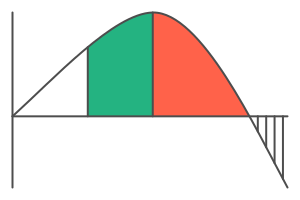 The Kelly Criterion is one of the most popular staking methods available to football bettors. Most importantly, it helps bettors determine how much they should stake on a given bet. When using the Kelly Criterion, you must account for your perceived edge.
Before placing a bet, you need to answer several key questions. Decide which team you want to back, find the bookmaker offering the best odds on that event, establish why you believe the bet offers value, and determine how much you plan to stake.
Determining the appropriate stake size is one of the most difficult parts of betting. Many bettors therefore use the Kelly Criterion. This method calculates the optimal stake based on the odds and your perceived probability of success. The formula is: (B × P – Q) / B, where B is the decimal odds minus 1, P is the probability of winning, and Q is the probability of losing (1 – P).
Consider a coin toss for which the odds on tails are 2.00. Suppose the coin is biased and has a 52% chance of landing on tails. After the numbers are entered into the formula, the Kelly Criterion recommends staking 4% of your bankroll. A positive result indicates that the bet has a positive expected value. If the result is negative, you should avoid betting on that outcome.
Be cautious when making these calculations, as errors can turn a potentially valuable bet into a waste of time and money.
Arbitrage Betting
 Arbitrage betting is one of the most appealing soccer betting approaches because it is relatively straightforward and can generate a guaranteed profit when a valid opportunity is found and executed correctly. Some consider arbitrage a strategy, while others view it as a system. Either way, it can add to your betting bankroll if you find the right opportunities. Keep in mind, however, that most bookmakers do not welcome arbitrage bettors.
The system relies on identifying and exploiting price discrepancies between bookmakers. Once you spot such a discrepancy, place two or more bets on the same event to cover all possible outcomes. If the opportunity is valid and the bets are placed correctly, you can secure a profit regardless of the final result.
Although arbitrage betting may seem intimidating, an example can clarify how it works. Experienced bettors know that odds for the same event can differ from one bookmaker to another. While these discrepancies are often small, they can add up over time.
For example, imagine a match between Manchester United and Arsenal for which different bookmakers offer the best odds on different outcomes. To create an arbitrage bet, choose the bookmakers offering the best available odds on a Manchester United win, a draw, and an Arsenal win. Then divide your stakes across all three outcomes. By doing so, you cover every possible result and can secure a profit if the combined odds create a valid arbitrage opportunity.
Developing Your Own Football Betting System
 Soccer fans who want to improve their results may consider creating their own betting systems. Soccer betting systems offer several potential benefits, the most important of which is adding structure to your wagering. Developing a system encourages you to study statistics and become a more informed bettor. The more you know about football, the stronger your system may become. A well-designed system can also help you remove emotion from your decisions, provided you have the discipline to follow it.
With that in mind, the following steps outline how to create your own football betting system. First, make sure that soccer is the sport you want to target and ensure you already have a solid knowledge base.
Next, examine the statistics and identify the factors that influence match outcomes. Statistics are crucial in sports betting, so compile a list of the most important variables to consider when selecting a bet. You can assign a percentage weight to each factor based on its relative importance.
Make sure your statistical sources are reliable and that the figures are accurate. You should also have easy and consistent access to the data.
Next, create your own formula or checklist. After identifying the key criteria, add them to a checklist so you can determine which combinations of factors produce the best results.
Afterward, search for games that fit your established framework and apply your criteria in practice. Remember that your first checklist is only a draft, so do not be discouraged if it is not immediately successful. There are two main ways to test whether your checklist or formula works.
First, create a spreadsheet to track potential bets. You do not need to place these bets. Simply record which ones your system recommends and which ones it rejects. With a spreadsheet, you can evaluate whether your system works without risking any money.
Alternatively, you can test the system using small real-money stakes. This approach allows you to see whether the system performs as expected and whether you can follow it consistently.
Regardless of the method you choose, always track your results. Doing so helps you determine which criteria are effective and which need refinement.
Once you identify weaknesses, adjust the system and continue developing it. Do not be discouraged if it is not perfect immediately, as getting every detail right takes time. Replace ineffective factors rather than discarding the entire system. You should also make sure your sample size is large enough before drawing conclusions.
Once you have developed a football betting system that works for you, continue tracking its performance and refine it whenever necessary.