NFL Betting Odds
 | Updated:
  Understanding the odds is one of the fundamental keys to betting successfully on the NFL. It is especially important to study them because NFL odds are often set with considerable precision. This precision stems from the sport’s large audience and extensive media coverage. Consequently, bookmakers have access to more information when setting their odds.
 Best Rated Bookmakers for United States
-
 Claim
Claim
$1000
Match Bonus9.718+ New customers only. 100% match bonus up to $1000. Min deposit $50. 10x rollover requirement. Promocode: MYB100 -
Claim
$250
Match Bonus9.4Join Bovada, make your first deposit and instantly receive a 50% Sports Welcome Bonus up to $250. -
Claim
$500
Match Bonus9.3Get a 100% Bonus, up to $500, to wager in the Xbet Sportsbook when you sign up and fund your new account with minimum of $45. Be sure to use promocode XB100 to claim this offer on your first deposit. 7x rollover requirement prior withdrawal. -
Claim
$200
Match Bonus9.2The bonus and the deposit need to be rolled over 4x at min. odds of -200 (1.5) before a payout is possible Max. $200 of every bet count towards the rollover. -
Claim
$150
Match Bonus9.1Get a 150% Bonus, up to $150, to wager in the BetUSR Sportsbook. Deposit minimum $100 and wager at least $500 within 30 days of registerening your account and you will automatically qualify for $150 CASH BONUS with just 1x wagering requirement.



This wealth of information can also help bettors because it is widely available. Bettors can use it to create their own probability estimates and calculate both the implied and estimated true probability of a certain event occurring.
How Do Odds Work?
 At this point, you might assume that the odds for a given bet indicate its true probability. However, that would be a mistake. This may be familiar to seasoned bettors, but it is still important to cover in this guide. We will start by explaining exactly how odds are made and why they are set the way they are.
To calculate odds, a bookmaker must estimate the probability of a certain event occurring. This can involve broad outcomes, such as the winner of a game or league, or a highly specific event on which bettors can wager. Once the bookmaker has estimated the probability of the event, the odds are set. The odds indicate the potential payout for a bet, not the true chance of the outcome occurring. Because the odds generally favor the sportsbook, bettors should focus on disciplined decisions rather than relying on one big win.
If the odds represented the true probability of an event, sportsbooks would generally not make a profit. Odds are set to offer bettors potential returns while allowing the sportsbook to include a margin. That is why you will rarely find a two-way market priced at +100 on both sides. For instance, if the odds were +100 for A and +100 for B, and bettors placed the same amount, such as $30,000 on A and $30,000 on B, the winning group would receive the full payout, leaving nothing for the house.
Betting odds and probability are therefore two different things. This does not mean you should dismiss the odds or avoid considering them when placing a bet. On the contrary, they matter considerably, as we will explain later.
Different Odds Formats
 When it comes to NFL betting, you are most likely to encounter the moneyline format, which is also known as the American format because it is used primarily in the US. However, you may encounter the other formats as well. This information is also helpful if you are accustomed to Decimal or Fractional odds and are just beginning to learn the moneyline format.
If you wish to bet on the NFL seriously, you will need to understand the key aspects of sports betting. Betting successfully on any sport requires a disciplined and informed approach. This includes understanding the different odds formats.
Along with explaining how they work, we will show you how to convert each format into the others. This way, you will be able to convert odds into the format you find easiest to understand. This is especially useful when comparing the odds offered by different sportsbooks because they may not all display odds in the same format.
Moneyline
 As mentioned above, these odds revolve around the number 100. They cannot have an absolute value below 100, but they can be positive or negative. For instance, if the odds are +200 and you place a winning $300 bet, your total return will be $900. To break it down, this means you earn $200 for every $100 you wager. If the odds are -200 and you place the same bet, your total return will be $450. This means you receive your stake back plus a profit equal to half of your stake. Odds of -200 are equivalent to 1/2 or 1.5000.
Formulas can help you calculate your potential profit more quickly. For positive moneyline odds, use the following formula: Initial Bet x (Odds / 100) = Potential Profit. For negative moneyline odds, use this formula instead: Initial Bet / (Absolute Value of Odds / 100) = Potential Profit.
You can also convert moneyline odds into Decimal or Fractional odds. You can do this by using an online converter or learning the formulas yourself. For instance, you can convert positive moneyline odds into Decimal odds with this formula: (Moneyline Odds + 100) / 100. For negative odds, use this formula: (Absolute Value of Moneyline Odds + 100) / Absolute Value of Moneyline Odds.
You can convert moneyline odds into Fractional odds quite simply. For positive moneyline odds, place them over 100 and simplify the fraction if possible. For example, odds of +300 translate to Fractional odds of 3/1. For negative moneyline odds, invert the equation, so odds of -300 become 1/3.
Decimal
 Decimal odds, also known as European odds because they are the most common format in Europe, are quite straightforward. There are no positive or negative signs, only a decimal number. To determine your potential return, multiply your bet by the odds. The formula is Bet x Odds = Potential Return.
You can convert Decimal odds into the moneyline or Fractional format by using formulas. Because moneyline odds can be positive or negative, there are two formulas for converting Decimal odds into them. For Decimal odds below 2.00, use 100 / (Decimal Odds – 1), then add a minus sign to obtain negative moneyline odds. For Decimal odds of 2.00 or above, use (Decimal Odds – 1) x 100, then add a plus sign to obtain positive moneyline odds.
To convert Decimal odds into Fractional odds, use this equation: (Decimal Odds – 1) x 100, then place the result over 100. After simplifying the fraction, you will have the corresponding Fractional odds.
Fractional
 The Fractional format is most widely used in the UK, so it is also known as the British format. Although it is less common in some markets, you may still encounter it. That is why we will explain how to understand it and convert British odds into the other two formats.
Fractional odds are exactly what the name suggests: fractions. They can be expressed in various forms, ranging from simple fractions such as 2/1 to more complex ones such as 10/11. You can calculate your potential profit from Fractional odds with this formula: Bet x Fractional Odds = Potential Profit.
If you would rather convert these traditional odds into the American format, there is a simple way to do so. You will need two separate equations because the resulting moneyline odds may be positive or negative. For odds against, meaning odds higher than evens, use the following formula to convert them into positive moneyline odds: Fractional Odds x 100. Then add the plus sign.
For odds on, meaning Fractional odds lower than evens, you can convert them into negative moneyline odds with this formula: 100 / Fractional Odds. Then add the minus sign.
If you prefer Decimal odds, you can convert Fractional odds into them with this formula: Fractional Odds + 1. This formula is simple to use and can be particularly useful when comparing different odds formats.
Understanding the Importance of Odds
 Odds are not everything, but understanding how they work can help you evaluate potential returns and the implied probability of a winning bet. Odds do not directly state the true probability of an outcome. Instead, they indicate potential value and can be converted into implied probability.
The odds show you how much money you could win from a given bet. If the odds are even, your total return will be double your stake, provided that you win. If a bet has odds on, it is considered more likely to win, but the potential profit will be lower than it would be at even odds.
If a bet has odds against, it is considered less likely to win, but it could produce a return that more than doubles your stake. For instance, if you bet on an underdog to defeat a team that has proven itself superior, you would be placing a bet at odds against.
The question remains: how exactly do you find value in a bet? This is where probability comes into play.
Odds and Probability
 Odds and probability are linked, but they are not the same thing. The true probability of a certain outcome may not be accurately reflected in the odds. Regardless of the format, the odds also account for the sportsbook’s margin.
Although the odds offered by sportsbooks can align with your assessment of an event, you should still evaluate the probability for yourself. For example, if you have closely followed a team’s development, you might conclude that, despite being the underdog, it is more likely to win than the favorite. This could give you an advantage, which is why knowledge of the game is essential.
Implied Probability
 There are three important terms to understand: odds, probability, and implied probability. Odds indicate the potential return, while probability estimates the likelihood of an outcome. Implied probability is the likelihood suggested by the odds.
Implied probability bridges the gap between odds and estimated probability, and it can be calculated quite easily. Convert the odds into Decimal format and apply this equation: 1 / Decimal Odds. To express the result as a percentage, multiply it by 100.
This percentage gives you a clearer idea of the probability implied by the odds. You can then compare it with your own assessment of the likelihood of a certain event occurring. By comparing the two, you can determine whether the bet offers any value and whether it is worth considering.
The Vig
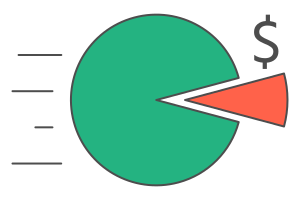 It is also important for new bettors to understand the vigorish and how it works. The vig, also known as the juice or the sportsbook’s cut, is not usually charged as a separate fee. Instead, it is built into the odds. Sportsbooks do this by adjusting potential payouts relative to the estimated true probability. This is why you will rarely see a two-way market offering +100 on both sides.
If both sides were offered at +100 and equal amounts were wagered on each outcome, the sportsbook would pay out approximately the same amount it collected, leaving no profit. Sportsbooks therefore adjust their odds to include a margin while still offering potential returns to bettors.
Naturally, this affects the odds that sportsbooks offer. Sportsbooks may adjust their odds to encourage a wager distribution that suits their needs. Understanding odds, implied probability, and the vig can help you assess wagers more carefully and make more informed NFL betting decisions.